The Caregiver Archetype: Why Helping Becomes Control

Search the caregiver archetype and you will meet the same person on every page. Warm. Selfless. Generous. Driven by compassion, terrified of being called selfish. Near the bottom, after the list of strengths, a short paragraph concedes that there is a shadow, names it martyrdom, and stops.
That structure has the archetype backwards. The Caregiver is one of the few patterns whose damage arrives wearing the face of its virtue. The shadow is not a footnote to the description. It is half of what is being described, and the half that gets left out is the half that runs people’s lives.
There is a second problem with the standard account, and it is a matter of record rather than interpretation. Carl Jung never wrote about a Caregiver archetype. The figure comes from somewhere else, was renamed on the way, and the renaming removed exactly the information you need. Getting the lineage straight is not pedantry. It changes what the archetype means.
What is the caregiver archetype?
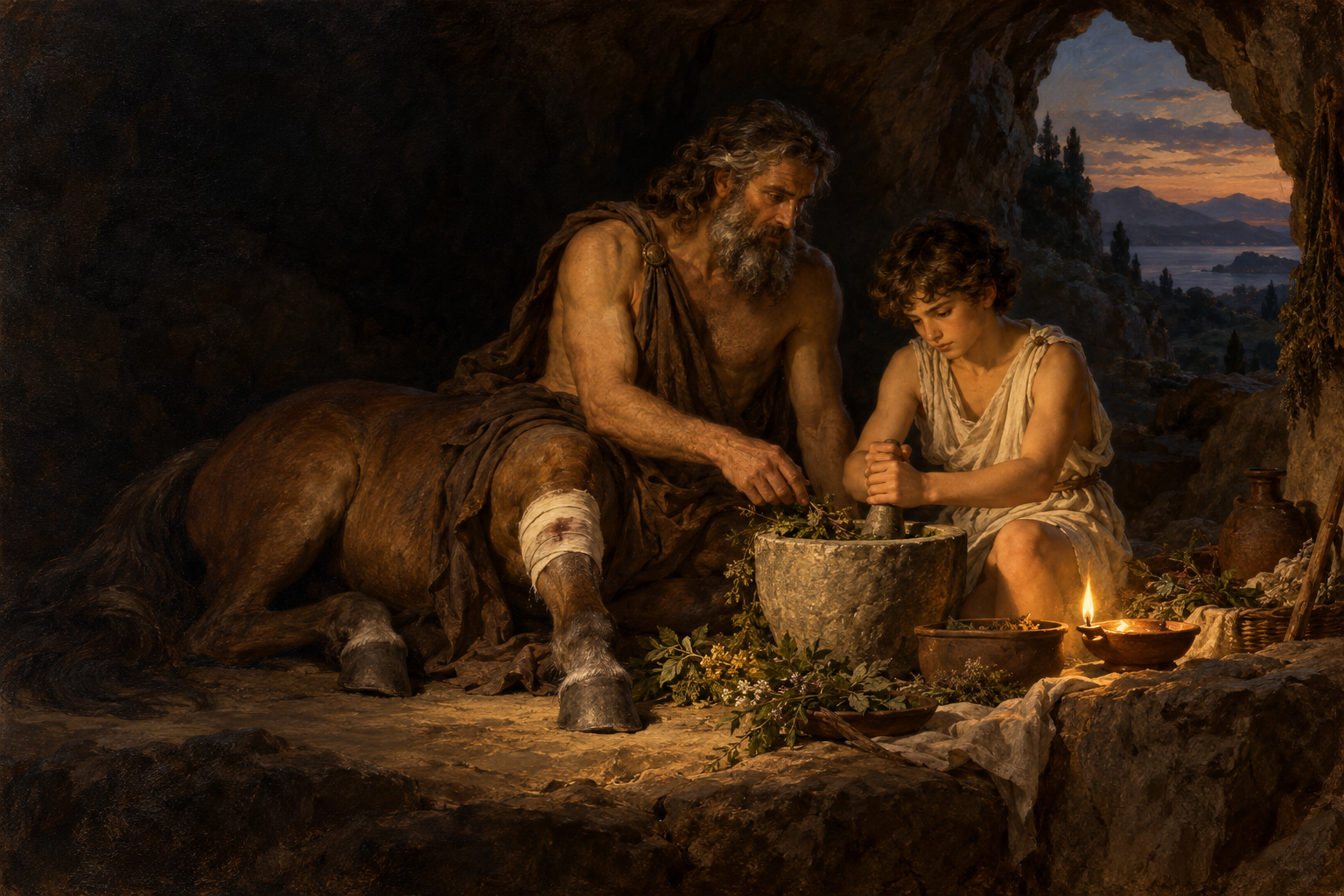
The caregiver archetype is the psychic pattern organised around meeting the needs of others, in which a person’s sense of value, safety, and identity is bound to being the one who provides. Its gift is real: sustained attention to another person’s welfare, and the willingness to stay when staying is inconvenient. Its cost is that the provider stops being a person with needs and becomes a function.
The pattern shows up as compassion, patience, and a strong stomach for other people’s distress. It also shows up as an inability to rest, a habit of answering every request before considering it, and a quiet accounting system that tracks what has been given and never presents the bill.
Under the archetype sits a single unspoken proposition: I am safe here as long as I am necessary. Everything the Caregiver does that looks like love and everything it does that looks like control both follow from that sentence.
The caregiver is not one of Jung’s archetypes
Jung’s writing contains the Shadow, the Anima and Animus, the Persona, the Self, the Wise Old Man, the Trickster, the Child, and above all the Mother. There is no Caregiver.
The name comes from Carol S. Pearson. In The Hero Within (1986) she set out six archetypes as stages of a developmental journey, and the figure that later became the Caregiver appeared there under a blunter label: the Martyr. In Awakening the Heroes Within (1991) the system expanded to twelve, and the Martyr was folded into a broader figure named the Caregiver. Margaret Mark and Pearson then carried those twelve into marketing with The Hero and the Outlaw (2001), which is why most search results for this term are written for brand strategists.
The original name was the accurate one. Something happened between 1986 and 1991 that took a figure defined by self-sacrifice and its costs and rebranded it as a figure defined by warmth. Every softened description since has inherited that edit. Our guide to Jungian archetypes covers how Pearson’s twelve relate to Jung’s much smaller and stranger cast, and the short version is that the twelve are a typology built on Jungian foundations, useful for self-recognition, weaker as psychology than what they were built from.
So if you want the Caregiver’s actual depth, you have to go back past Pearson to the archetype she was drawing on.
Where the caregiver comes from
The Caregiver is the positive half of Jung’s Mother archetype, cut away from its other half and given its own name.
In Psychological Aspects of the Mother Archetype (Collected Works, Vol. 9i), Jung lists what the archetype carries on its positive side: maternal solicitude, sympathy, the magic authority of the female, wisdom, anything that nourishes and sustains, anything that fosters growth and fertility. Read that list on its own and you have the Caregiver as every blog describes it.
Jung does not stop there. In the same essay he gives the other side: anything secret and hidden, the abyss, the world of the dead, anything that devours and seduces and poisons, anything terrifying and inescapable as fate. One archetype. Two faces. The Good Mother and, in the term Jung used throughout Symbols of Transformation (CW 5), the Terrible Mother.

Erich Neumann built out the structure in The Great Mother (1955). He distinguished the elementary character of the feminine, which holds, contains, and nourishes, from the transformative character, which drives change and release. The elementary character has a positive pole and a negative one, and the negative pole is not cruelty. It is holding that will not let go. The vessel that nourishes and the vessel that refuses to open are the same vessel doing the same thing for too long.
This is the piece the Caregiver literature deletes, and it is the piece that explains the behaviour people find confusing in themselves. The mother who cannot stop feeding, the friend who cannot stop rescuing, the partner who solves problems that were not theirs to solve: none of these are people whose care went wrong. They are people whose care did not stop. Devouring is nourishing with no exit.
Which produces the correction that reorganises everything else on this page. The Caregiver’s shadow is not the opposite of caregiving. It is caregiving that has outlived the moment it was needed, and the reason it does not stop has nothing to do with the person being helped.
How the caregiver forms
Nobody chooses this. The pattern installs itself early, in a specific set of conditions, and the mechanism is well documented outside Jungian circles.
The most common origin is a household where a child’s needs were less urgent than somebody else’s. A parent who was ill, drinking, depressed, overwhelmed, or absent. A sibling who took up all available concern. In family therapy this is called parentification, a term developed by Ivan Boszormenyi-Nagy and Geraldine Spark in Invisible Loyalties (1973), and it describes the reversal that happens when a child takes on the emotional or practical role of the adult. The child reads the room, works out what is required, and supplies it. It works. The house gets calmer. The child is praised for being mature, helpful, easy.
Alice Miller described the inner half of the same process in The Drama of the Gifted Child (1979). A child who is attuned to a parent’s needs, and who is loved for that attunement, learns to register the parent’s feelings with great precision and to lose track of their own. Miller’s point was that the loss is not of the feelings themselves but of access to them. They keep operating. They stop being available.
John Bowlby gave the adult outcome a name. Writing about attachment patterns in Loss: Sadness and Depression (1980) and elsewhere, he identified compulsive caregiving as a strategy in which a person persistently gives to others the care they need and cannot ask for. The giving is real. It is also a route to closeness that avoids the risk of asking, because the person who is needed does not have to be wanted.
Put the three together and you have the developmental sequence. Care becomes the price of belonging. The price gets paid so early and so consistently that it stops registering as a price. By adulthood, the person does not experience themselves as strategising. They experience themselves as kind, and they are, and the kindness is load-bearing in a way they cannot see.
Jung’s line about the greatest tragedy of the family being the unlived lives of the parents, which appears in our collection of Carl Jung quotes, points at the same machinery from the other direction. The unlived life does not vanish. Somebody in the house carries it.
Caregiver archetype traits, and the ones the lists leave out
The standard trait lists are not wrong. They are partial. Here is the full set, including the parts that do not flatter.
What the lists include
- High tolerance for other people’s distress, including distress that would send most people out of the room
- Fast, accurate reading of what others need, often before they say it
- Reliability under pressure, and a reputation for it
- Discomfort with praise, and a reflex to redirect it
- Guilt as the dominant signal, arriving faster than anger or want
What the lists leave out
- A pronounced difficulty receiving anything, from a compliment to a lift to the station
- Chronic low-grade resentment that the person would not describe as resentment
- Attraction to people in difficulty, and a flatness in relationships with people who are fine
- A quiet, unadmitted contempt for the people being helped
- Panic when someone they have been helping no longer needs them
- Exhaustion described as busyness
That last cluster is the diagnostic one. Someone can be warm, dependable, and endlessly generous without being run by this archetype. What marks the archetype is what happens when the giving stops. If the identity survives, the care was a choice. If the identity collapses, the care was the mask and there is a question underneath it that has not been asked in decades.
The shadow of the caregiver archetype
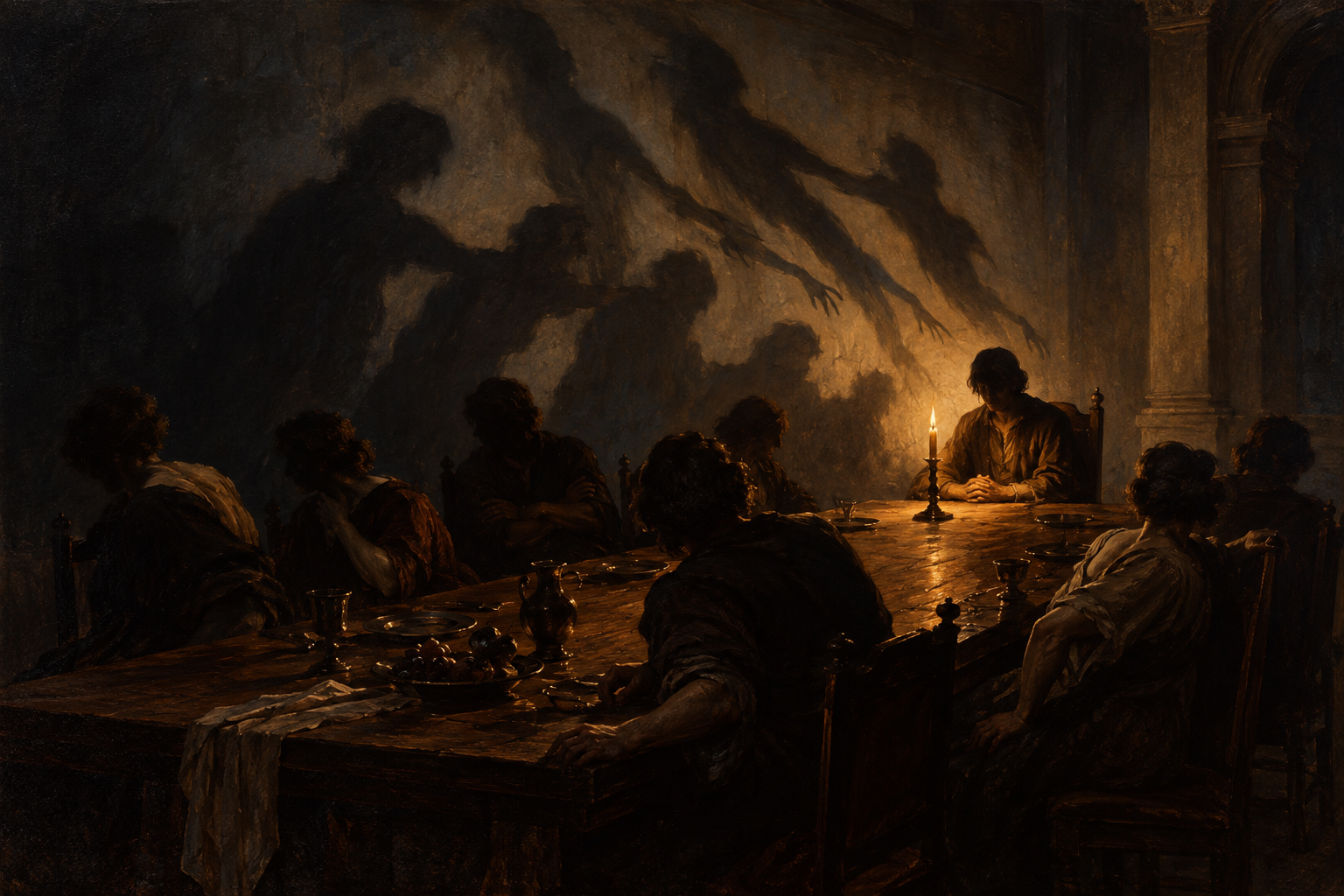
Every archetype has a shadow, and in most cases the shadow is the pattern’s opposite. The Hero’s shadow is the Coward. The Caregiver is more slippery, because its shadow wears the same clothes as its virtue and gets thanked for it.
The invisible invoice
The Caregiver gives, and a debt is created, and the debt is never stated. Because it is never stated, it can never be settled. The recipient has no idea what they owe, only that they owe, and that whatever they do will not cover it.
This is martyrdom in its working form, and it is much quieter than the word suggests. It rarely announces itself. It appears as a sigh. As “no, it’s fine, I’ll do it.” As a small factual reminder of how late someone stayed up. The Caregiver who says after everything I have done for you has stopped hiding the invoice, and by then the accounting has been running for years.
The thing to see clearly is that the debt is the point. An unpayable debt keeps the other person in place. Consciously the Caregiver wants gratitude. Structurally the arrangement produces obligation, which is more durable.
Enabling, or care that reduces capacity
Some care makes a person more able. Some care makes them less able, and the second kind is easier to give because it produces immediate relief in the room.
The Caregiver who takes over a task their adult child could learn to do, who covers a partner’s obligations, who manages a friend’s crises so consistently that the friend stops developing crisis skills, is not being taken advantage of. They are protecting something. If the other person becomes capable, the Caregiver’s position becomes optional, and optional is the state this archetype exists to prevent.
Ask the question directly and it is uncomfortable: is the person you are helping more able to function than they were a year ago, or less? Care that reduces capacity over time is doing something other than what it says.
Contempt for the person you are helping
The German psychoanalyst Wolfgang Schmidbauer wrote about this in Die hilflosen Helfer (1977), the book that introduced the idea of a helper syndrome. His observation, drawn from working with people in the helping professions, was that the helper often carries an unadmitted disdain for those they help.
The mechanism is projection, and it is the same one described in our guide to how to do shadow work. The Caregiver has disowned their own dependency. Needing things was the thing that was not allowed. So the need is projected onto whoever is nearest, and then it is looked after, and then it is faintly despised, because it is unbearable in the place it came from.
You can hear it in how competent helpers talk about clients, patients, students, and family members when they are tired. The affection is genuine. So is the edge under it. The edge belongs to the helper.
The refusal to receive
The Caregiver will not be on the other side of the exchange. Offers of help get deflected with reflexes so fast they look like personality. Sickness is managed alone. Compliments are corrected.
This is not modesty. Receiving requires admitting need, and admitting need is the exact move the archetype was built to make unnecessary. A person who never receives has arranged their life so that they can never be disappointed by a person who fails to give, which is a version of the defensive structure we traced in the architecture of the emotional fortress. The walls are made of usefulness.
What is buried underneath
If the Persona is generous, the shadow holds selfishness. If the Persona is patient, the shadow holds rage. The Caregiver’s unconscious material is usually some combination of appetite, aggression, ambition, and the wish to be looked after, and those things do not stay quiet. They surface as sudden disproportionate anger about something small, as passive resistance, as illness, or as the collapse that arrives when the last person who needed them moves out.
Jungians call the buried valuable material the gold in the shadow. For the Caregiver, the gold is often the Warrior’s capacity to say no and the Lover’s willingness to want things for no reason beyond wanting them.
The caregiver archetype in relationships
In intimate relationships the archetype produces a recognisable shape. The Caregiver selects, without knowing they are selecting, a partner who needs something. Chaos, addiction, instability, unrealised talent, a difficult history. The relationship organises around repair.
For a while this works well for both people. Then one of two things happens.

The partner improves. They get sober, get the job, get their life together, and the Caregiver, who has spent years wanting exactly this, finds themselves obscurely bereft and picking fights. The bond was built on a role, and the role is now vacant.
Or the partner does not improve, and the Caregiver’s resentment builds until it becomes the weather in the house. They stay, because leaving would confirm that the giving was conditional. Nobody is happy. Nobody leaves.
Both outcomes come from the same place, and it is not the partner’s behaviour. The Caregiver has projected their own helplessness outward and then married it, which is a version of the pattern we described in why we run from real intimacy. Genuine mutuality would require the Caregiver to be seen in a state of need, which is the one condition they have arranged their entire personality to avoid.
The same shape appears in friendships. The Caregiver is the person everyone calls in a crisis and nobody calls on a Tuesday, and they will tell you this is fine, and they will mean it, and they will also be lonely in a way that has no obvious cause.
The caregiver in the workplace and the helping professions
Nursing, teaching, social work, therapy, ministry, care work, and medicine all select for this pattern and then run on it. So do the unpaid roles inside families and the informal ones inside organisations, where a particular person becomes the one who notices when a colleague is struggling and stays late to absorb the consequences.
The institutional problem is that the Caregiver is the ideal employee for any system that is under-resourced. Somebody who will not stop, will not ask, and feels guilty about leaving on time is load-bearing infrastructure, and infrastructure does not get replaced until it fails. The World Health Organization classifies burnout as an occupational phenomenon arising from chronic workplace stress that has not been successfully managed, which puts the responsibility where it belongs. That framing gets lost quickly in workplaces where exhaustion reads as commitment.
Schmidbauer’s original observation was that people drawn to helping work are frequently people for whom being helped was not available. The profession then supplies a socially sanctioned position in which need is always somebody else’s. It is a good arrangement. It holds for decades. It tends to fail suddenly.
The wounded healer archetype looks at the same professions through the helper’s own hurt, and at what happens when the helper hands that hurt to the people being served.
There is a related pattern among high performers who reach the thing they were working toward and find nothing there, which we examined in the emptiness that follows achievement. The Caregiver’s version arrives when the people they were carrying no longer need carrying.
The caregiver archetype in dreams
Dream figures do not announce which archetype they belong to, but a few images recur around this material often enough to be worth watching for.
Houses and containers show up frequently, which fits Neumann’s reading of the feminine as vessel. A house you cannot leave, a room with no door, a car with someone else at the wheel. Feeding appears, sometimes as endless preparation of food nobody eats. So do animals or infants that need care and keep multiplying, or that the dreamer keeps forgetting and finding half-starved in a back room.
The compensatory dreams are the interesting ones. A person run by this archetype will sometimes dream of walking away from someone who needs them, of shutting a door on a child, of watching a disaster without moving. These dreams tend to produce guilt on waking and get dismissed as evidence of some hidden coldness. Read through the compensatory function described in our guide to Jung’s method of dream analysis, they read the other way. The psyche supplies what the conscious attitude lacks, and what this conscious attitude lacks is permission to stop.
Smothering, drowning, and being buried carry the negative pole of the same archetype, and they can appear in the person doing the caring as readily as in the person being cared for.
Is the caregiver archetype the same as codependency?
They overlap heavily and they are not the same thing, and the difference is worth holding onto because the codependency literature has been applied more broadly than its evidence supports.
Codependency is a clinical and self-help description of a relational pattern, developed largely within addiction recovery from the 1980s onward, in which a person’s functioning becomes organised around another person’s dysfunction. It describes behaviour and it prescribes intervention.
The Caregiver is an archetypal pattern, which means it describes an impersonal form the psyche can take, one with a positive expression as well as a negative one. Codependency has no upside by definition. The Caregiver does, and the upside is not a consolation prize. Sustained, competent, unglamorous care of other people is among the things that holds human life together, and any framework that cannot distinguish it from pathology is a bad framework.
The practical distinction: codependency is what the Caregiver looks like when it is unconscious and unrelated to. The same energy, held consciously, produces someone who gives generously and can also stop, refuse, and be looked after. The difference is not in how much they give. It is in whether they can choose not to.
The caregiver brand archetype and why it muddies the water
Most of the first page of Google for this term is written for marketers, so it is worth saying plainly what that material is.
In The Hero and the Outlaw, Mark and Pearson mapped the twelve archetypes onto brand identity, and the Caregiver became the position occupied by brands selling protection, safety, and care. Insurance, healthcare, baby products, and the car manufacturers whose entire proposition is that your family will survive the crash.
As a positioning tool it is coherent. As psychology it is a different activity wearing the same vocabulary. Brand archetypes are chosen deliberately by a committee and applied consistently to sell things. Psychological archetypes are not chosen, cannot be applied consistently, and produce most of their effects while nobody is looking. A brand can occupy the Caregiver position without any shadow, because a brand has no unconscious. A person cannot.
If you arrived here from a brand strategy deck, the material above will not help you write a tagline. If you arrived here because you recognised yourself in the description, the brand material is why the search results felt so thin.
What integration looks like for the caregiver
Integration is not becoming less caring. That misreading turns the work into a personality transplant and produces people who announce their boundaries in therapeutic language while changing nothing, which is the failure mode we set out in why shadow work so often fails.
The work is narrower and harder than that. It runs along a few lines.
Find the invoice
After you give something, notice whether a small ledger entry appears. Not whether you resent it. Whether something in you is now owed. That noticing is the whole practice, and it is unpleasant for about six weeks.
Practice receiving badly
Accept help you do not need, from people who offer it, and sit with the discomfort without converting it into a return favour within the hour. The return favour is the tell. It closes the account before the account can teach you anything.
Locate the anger
It is there, it has been there a long time, and it is usually pointed at whoever originally needed too much. Working with that material is what the trigger log and the relationship pattern map in the Shadow Work Field Journal are built for, because the pattern shows up across decades in different costumes and is hard to see in any single instance.
Ask what the person would do without you, and let the answer be survivable
Most of the time they would manage. The fantasy that they would not is doing work for you.
Watch for the collapse
When a Caregiver first stops, the reaction is rarely relief. It is guilt, then emptiness, then a period where nothing has any point. That period is not evidence that the giving was correct. It is what happens when a structure that has been holding an identity in place is removed, and it is the same threshold described in our work on individuation, where the constructed self stops working before anything has arrived to replace it.
What comes out the other side is not a colder person. It is somebody who can give without an invoice, refuse without a case file, and be looked after without treating it as an emergency. Less saintly. Considerably better company.
The criticisms worth taking seriously
A page that treats this framework as settled is advertising, so here are the objections.
The Caregiver has no standing in Jung’s own work. It is Pearson’s category, built on Jungian foundations but not derived from them, and Pearson’s twelve have the same problem as most archetype typologies: they are descriptively satisfying and difficult to test. The mother archetype behind it has better provenance and is itself contested.
The archetypal frame pathologises ordinary decency. Plenty of people are generous because generosity is good, were raised by people who were also generous, and have no complex to speak of. Reading every act of care as a hidden bid for indispensability is a cynicism that flatters the reader and describes nobody.
The gender mapping is a problem. Jung’s mother archetype is explicitly bound up with the feminine, and the Caregiver inherits that, which reproduces a division of labour as though it were a law of the psyche. Many contemporary Jungians keep the structural insight, that the psyche splits off and then gendered a capacity for care, while dropping the claim that the capacity belongs to women.
The enabling language is over-applied. It came out of addiction recovery, where it describes something specific, and it now gets used on people doing necessary and non-negotiable care for genuinely dependent family members. A person looking after a parent with dementia is not enabling anybody, and telling them to examine their motives is a category error with real costs.
And the general objection to the whole tradition applies here too. This is a framework for interpretation, not prediction. It illuminates experience after the fact and cannot tell you what happens next. Held that way it is useful. Held as science it is oversold.
Common questions about the caregiver archetype
Is the caregiver a real Jungian archetype?
Not in Jung’s own writing. Jung wrote about the Mother archetype, with its nourishing and its devouring aspects. The Caregiver as a named archetype comes from Carol Pearson, who called the same figure the Martyr in The Hero Within (1986) before renaming it in the twelve-archetype system of Awakening the Heroes Within (1991).
What is the shadow side of the caregiver archetype?
Martyrdom, in which giving creates an unstated debt. Enabling, in which care quietly maintains the other person’s incapacity. An inability to receive. And an unadmitted contempt for the people being helped, which comes from projecting one’s own disowned dependency onto them.
Is the caregiver archetype the same as codependency?
No. Codependency describes a dysfunctional relational pattern with no positive form. The Caregiver is an archetypal pattern with a genuine positive expression. Codependency is closer to what the Caregiver looks like when it operates unconsciously, and the marker of integration is whether the person can choose not to give.
Which archetype opposes the caregiver?
Structurally, the archetypes that carry appetite and self-assertion, which for most Caregivers means the Warrior’s capacity to refuse and the Lover’s willingness to want. Within Pearson’s twelve, the Caregiver’s material is frequently mirrored by the Orphan, the figure who expects nothing from anyone.
What causes the caregiver archetype to form?
Most often a childhood in which a parent’s needs took precedence, a pattern family therapists call parentification. The child supplies care, is rewarded for maturity, and learns that belonging is contingent on being useful. Bowlby described the adult version as compulsive caregiving.
Can you be a caregiver without burning out?
Yes, and the condition is not doing less. It is being able to receive, which lets the exchange run in both directions instead of draining in one. The people who last in caring work are usually the ones who are looked after by somebody.
Sources and further reading: C.G. Jung, “Psychological Aspects of the Mother Archetype,” Collected Works Vol. 9i; Symbols of Transformation, CW 5, on the Terrible Mother. Erich Neumann, The Great Mother: An Analysis of the Archetype (1955). Carol S. Pearson, The Hero Within (1986) and Awakening the Heroes Within (1991). Margaret Mark and Carol S. Pearson, The Hero and the Outlaw (2001). Ivan Boszormenyi-Nagy and Geraldine Spark, Invisible Loyalties (1973), on parentification. Alice Miller, The Drama of the Gifted Child (1979). John Bowlby, Loss: Sadness and Depression (1980), on compulsive caregiving. Wolfgang Schmidbauer, Die hilflosen Helfer (1977), on the helper syndrome.
This article is for understanding rather than diagnosis. If you are carrying a caring role that has become unsustainable, or recognise a pattern here that is affecting your health, a therapist or depth-oriented analyst is the right place to take it.