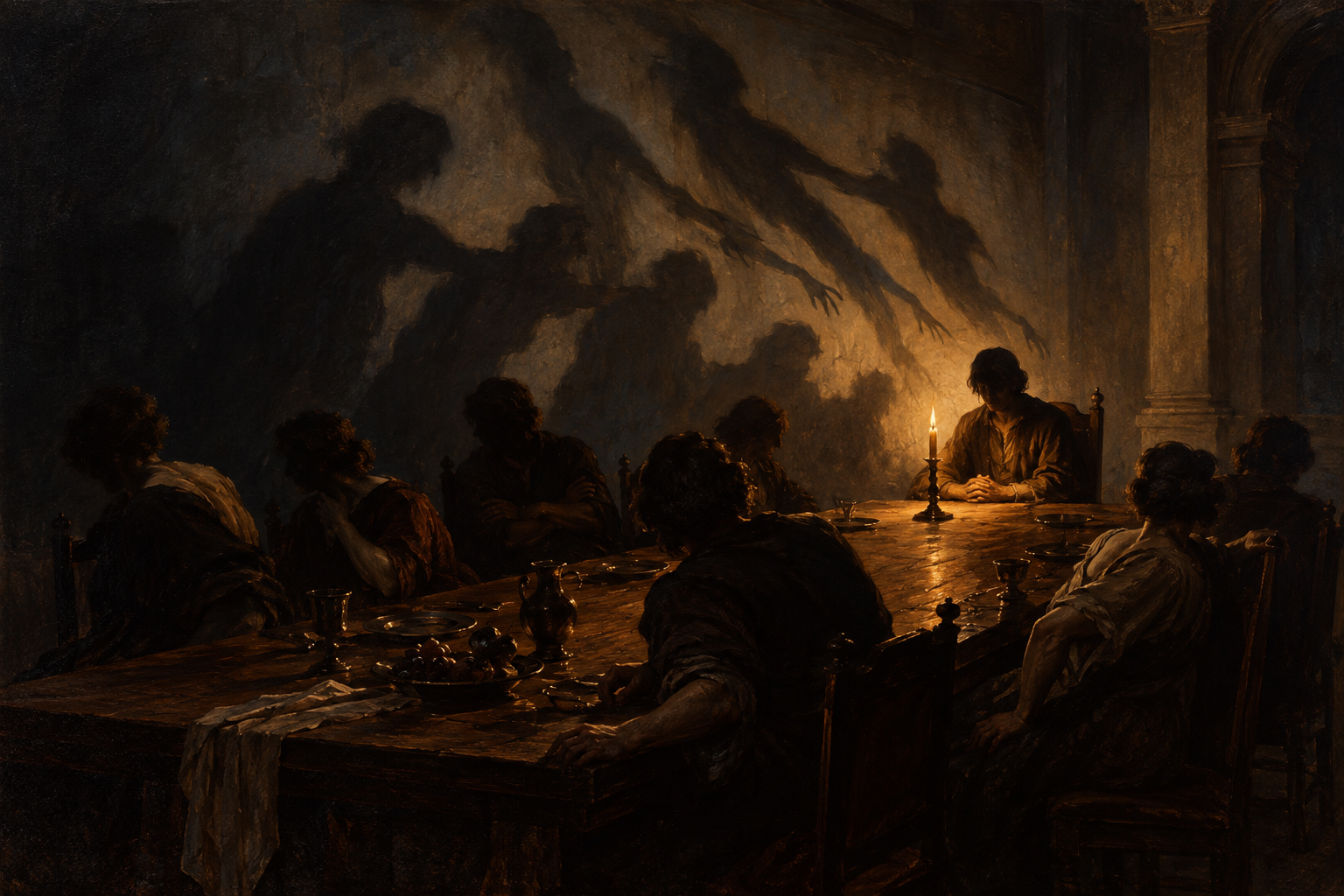
How to Do Shadow Work: A Jungian Guide to Confronting the Unconscious

Most advice on shadow work is wrong. Not dangerous, necessarily, just shallow enough to be useless.
Open any wellness blog and you’ll find variations of the same formula: journal about your childhood, list your “triggers,” meditate on self-love, and presto, integration. This version of shadow work has about as much in common with what Carl Jung actually described as a horoscope has with astrophysics. It borrows the vocabulary while discarding the mechanism.
Jung did not invent shadow work as a self-care practice. He identified the shadow as a structural component of the psyche. A living system with its own intelligence, its own agenda, and its own capacity to destroy your life if left unexamined. Engaging with it is not gentle. It is not always safe. And it is never finished.
What follows is a guide to the actual practice. Not the Instagram version. If you are looking for affirmations and comfort, this is the wrong article. If you are willing to see what you have spent years hiding from yourself, keep reading.
What the Shadow Actually Is (According to Jung, Not TikTok)
The shadow is not your “dark side.” That framing, while poetic, reduces a complex psychological structure to a moral binary. In Aion, Jung described the shadow as “the thing a person has no wish to be.” That’s a more precise and more disturbing definition. The shadow is not simply your anger or your jealousy. It is the entire constellation of traits, desires, memories, and capacities that your conscious identity has rejected. Everything you decided (or were taught) you could not afford to be.
Jung outlined the shadow across several key works. In Two Essays on Analytical Psychology, he wrote: “The shadow is a moral problem that challenges the whole ego-personality, for no one can become conscious of the shadow without considerable moral effort.” He was not being dramatic. The shadow resists being seen because the ego’s coherence depends on it staying hidden. Your self-image is constructed around the exclusion of shadow material. To confront it is to threaten the very architecture of who you believe you are.
This is why most popular shadow work fails. It asks you to acknowledge your shadow while leaving your ego intact. That’s like asking someone to renovate a house without disturbing the foundation. The foundation is the problem.
The Shadow Forms in Childhood
The process is mechanical, not mystical. A child learns very early which parts of themselves receive love and which do not. If anger is met with abandonment, anger gets buried. If ambition is met with ridicule, ambition gets buried. If sexuality, creativity, or assertiveness are punished, whether directly or through withdrawal of affection, those capacities go underground.
Jung wrote about this process extensively in The Archetypes and the Collective Unconscious. The child does not destroy these traits. They cannot be destroyed. They are repressed into the personal unconscious, where they continue to operate outside conscious awareness. The repression is not passive storage. These traits remain active, energized, and increasingly distorted by their confinement.
A child who buries anger does not become a person without anger. They become a person whose anger has no conscious outlet, which means it expresses itself through passive aggression, psychosomatic illness, sudden outbursts that seem to come from nowhere, or an attraction to angry people who act out the rage they cannot permit in themselves.
This last mechanism, projection, is the shadow’s primary mode of operation.
Projection: How the Shadow Operates in Your Daily Life
Projection is not a metaphor. It is the specific psychological mechanism by which unconscious content is transferred onto external objects, usually other people. When you encounter someone who triggers an intense, irrational reaction in you (whether hatred, fascination, or obsessive admiration), you are almost certainly looking at your own projected shadow material.
Jung’s quote was direct about this in Aion: “Projections change the world into the replica of one’s own unknown face.” The person who infuriates you at work for being “so arrogant” may be carrying your disowned ambition. The friend whose neediness repulses you may be mirroring the dependency you will not allow in yourself. The partner you idealize may be holding qualities you have refused to develop on your own.
This is not a comfortable idea. Most people resist it aggressively, because accepting it means that every strong emotional reaction to another person is potentially information about yourself. It means you cannot simply be right about the people you despise. You have to ask what they are showing you.
The Golden Shadow
Projection does not only work in the negative direction. Jung and subsequent analysts, particularly Robert A. Johnson in Owning Your Own Shadow, emphasized that we also project our positive qualities. The person you admire so intensely that it borders on worship? They are likely carrying your “golden shadow,” the unlived potential that you have disowned because, at some point, it felt too dangerous to claim.
This happens constantly. The writer who is in awe of every published author but cannot finish their own manuscript is projecting their creative capacity outward. The person who falls in love with strong, decisive partners while describing themselves as “easygoing” has buried their own decisiveness. The golden shadow is arguably harder to reclaim than the dark shadow, because admitting that you are capable of greatness is, for many people, more terrifying than admitting that you are capable of cruelty.
The Five Practices of Genuine Shadow Work
What follows are the actual methods. Not visualizations, not affirmation scripts. The practices that Jungian analysts use (and that Jung used on himself) to make unconscious material conscious. Each of these requires sustained effort over months and years. None of them produce results in a single sitting.
1. Trigger Tracking
This is the entry point, and it is the practice most people skip in favor of something that feels deeper. It is not deep. It is granular, repetitive, and unglamorous. That is why it works.
The practice is simple in structure: every time you experience an emotional reaction that is disproportionate to the situation, you record it. Not in your head. On paper. You note what happened (the factual trigger), what you felt (the emotional reaction), how intense it was, and (this is the critical part) what earlier experience in your life the feeling reminds you of.
You do this consistently for weeks. What begins to emerge is a pattern. You discover that the same wound is activating across completely different situations. Your reaction to your partner’s silence, your boss’s criticism, and the stranger who cuts you off in traffic share a common root. They are all variations on the same unresolved injury, usually one that predates your adult life by decades.
Jung never used the phrase “trigger tracking,” but the principle is embedded throughout his clinical work. In The Practice of Psychotherapy, he describes the analyst’s task as identifying the “complexes,” emotionally charged clusters of associations organized around a core wound. A complex, once activated, temporarily seizes control of the ego. Your reaction in that moment is not really yours. It belongs to the complex. Tracking your triggers is the first step toward identifying which complexes are running your life.
Note that tracking triggers requires brutal honesty about intensity. If you rate every reaction as a 4 out of 10, you are already defending the ego. The reactions that matter are the 8s and 9s. The moments where you lost control, where you said something you regret, where you felt physically ill with rage or jealousy or shame. Those are the data points. Everything else is noise.
2. Dream Analysis
Jung regarded dreams as the unconscious mind’s primary communication channel. Unlike free association (which he eventually rejected as too ego-directed), dreams bypass the conscious mind entirely. They speak in symbols, compressed narratives, and affect. They do not lie.
In Memories, Dreams, Reflections, Jung wrote: “The dream is a little hidden door in the innermost and most secret recesses of the soul.” He was describing something functional, not poetic. Dreams serve what he called a “compensatory function”: they balance what is one-sided in conscious life. A person who is excessively controlled during the day may dream of chaos, floods, or wild animals. A person who suppresses grief may dream of funerals, abandoned houses, or crying children.
How to actually work with dreams:
Record the dream immediately upon waking, in present tense (“I am standing in a dark corridor”), before the conscious mind begins to smooth over the details. The specific images matter more than the narrative arc. A red door, a flooded basement, a figure who looks like your mother but is not your mother. These are the shadow’s vocabulary. Over weeks and months of recording, you will notice certain symbols recurring. These are the entry points.
Jung’s method of dream interpretation differed from Freud’s in one critical respect. Freud treated dream symbols as disguises for repressed wishes. Jung treated them as direct expressions of the unconscious’s intent. The dream is not hiding something from you. It is showing you something you have not yet learned to read.
Do not use dream dictionaries. The unconscious does not speak in universal codes. A snake in your dream does not “mean” the same thing as a snake in someone else’s dream. Your associations to the symbol – what you feel when you encounter it, what memories it connects to, are the only valid interpretive material.
3. Active Imagination
This is Jung’s most powerful and least understood technique. He developed it during the crisis period documented in The Red Book, the years between 1913 and 1930 when he deliberately engaged with the figures of his unconscious and recorded the encounters in both text and image.
Active imagination is not guided meditation. Guided meditation tells you what to see. Active imagination requires you to surrender control and let the unconscious generate its own content. The distinction is that in fantasy, the ego directs the narrative. In active imagination, the ego participates as an observer and interlocutor, but it does not control what happens.
The process:
Begin with an image. A figure from a dream, a persistent emotion, a recurring memory. Close your eyes. Allow the image to stabilize without forcing it to do anything. When the image becomes vivid, engage with it. Speak to it. Ask it what it wants. Listen for a response. The response may come as words, feelings, physical sensations, or further images.
Then open your journal and record the dialogue exactly as it occurred. “I asked the figure what it wanted. It said: ‘You’ve been ignoring me for twenty years.'” Write it as a script. Do not analyze during the recording. Analysis comes later.
This sounds strange. It should. Jung himself acknowledged the strangeness of it. In Mysterium Coniunctionis, he wrote that the process requires holding the tension between rational consciousness and irrational psychic life without collapsing into either. If you dismiss the figures as “just imagination,” you lose the material. If you identify with them as literal entities, you risk inflation – a psychological state where the ego becomes possessed by an archetype.
The balance is difficult, and it is why active imagination is not recommended without some experience in the other shadow work practices, or ideally, the support of a trained analyst. The unconscious is not a toy. The figures you encounter have genuine psychic energy and can produce real destabilization if approached carelessly.
4. The Persona Examination
The persona is the mask you present to the world. Jung took the term directly from classical theater. The persona was the mask worn by actors on stage. In psychological terms, it is the curated self: the version of you that knows how to behave in each social context.
Jung discussed the persona at length in Two Essays on Analytical Psychology. The persona is necessary. Without it, social life is impossible. But pathology begins when the persona is mistaken for the whole self. When someone says “I don’t know who I am,” they are often describing the moment when the persona has cracked and they realize there is nothing behind it that they recognize.
The practice:
Examine, context by context, the version of yourself you perform. At work. With your family of origin. With your partner. On social media. With strangers. For each, ask: What do I suppress in this context? What would happen if I stopped performing? What am I protecting by maintaining this mask?
The persona and the shadow are intimately connected. Whatever the persona excludes, the shadow includes. If your professional persona is “calm, competent, and in control,” your shadow contains the part of you that is panicked, incompetent, and out of control. If your social persona is “easygoing and agreeable,” your shadow contains your rage, your opinions, your capacity for conflict.
You do not need to destroy the persona. You need to wear it consciously, the way an actor wears a costume, knowing it is a costume, able to remove it when the scene is over.
5. Projection Withdrawal
This is the most relationally demanding practice, because it requires you to stop blaming other people for what you feel.
The mechanism is specific: when you notice an intense emotional charge toward another person, whether positive or negative, you pause. Instead of acting on the feeling (criticizing them, idealizing them, avoiding them), you turn the lens inward. You ask: “What part of myself is this person carrying for me?”
This does not mean the other person has done nothing wrong. They may have. But your reaction, the intensity, the flavor, the bodily sensation, belongs to you. The reaction is the shadow’s fingerprint. Someone else’s behavior provided the surface for the projection, but the projected content originated in your own unconscious.
Jung wrote in Psychology and Alchemy that withdrawal of projections is one of the central tasks of individuation. Each projection you retrieve returns energy to the psyche. Each one makes you slightly more whole and slightly less dependent on others to carry the parts of yourself you will not hold.
In practice, this looks like a series of questions:
When you find yourself obsessively irritated by someone’s behavior, ask: Where do I exhibit this same quality, however faintly?
When you find yourself infatuated with someone’s strength, ask: What would it mean to develop this capacity in myself?
When you find yourself terrified of someone’s judgment, ask: Whose judgment am I actually afraid of – and when did that fear originate?
These questions are uncomfortable. They are supposed to be. If the inquiry feels easy, you are probably not going deep enough.
The Risks: Why Shadow Work Can Be Destabilizing
The popular narrative treats shadow work as universally positive, a form of emotional housekeeping that always leaves you healthier than you started. This is irresponsible. Jung himself issued warnings throughout his work.
In The Practice of Psychotherapy, he observed that encountering the shadow can produce a “violent moral and emotional reaction” that temporarily overwhelms the ego. The person who has maintained rigid control over their anger for thirty years and suddenly contacts that anger in a shadow work exercise does not necessarily experience gentle catharsis. They may experience a flood of rage that has accumulated three decades of pressure. Without adequate ego strength and ideally professional support, this can lead to acting out, dissociation, or a destabilizing episode that sets the work back rather than advancing it.
Shadow work is also dangerous when it becomes narcissistic. There is a specific trap, especially common among people drawn to Jungian ideas, where “doing the work” becomes its own form of ego inflation. The person begins to identify as someone who “has done their shadow work,” which creates a new persona built around psychological sophistication. The shadow, in this case, has not been integrated. It has been replaced with a more socially acceptable one. Jung called this phenomenon inflation and regarded it as one of the primary obstacles to genuine individuation.
Three signs that shadow work has gone wrong:
You feel superior to people who “haven’t done the work.” That is ego inflation, not integration. Integration produces humility, not hierarchy.
You use psychological language to avoid feeling. Saying “I’m projecting” during a fight is not shadow work if it functions as a defense mechanism, a way to intellectualize the emotion rather than experience it.
Your relationships have not changed. Shadow work that remains purely internal and never alters how you relate to actual people is incomplete. Integration shows up in behavior, not in journal entries.
How to Structure an Ongoing Practice
Shadow work is not a weekend retreat. It is a sustained orientation toward the unconscious that unfolds over years. But it does need structure, because the ego will resist unstructured engagement with shadow material. Avoidance is the ego’s first and most reliable defense.
A minimum viable practice looks like this: dedicated time (fifteen to thirty minutes) at least three times per week, ideally at a consistent time. Some of that time goes to trigger tracking, recording and analyzing the emotional reactions of the past few days. Some goes to dream recording and interpretation. And periodically, once a week or once a month depending on your readiness, time for active imagination or deeper journaling exercises.
The journal is the anchor. Without a written record, the insights dissolve. The ego is remarkably skilled at forgetting what it does not want to remember. You will have a breakthrough at 11 p.m. and by morning it will feel irrelevant, exaggerated, or embarrassing. The journal holds the material in place so the conscious mind cannot renegotiate it.

Structure your journal to match the actual domains of shadow work: sections for trigger logs, dream records, active imagination dialogues, persona observations, and open reflection. The Shadow Work Field Journal in The Apothecary was designed around this exact framework, with seven sections mapping to the stages of integration, with structured fields for each practice described in this guide.
What Integration Actually Looks Like
Integration is the most misunderstood part of this process. It is not a moment of revelation. It is not “accepting your dark side” in a single journaling session. It is what happens when unconscious material becomes conscious and you allow it to change how you live.
Jung described it as the transcendent function, the psyche’s capacity to hold opposing forces in tension until a third position emerges that transcends the original conflict. In The Transcendent Function (1916), he wrote that this process requires tolerating the discomfort of contradiction without resolving it prematurely. You are both the person who wants control and the person who craves chaos. You are both generous and selfish. You are both the helper and the one who wants to be helped.
Integration is not choosing one side. It is holding both, consciously, and allowing your behavior to emerge from the whole of who you are rather than from one preferred fragment.
In practice, you notice it in small ways. You catch yourself mid-pattern, about to snap at your partner the way you always do – and you feel the impulse without acting on it. Not because you’ve suppressed it. Because you recognize where it comes from, and that recognition creates a fraction of a second of choice that did not exist before. That fraction of a second is integration. It is not dramatic. It will not make a good Instagram post. But it is the only thing that actually changes your life.
A Final Note on Pace
The unconscious does not operate on your timeline. You do not get to decide when a particular piece of shadow material surfaces, and you do not get to skip ahead. The work moves at the speed your psyche can tolerate, not the speed your ambition demands.
Jung spent the last fifty years of his life engaged in this process and did not consider it complete. In Memories, Dreams, Reflections, reflecting near the end of his life, he wrote: “The more uncertain I have felt about myself, the more there has grown up in me a feeling of kinship with all things.”
That is not a destination. It is a direction. Shadow work does not produce a finished self. It produces a self that is increasingly honest about what it contains – and increasingly willing to let that honesty shape how it moves through the world.
The work is not gentle. It is not always safe. And the people who tell you otherwise are selling you something other than what Jung described.
But it is the only path to wholeness that does not require you to lie about who you are.