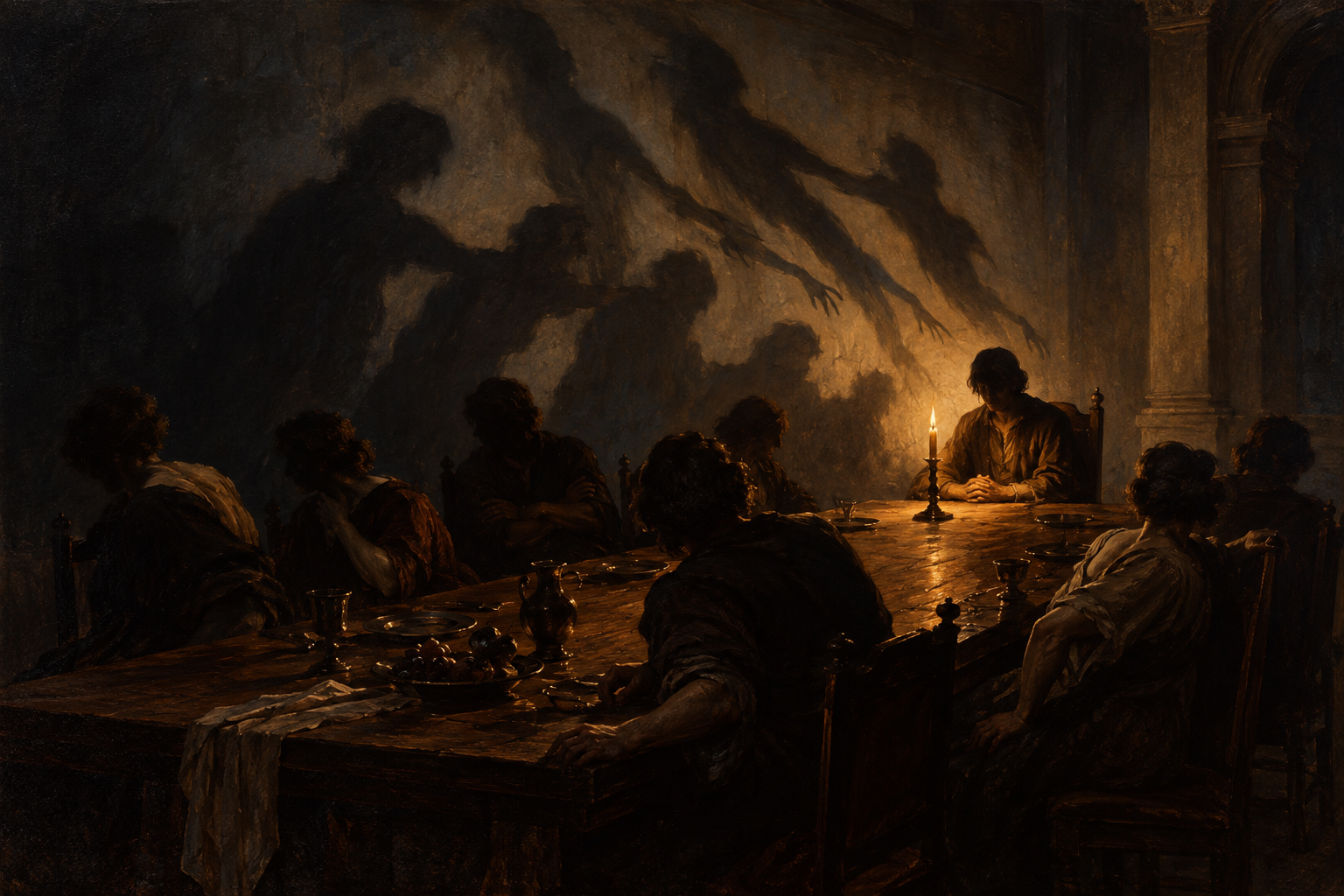
The Mask You Can’t Remove: Why Your Persona Is Slowly Killing You

You know that feeling at the end of a dinner party; the one where you were charming, articulate, funny in all the right places; when you close the front door, and something collapses inside your chest? Not sadness exactly. Something more like the exhaustion of a performance you didn’t consciously choose to give. You sit down. You feel hollow. And for a moment, before the noise of your life rushes back in, a question surfaces that you immediately push away:
Who was that person?
You already know the answer. That person was you, or at least, the version of you that the world has agreed to reward. The version your parents could love. The version your employer promotes. The version your partner chose. You’ve been rehearsing this character for so long that you’ve forgotten when the rehearsal started. And the terrifying part – the part that Jung understood better than any psychologist before or since – is that you can no longer tell where the character ends and you begin.
Jung called this character the Persona.
Most people who encounter the term assume it means something like “the mask we wear in public.” That’s technically correct and practically useless. It reduces one of the most dangerous dynamics in the human psyche to a metaphor about social politeness. The Persona is not a mask you put on and take off. For most people, it has fused to the skin. And the longer it stays fused, the more of you dies underneath it.
The Architecture of a False Self

The word persona comes from the Latin for the masks worn by actors in Roman theater. Jung chose it deliberately. In ancient drama, the mask didn’t just hide the actor’s face – it amplified the voice. It projected a character outward, made the actor legible to an audience of thousands. The actor behind the mask didn’t matter. The role did.
This is exactly how the Persona functions in the psyche. It is the psychological structure that mediates between your inner world and the social environment. It answers the question every child unconsciously asks: What do I need to become in order to be loved here?
Note the precision of that question. Not who am I? That question comes later, if it comes at all. The first question is strategic. Survival-oriented. The child scans the emotional environment of the family – the moods of the mother, the expectations of the father, the unspoken rules about which emotions are acceptable and which are dangerous – and begins constructing a self that fits.
A boy raised by a father who mocks vulnerability learns to perform stoicism before he can spell the word. A girl raised in a household where achievement is the only currency of attention learns to perform competence in everything, including things she hates. A child in a chaotic home learns to perform calm. A child in an emotionally dead home learns to perform brightness, becoming the family entertainer, the one who keeps everyone from feeling the void.
None of this is conscious. None of it is chosen. The Persona is assembled before the ego is mature enough to question it. By the time you’re old enough to ask who am I really?, the Persona has been running the show for years. And it has been so successful – you were loved, you were praised, you survived – that questioning it feels like questioning your own right to exist.
This is the trap. The Persona is not a lie. It is a partial truth that has claimed the entire territory. You really are competent. You really are charming. You really are calm under pressure. But those qualities were selected – curated by an unconscious intelligence that understood, long before you did, which parts of you were welcome in the world and which parts needed to be buried.
What got buried is the Shadow. And the relationship between the Persona and the Shadow is not a loose metaphor. It is a precise, hydraulic system. Everything the Persona includes, the Shadow excludes. Every quality you perform, its opposite sinks into the unconscious. The man who built a Persona around being easygoing has a Shadow full of rage. The woman who built a Persona around intellectual control has a Shadow full of chaotic desire. The person who is always helpful, always available, always warm – their Shadow holds a selfishness so absolute it terrifies them.
You cannot understand the Persona without understanding this mechanism. The mask does not just conceal. It generates what it conceals.
The Inflation Point
Jung distinguished between having a Persona and being identified with a Persona. The distinction is everything.
A healthy Persona is functional. You behave differently in a job interview than you do with your closest friend. You modulate your speech, your energy, your emotional display depending on context. This is not pathological. This is social intelligence. Jung never argued for the abolition of the Persona – he argued against losing yourself inside it.
Identification happens when the ego mistakes the Persona for the Self. When the doctor begins to believe he is medicine. When the mother begins to believe she is nurturing. When the entrepreneur begins to believe he is his productivity. The role stops being something you do and becomes something you are. And once that fusion occurs, any threat to the role becomes an existential threat.
This is why certain people fall apart after retirement. It’s why divorce destroys people who built their entire identity around being a good spouse. It’s why getting fired can trigger a psychological crisis that looks, from the outside, wildly disproportionate to the event. The job was not just a job. The marriage was not just a marriage. It was the scaffolding that held the Persona in place. Remove it, and there is nothing behind it. Just a void where a self should have been.
Jung observed this pattern repeatedly in his clinical practice, particularly in patients at midlife. People who had spent twenty or thirty years excelling in their roles – successful doctors, lawyers, executives, mothers – would arrive in his office not with a specific symptom but with a feeling they couldn’t name. A deadness. An internal flatness that no external achievement could reach. They had everything the Persona promised would make them whole, and they had never felt more hollow.
He called this the problem of the first half of life. In the first half, you build the Persona. You establish yourself in the world. You gain competence, status, relationships, identity. This is necessary work. The problem is that most people mistake this work for the only work. They assume that the identity they’ve built is who they are. And so the second half of life – which demands that you dismantle what the first half built, in order to meet the parts of yourself that the Persona excluded – either never begins, or begins as a crisis.
The Body Keeps the Persona’s Score
The Persona doesn’t just live in your social behavior. It lives in your body.
Watch someone who has built a Persona around strength and control. Their jaw is clenched. Their shoulders are high and locked. Their breathing is shallow – chest-bound, never reaching the belly. Their body has been recruited into the performance. It holds the shape of the character they’re playing, twenty-four hours a day, even in sleep.
Wilhelm Reich, a contemporary of Jung’s who took psychoanalytic ideas into the body, described what he called “character armor” – chronic muscular tension patterns that correspond to psychological defenses. The man who cannot cry has a locked throat. The woman who cannot feel anger has a collapsed chest. The person who is always performing warmth and availability has tension in the face – around the eyes, the mouth – from holding the expression of openness even when they feel closed.
This isn’t metaphor. The muscular patterns are measurable. They restrict breath, blood flow, emotional range, and sexual vitality. The Persona doesn’t just limit who you can be psychologically. It limits what your body can feel.
Many people who have been identified with a Persona for decades describe the same experience: numbness. Not depression – they can still function, still perform – but a muted quality to their inner experience. Colors are less vivid. Music doesn’t move them the way it once did. Sex becomes mechanical. They go through the motions of enjoyment without the felt sense of it. And they assume this is just what happens when you get older.
It isn’t. It is what happens when you’ve been wearing the mask so long that the nerve endings underneath have gone quiet.
The Persona in Love
Nowhere does the Persona cause more damage than in intimate relationships. And nowhere is the damage less understood.
Here is the pattern. Two people meet. They are attracted to each other. But what is actually attracted? In many cases, it is Persona meeting Persona. The competent man meets the nurturing woman. The adventurous free spirit meets the grounded, responsible partner. Each is drawn to the other not as a whole person but as a complementary image – and, as Jung would add, as a carrier of their own unlived qualities projected outward.
The relationship works beautifully for a time. Then, slowly, resentment builds. The nurturing woman begins to feel trapped in her caretaking role. The competent man begins to feel that his partner sees him only as a provider. Both are correct. They are being seen – but only the Persona is being seen. The parts they hid in order to be lovable remain hidden. And those hidden parts begin to scream.
This is the origin of the most common complaint in long-term relationships: You don’t really know me. The complaint is usually delivered with accusation, as though the partner failed to see through the mask. But the accusation is misplaced. You didn’t let them see. You performed so well, so consistently, for so long, that they believed the performance. And now you resent them for it.
The cruelest version of this dynamic is when someone finally drops the Persona in a relationship – shows the anger they’ve been hiding, the neediness they’ve been suppressing, the ambition or the grief or the selfishness that the Persona excluded – and their partner recoils. This isn’t the person I fell in love with. And they’re right. It isn’t. The person they fell in love with was a construct. The real person is the one standing here now, terrified, asking to be seen for the first time.
Many relationships do not survive this moment. The ones that do are the ones where both partners understand, at least intuitively, that they married a mask – and that the face behind it, while less polished, is more real.
The Persona of the Healed
There is a particular version of the Persona that is worth examining because it is endemic to anyone reading an article on a Jungian psychology website. It is the Persona of the person who has “done the work.”
You’ve read the books. You can name your attachment style. You know what the Shadow is. You can identify your patterns in relationships. You speak fluently about trauma, boundaries, integration. You may have been in therapy for years. And all of this knowledge – real knowledge, hard-won knowledge – has been absorbed into a new Persona: the Persona of the psychologically aware individual.
This is not a criticism of the work itself. The work is real. But the ego has a remarkable ability to co-opt even the tools designed to dismantle it. Shadow work becomes a performance of depth. Vulnerability becomes a strategy for appearing authentic. Boundaries become a sophisticated form of control dressed in therapeutic language.
You see this everywhere now. On social media, people perform psychological awareness with the same polished precision that an earlier generation performed material success. “I’m setting a boundary” has become a Persona statement as rehearsed and as empty as “I’m a self-made entrepreneur.” The words are correct. The felt experience behind them is absent.
Jung anticipated this problem. He warned that the most dangerous form of unconsciousness is not ignorance – it is the unconsciousness of someone who believes they are already conscious. The person who has never examined their Persona is, in some ways, less trapped than the person who has built a new Persona out of the language of self-examination. Because the first person might still stumble into a genuine crisis. The second has inoculated themselves against one.
If you recognize yourself in this description – and you should feel uncomfortable, not reassured, if you don’t – the question is not have I done the work? The question is: has the work changed my behavior, or has it changed my vocabulary?
When the Mask Cracks
The Persona doesn’t usually dissolve through insight. It cracks through failure.
A public humiliation. A firing. A betrayal that strips away the social scaffolding you built your identity on. An illness that removes your ability to perform. A divorce. A breakdown. The death of someone who saw through the mask, whose loss means there is now nobody alive who knows the real you.
These events are not obstacles to individuation. They are, in many cases, its precondition.
Jung noticed that many of his most significant patients arrived not when things were going well but when their world had collapsed. The collapse was not the problem – it was the beginning of the solution. The Persona had been holding for so long, and consuming so much energy, that the psyche could no longer sustain it. Something had to break. The question was never whether the Persona would crack. It was what the person would do when it did.
There are two responses to the cracking of the Persona. The first is to rebuild it as quickly as possible – find a new job, a new relationship, a new identity, anything to restore the structure. This is the more common response. It is also the one that ensures the cycle will repeat, usually with escalating severity, until the person either integrates or dies without ever having met themselves.
The second response is to stay in the ruin. To resist the urge to immediately reconstruct. To sit in the disorienting, terrifying space where you do not know who you are – because the person you thought you were turned out to be a role you’d been playing. This is not comfortable. It is not Instagram-worthy. It looks, from the outside, like a person falling apart. From the inside, it feels like it too.
But it is here, in this ruin, that the individuation process begins in earnest. Not in the reading of books. Not in the identification of archetypes. Not in the therapeutic fluency that makes you feel like you understand yourself. It begins when the Persona fails, the void opens, and you discover – perhaps for the first time since childhood – that you have no idea who you are.
Integration, Not Destruction
A common misreading of Jung – and one that the modern self-help repackaging of his work perpetuates – is that the goal is to destroy the Persona. To rip off the mask. To be “authentic” at all times, in all contexts, regardless of consequence.
This is adolescent thinking dressed in psychological language.
Jung’s actual position was more demanding and more subtle. The goal is not to eliminate the Persona but to dis-identify from it. To use it consciously rather than being used by it. To be the actor who knows they are wearing a mask, rather than the actor who has forgotten there is a face underneath.
This means you will still modulate your behavior in social contexts. You will still present differently in a boardroom than in a bedroom. You will still, at times, perform. The difference is awareness. The difference is that the performance no longer consumes you. You can put the mask on and take it off. You know where it ends and you begin.
What does this look like in practice? It looks like the executive who can sit in silence without needing to prove their competence. It looks like the caretaker who can say no without guilt spiraling for a week. It looks like the person who can be disliked – genuinely disliked, not in the curated way that social media allows – without experiencing it as annihilation.
It looks, most often, like grief. Because integrating the Persona means mourning the version of yourself that everyone loved. The golden child. The reliable one. The strong one. The healer. That version served you. It kept you safe. And now you have to let parts of it die so that the rest of you can live.
This is the cost of individuation that nobody warns you about. The price of meeting yourself is losing the self that others recognize.
The Face Behind the Face
There is a moment in the analytic process – not in every analysis, and not on a predictable timeline – where the patient stops performing entirely. Sometimes it lasts only seconds. The therapeutic mask drops. The “good patient” mask drops. The articulate, psychologically literate mask drops. And what remains is a person who does not know how to present themselves, because they have never been in a room without a Persona running.
It is, by most accounts, one of the most frightening moments a person can experience. And one of the most alive.
Jung wrote that the Persona is the individual’s system of adaptation to the world. Withdraw that system, even for a moment, and the raw psyche stands exposed – unmediated, unsocialized, full of contradictions that the Persona was designed to resolve. You discover that you are both kind and selfish. Both courageous and terrified. Both the healer and the one who needs healing. The Persona selected one pole and buried the other. Integration means holding both.
This is not a comfortable way to live. It is not a marketable identity. You will not be able to summarize yourself in a bio. You will not be able to perform consistency, because you are no longer one thing. You are a person – messy, contradictory, alive in a way that the mask never allowed.
The question was never who are you really? That question still assumes there is a fixed answer waiting to be uncovered, like a statue inside a block of marble. The real question – the one the Persona exists to prevent you from asking – is simpler and more unsettling:
Can you tolerate being unknown, even to yourself?
Everything you’ve built – every identity, every role, every carefully curated version of who you are – was an answer to a question you were asked before you had the language to refuse it. The Persona was your answer. It was a good answer. It kept you alive.
But you are no longer a child in a room full of people whose love you need to earn. And the mask that saved you then is suffocating you now. The only question left is whether you will take it off before your face forgets it was ever there.