The Dark Side of Self-Awareness and Why People Turn Against You
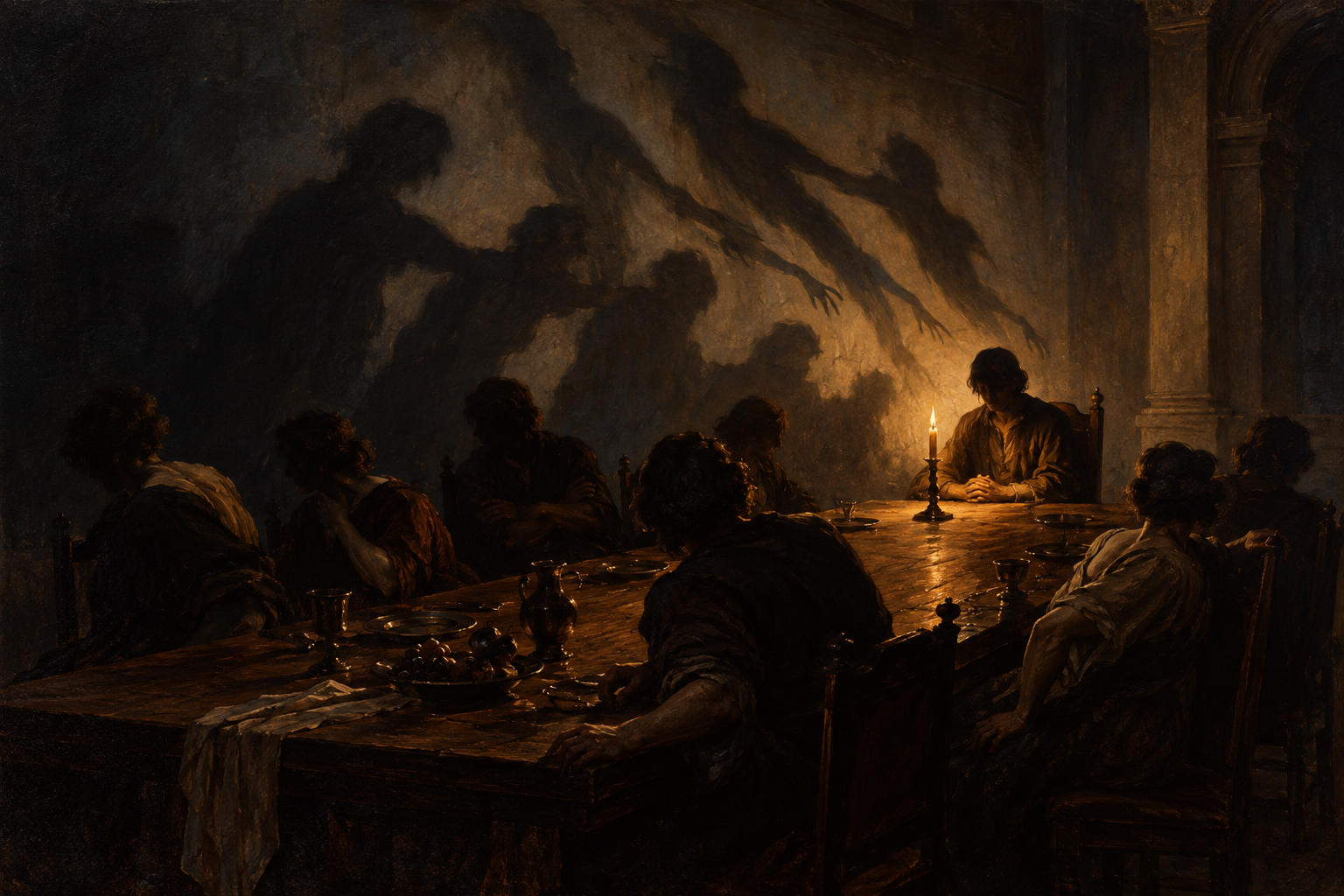
Self-awareness earns you less goodwill than the self-help shelf promises. Some people relax around a person who knows their own motives. Others go cold, call that person arrogant, or drift away without ever naming a grievance.
Jung’s psychology accounts for the second reaction with four mechanisms. People project their disowned traits onto whoever unsettles them. They envy, in a quiet and moralized way, anyone who lived the life they declined. Groups protect the blind spots that hold them together. And close relationships depend on roles that self-knowledge stops performing.
Jung also described a failure on the self-aware person’s side, which he called inflation: treating insight as proof of superiority. An inflated person is hard to be around for their own reasons, and they usually experience the resulting distance as everyone else’s problem.
Where the reaction starts: persona and shadow
Every reaction described here comes from the distance between two parts of the psyche: the persona a person shows a group, and the shadow they keep out of view, often from themselves as well.
The persona is a selection. It holds the parts of you a family, an office or a friend group will accept, and it lets you sit through a meeting without announcing what you think of everyone in it. Jung didn’t treat it as dishonest. The trouble begins when a person forgets the mask is a mask, which is the subject of the earlier piece on the persona and identity.
The shadow holds whatever the persona couldn’t fit. In Psychology and Religion Jung wrote that “everyone carries a shadow, and the less it is embodied in the individual’s conscious life, the blacker and denser it is.” People hear “shadow” and think of cruelty or lust. Those are in there. So is the ambition a family punished, the anger a child learned was dangerous, the tenderness a boyhood had no room for, and the talent that would have meant leaving home.
Keeping that material out of sight takes effort, even when the person spending it has no idea they are. When someone nearby starts looking at their own, the effort gets harder to sustain. The slow process of facing that material is covered in this guide to Jungian shadow work.
How shadow projection turns your calm into “arrogance”
When a person can’t tolerate a trait in themselves, the psyche moves it outward and attaches it to someone nearby. A composed, self-possessed person makes an unusually good target. Jungians call this shadow projection. Jung’s own framing was that whatever stays unconscious in us gets encountered in other people.
Someone who has admitted their own vanity and cowardice usually needs less from a conversation. They can let a silence run. They can take criticism, think about it, and answer later. They don’t need the room to agree with them before they feel settled.
To someone whose stability depends on never looking inward, that composure lands as a comparison. Nothing has been said, and they still feel measured. The feeling needs an explanation, and the explanation that protects them points at the other person: she’s cold, he thinks he’s better than us, they’re judging everyone at the table. A long pause in conversation becomes contempt, and an unruffled reply to criticism becomes a sign they think they’re above it.
Jung wrote in a letter that “knowing your own darkness is the best method for dealing with the darknesses of other people.” The line usually gets shared as encouragement, though it also implies a cost: the self-knowledge that helps you read other people’s darkness makes you a convenient place for them to put it.
To the person doing it, projection feels like accurate perception. When they say you make them uncomfortable, they mean it, and they’re right about the discomfort. They place the cause in you because placing it in themselves would mean opening a door they’ve kept shut for years. That’s why arguing with a projection rarely gets anywhere. Every piece of evidence you offer goes into a frame whose job is to keep the original discomfort somewhere else.
Projections also tend to carry more heat than the situation explains. A colleague who calls you arrogant once, in a flat tone, after you dismissed their idea in a meeting, may simply be right. One who returns to it in unrelated settings, with an intensity nothing you did could account for, is probably describing something closer to home.
Ressentiment and the envy of the unlived life
Some of the hostility self-aware people meet is envy of a specific, moralized kind, the kind Nietzsche called ressentiment. It attaches to people who took a road the envious person decided against, and it shows up dressed as a verdict on their character.
Nietzsche laid out the idea in On the Genealogy of Morals (1887). In his account, ressentiment belongs to people who can’t act on a grievance directly, so they take their revenge in imagination, mostly by redefining another person’s strength as a vice. Of the man of ressentiment he wrote that “his soul squints.” The German philosopher Max Scheler extended the analysis in 1912, and the concept has stayed useful because it explains why some envy turns into moral disapproval. Ordinary envy wants what another person has, while ressentiment works to convince itself that what they have is bad. Nietzsche’s broader argument about how this reshaped Western values is covered in this overview of Nietzsche’s key ideas.
Jung’s version of the same terrain is the unlived life. He wrote about it most directly in his essays on child development, where he argued that the life parents failed to live tends to land on their children. Robert A. Johnson later built a whole book around the idea, Living Your Unlived Life. Every life closes doors. Safety gets chosen over risk, approval over honesty, the familiar job over the frightening one, the hometown over the city that kept calling. The person who might have lived behind each door doesn’t disappear. They persist as restlessness and as a sharp envy that switches on around someone who walked through the door you shut.
The reaction tends to arrive in a sequence. Recognition comes first, and it hurts. Then comes a story that makes the hurt go away: the other person was lucky, selfish, naive, had no responsibilities, will regret it. The story spares the envious person from seeing their own closed door as a choice they made.
This can come from people who love you. A parent who gave up painting for a steady salary may find a child’s decision to go freelance unbearable for reasons the parent could never say out loud. Their objections will be about money and stability, while the feeling underneath them predates the child’s career by decades.
The collective shadow and why groups close ranks
Groups carry shadows too: whatever a family, a friendship, a company or a whole profession has silently agreed not to see about itself. When one member starts seeing it, or simply stops cooperating with the silence, the group often decides that member is the problem.
The agreements are never written down. A family plans every holiday around one person’s drinking and nobody names it. Two friends compete over everything and both would deny it under oath. A team calls answering emails at midnight “commitment.” Enforcement happens through tone, usually a change of subject or a well-timed joke.
In The Undiscovered Self (1957) Jung wrote that “resistance to the organized mass can be effected only by the man who is as well organized in his individuality as the mass itself.” He had states and ideologies in mind, writing a decade after the Second World War. The same dynamic plays out at family dinner tables. A group’s cohesion can rest on a shared blind spot, and someone with their own center of gravity no longer needs the blind spot in order to belong.
Family therapists describe the response in practical terms. The psychologist Harriet Lerner, working from Murray Bowen’s family systems theory, called it the “change back” reaction: when one person in a system shifts, the others push to restore the old arrangement. The push usually starts gently (“you’ve changed,” “you used to be fun”) and can escalate to exclusion from the real conversations, or to a story about you that circulates when you’re not in the room.
Jung’s line from Aion applies here at group scale: “when an inner situation is not made conscious, it happens outside, as fate.” Whatever a group refuses to hold consciously gets acted out between its members, very often by casting the one who noticed as the troublemaker.
Why close relationships change when you stop playing your role
Intimate relationships run on unspoken arrangements about who needs whom, and self-knowledge rewrites those arrangements without asking. The other person experiences a broken agreement they never knew they had made.
Two kinds of arrangement do most of the work. The first is about predictability. One partner always apologizes first. One friend is always the listener and never the one who falls apart. A sibling is cast as the reliable one and keeps getting the calls when something goes wrong. As long as everyone reacts on cue, the relationship feels stable.
The second is about influence. If you need someone’s approval, their disappointment steers you, and that gives them a quiet form of power they rarely know they’re using. Care can work the same way. Being the person someone depends on is a way of staying necessary to them, which is the pattern explored in the piece on how helping turns into control.
Self-knowledge loosens both. You stop apologizing for things you didn’t do. You hear “I’m disappointed in you,” register that it hurts, and make your own decision anyway. You experience this as clarity. The person who relied on your need may experience it as being left, because whatever made them feel essential to you has stopped working.
What often follows is an attempt to restore the old balance. Persuasion comes first. If that fails, pressure, then guilt, and eventually a withdrawal that’s meant to be noticed. In Psychology and Alchemy Jung wrote that “people will do anything, no matter how absurd, in order to avoid facing their own souls,” and a long effort to bring back the old version of you can be one form of that avoidance.
Give people time before you draw conclusions. The first reaction to a changed role is rarely the final one, and plenty of relationships renegotiate once the other person sees the change is stable. Some don’t. A friendship can end with no argument at all, because one person stopped filling the role it depended on.
Why some people dislike you the moment you meet
Instant dislike from a stranger usually tells you about the stranger. One type in particular reacts fast to self-aware people: anyone who manages others through charm or guilt, because they notice within minutes that their usual moves aren’t landing.
Each move expects a response. Flattery expects you to warm up. A sad story expects you to step in and rescue. A small dig expects you to defend yourself, and the defense gives them something to work with. A person who has looked hard at their own need to be liked bites less often. They notice the move instead, and for someone running a routine, being watched can feel more threatening than a refusal, since it suggests the routine is visible.
Keep this explanation on a short leash. Strangers also go cold because you remind them of someone, or because your manner reads differently in their culture than in yours. Treating every chilly first meeting as proof that you saw through a manipulator is a habit worth watching for in yourself.
When the problem is you: inflation and the “mirror” identity
Sometimes people pull away from a self-aware person because that person has become hard to be around. Jung’s name for the condition is inflation: the ego absorbs an insight or an archetypal image and starts treating it as personal superiority.
Jung described inflation in Two Essays on Analytical Psychology as an expansion of the personality beyond its proper limits, usually after contact with powerful unconscious material. Shadow work produces its own version. A person learns to spot projection and begins diagnosing everyone’s projections over dinner. They learn that their reactions are their responsibility and quietly conclude that everyone else’s reactions are those people’s problem. Conflicts get explained as other people’s unintegrated shadow, and friends who drift off are assumed to have found them too much.
The arrogance and judgment that person once disowned are still there, now dressed as insight. That is why the “I make people uncomfortable because I see too clearly” story deserves suspicion even when parts of it are true. It is the most flattering possible reading of being disliked, and the psyche reaches for flattering readings for the same reason it projects. Shadow work that hardens into a superior identity is one of the main ways the process stalls, as covered in this look at why shadow work so often fails. A related trap is treating one dramatic inner experience as arrival.
Some honest checks:
- Does the same complaint follow you across groups that have nothing to do with each other? One person calling you cold may be projecting. Five people in five settings deserve a hearing.
- Do you offer your read on other people’s psychology when nobody asked for it?
- How quickly do you reach for “that’s their projection” when criticized? Speed is a warning sign, because checking takes time.
- Did the distance start around when you began talking about your inner work to people who hadn’t asked about it?
- Can you name a recent conflict in which you were mostly in the wrong?
In Modern Man in Search of a Soul Jung asked, “How can I be substantial if I do not cast a shadow? I must have a dark side also if I am to be whole.” A person convinced their shadow has been dealt with has stopped looking for it, which leaves it free to act through them.
The loneliness of individuation, and which relationships survive it
Individuation does cost relationships, and Jung never pretended otherwise. The connections it tends to remove are the ones built on an old role. What stays, or arrives later, are people who can be near your inner life without feeling threatened by it.
The loneliness involved is a particular kind. In Memories, Dreams, Reflections Jung wrote that “loneliness does not come from having no people about one, but from being unable to communicate the things that seem important to oneself, or from holding certain views which others find inadmissible.” A person can have a full social life and still have almost no one to say the important things to. The second half of the sentence, about holding views others find inadmissible, fits this experience especially closely.
It helps to remember that individuation, as Jung described it, aims at wholeness, and wholeness and social ease pull in different directions more often than anyone would like. Someone who declines to go along with a room’s unspoken rules will make that room uncomfortable at times, however kindly they behave.
After a relationship cools, the first question is usually what you did wrong. A more useful one is what the connection rested on. If it needed you to stay small or to keep the family secret, its ending says something about its foundations.
Some of what you lose was real. People also drift away because you changed in ways they didn’t choose and don’t like, and that’s a loss worth grieving without turning it into a lesson about their shadow. Some of those people come back years later, after doing their own work. Jung’s line from “Marriage as a Psychological Relationship” applies to all of this: “There is no coming to consciousness without pain.”
The relationships that last through this tend to be ones where both people can be seen. A friend who hears about your darkness and stays, and who lets you see theirs in return, is uncommon. One or two people like that ease this kind of loneliness more than a busy calendar does.
Journal prompts for working through this
These prompts are meant to be written out and returned to over several weeks, since first answers tend to be the defended ones.
- Who has gone cold on you in the past year? Write what they would say about you if they were completely honest, then mark the parts you suspect are true.
- What role did you play in your family growing up, and who seems most unsettled now that you play it less?
- Think of a door you closed that someone else walked through. How do you talk about that person when they aren’t around?
- Whose approval still changes your decisions? Notice what happens in your body when that person is disappointed in you.
- When did you last explain someone’s criticism as projection? Spend one day treating that criticism as accurate and write down what changes.
If you want one place to keep this kind of writing, a dedicated shadow work journal gives the work some structure across weeks.
Frequently asked questions
Why do some people dislike self-aware people?
In Jungian terms, a self-aware person can trigger the shadow of people who avoid their own. That discomfort gets projected outward as accusations of arrogance or coldness. Envy of the unlived life and resistance to changed relationship roles add to it. Sometimes the cause is the self-aware person’s own inflation.
What is shadow projection?
Shadow projection is the process of attributing your own disowned traits to someone else. Jung held that unconscious contents tend to be met outside ourselves, in other people. The usual sign is a reaction far stronger than the other person’s behavior explains.
Are people who dislike me for no reason projecting?
Sometimes. Check for patterns first. If the same criticism comes from unrelated people in different settings, it probably deserves a hearing. A single person’s intense, repeated reaction that nothing you did accounts for is more likely projection.
What is the difference between ressentiment and resentment?
Resentment is a direct grievance against someone. Ressentiment, in Nietzsche’s sense, is resentment that can’t act on itself, so it recasts the other person’s strengths as moral failings.
Did Carl Jung say “I would rather be whole than good”?
The line is widely attributed to Jung, but we haven’t found it in his published writings. His documented work does contrast perfection with completeness, most clearly in Aion, where he argues that striving for perfection costs a person their wholeness.
Is loneliness a normal part of individuation?
Jung treated it as a common one. He described loneliness as the inability to communicate what matters to you, which can happen in a crowded life. It usually eases as relationships form around who you’ve become.