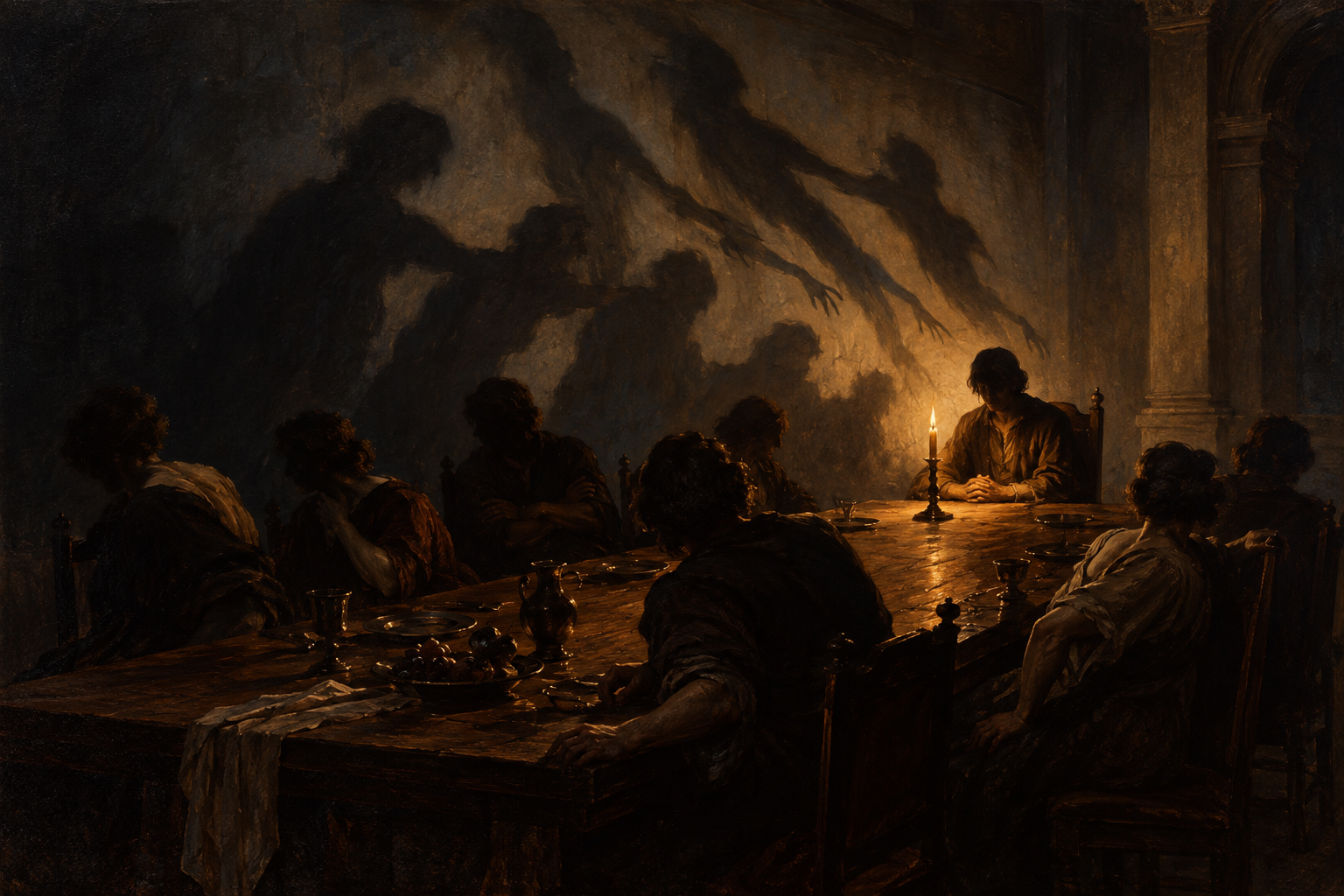
Ego Death: What It Really Means and What It Actually Feels Like

Somewhere tonight, someone is telling a story about the time they died. They took mushrooms, the room dissolved, their own name stopped meaning anything, and for a stretch of minutes there was no one left inside to be afraid. They call it ego death, and they say it like a trophy.
Somewhere else, a self-help post is ordering you to kill your ego, as though the thing that gets you dressed and keeps you employed were a tumor to cut out.
Both have hold of something real and strange, and both have it by the wrong end. Ego death is one of the most powerful experiences a human nervous system can produce, and it has become one of the most misused phrases on the internet, flattened into a psychedelic flex on one side and a wellness slogan on the other. This is the honest version. What it is, what it feels like from the inside, why it happens in your brain, who gets hurt by it, and the thing the depth-psychology tradition understood that the hype keeps missing.
What ego death actually means
Start with the plain answer, because most pages bury it. Ego death is the temporary, total collapse of your sense of being a separate self. The ordinary feeling of being a particular person, located behind your eyes, with a name and a history and a boundary between you and everything else, switches off. For the duration, there is experience, often vivid and overwhelming experience, but no one who feels like the owner of it.
The word “ego” is doing a lot of work here, and it is worth slowing down on. In everyday speech, ego means arrogance, the guy who can’t stop talking about himself. That is not what dies. In psychology the ego is the structure that organizes your identity, the center of your waking consciousness, the part that says “I.” It tracks who you are across time, holds your boundaries, sorts what is you from what is not you. Ego death is the felt disappearance of exactly that function. The “I” that usually narrates your life goes quiet, and the boundary it was maintaining between self and world stops being drawn.
People reach for different names depending on the tradition they come from. Psychedelic researchers tend to say ego dissolution, which is the more precise term, since the experience sits on a spectrum from a mild softening of the self to its complete disappearance. Buddhists point to anattā, the doctrine of no-self, the recognition that the solid separate “me” was always a process rather than a thing. Jung called it psychic death. They are circling the same territory from different doors.
The term itself has a traceable history, which helps explain why it carries so much spiritual freight. In 1964 Timothy Leary, Ralph Metzner, and Richard Alpert published a manual for the psychedelic experience modeled on the Tibetan Book of the Dead, mapping the dissolution of the self onto the bardo, the transitional state between death and rebirth. The framing stuck. Aldous Huxley had already described the doors of perception swinging open under mescaline a decade earlier. Stanislav Grof, working with LSD in clinical settings, documented ego death as a recurring stage in deep sessions, a psychological dying that tended to precede a sense of rebirth. The phrase arrived pre-loaded with the language of death and resurrection, which is part of why it gets treated as holy and part of why it gets misunderstood.
What ego death actually feels like
This is the question people are really asking, and it is the one the encyclopedias and the therapist blogs skate past. There is no single experience, but there is a recognizable arc, and the descriptions converge across thousands of accounts.
It usually begins at the edges. The boundary of your body gets uncertain. You cannot quite tell where your hand ends and the air begins, and that fuzziness creeps inward. Time loosens. The steady forward motion of one moment into the next breaks down, and you can find yourself with no sense of how long anything has lasted, or any conviction that duration is a real thing.
Then the autobiographical self starts to thin out. The running commentary in your head, the one that has been going your whole life, the voice that worries and plans and remarks, gets quieter and further away, until at the deep end it stops. Your name, your job, your story, the whole file labeled “me” becomes strangely inaccessible, and stranger still, its absence does not feel like amnesia. It feels like those things were always a costume, and the costume has slipped off.
At the center of it, the watcher dissolves. Ordinarily there is a sense that someone is behind your eyes receiving your experience. In full ego death that someone is gone. There is seeing with no one who sees, a happening with no one it is happening to. People describe becoming everything and nothing at once, merging into a vast field, dissolving into light or void, losing any line between themselves and the universe.

How that lands depends on whether you can let go. Surrender tends to open onto the blissful version: oceanic unity, a love with no object, a peace that the people who felt it spend years trying and failing to put into words. The word that comes up again and again is ineffable, beyond language, and they mean it as a description rather than a flourish. Resistance opens onto the other version. When the self senses it is dissolving and grabs for the railing, the experience can flip into raw terror, the conviction that you are genuinely dying or going permanently insane, an annihilation panic with nothing solid anywhere to hold. Same event, opposite valence, decided largely by whether you fight it.
The dying is not metaphorical to the person inside it. The brain seems to process the loss of the self with the same machinery it would use for an actual death, which is why “ego death” is the honest name and why people come out shaken even when it was beautiful.
The four doorways: how ego death happens
Ego death is not one thing arriving by one route. It shows up through several, and they matter, because the route shapes the risk.
Psychedelics
Psychedelics are the most common modern doorway. Classic psychedelics, psilocybin in mushrooms, LSD, DMT, mescaline, can dissolve the sense of self, with the depth scaling roughly with dose. DMT and high-dose psilocybin are the ones most associated with complete ego death. A caution that belongs right here rather than in a footnote: most of these substances are illegal in most places, the experience is powerfully dependent on dose, mindset, and setting, and a personal or family history of psychosis or bipolar disorder is a genuine red flag that can turn a session into a lasting crisis. This article describes the territory. It is not a guide to entering it.
Deep meditation
Deep meditation is the older doorway and, done seriously, no gentler. Sustained contemplative practice can erode the sense of a separate self on purpose, which is the explicit aim in much of Buddhism. Advanced practitioners describe the self thinning and at times vanishing. The traditions that map this also map its hazards, including the territory Western teachers have started calling the dark night, where the dissolution of the familiar self brings dread, destabilization, and despair rather than peace. The contemplative path is legal and unglamorous and still capable of cracking you open.
Breath and the body
Holotropic breathwork, developed by Grof precisely to reach these states without drugs, uses sustained rapid breathing to occasion ego dissolution. Extreme physical ordeal, fasting, sleep deprivation, intense rhythmic dance, the old ascetic technologies, can do it too. The body has its own keys to the same door.
Spontaneously, without being sought
This is the doorway nobody chooses, and it is more common than the trophy stories suggest. Ego death can arrive uninvited in a near-death experience, in the crush of sudden grief, under extreme stress or trauma, sometimes at the onset of a psychotic episode, occasionally in a moment of total absorption or awe. People stumble into it and spend months trying to understand what happened to them, often without the vocabulary to even name it.
If you came here searching how to experience ego death, here is the part worth hearing. You do not produce it by force of will, and the wanting is itself a problem we will get to. The routes above are how it tends to occur, not a recipe to be followed, and the two that are legal and self-directed, meditation and breathwork, are also the two that ask for patience and ideally a teacher rather than a weekend.
What happens in the brain
The science is younger than the experience by a few thousand years, but it has caught up enough to say something real, and this is the layer the thin blogs leave out entirely.
The key character is the default mode network, a set of brain regions that hum together when you are not focused on a task, when you are lost in thought, remembering, planning, narrating, daydreaming about yourself. The default mode network is, as much as any single thing in the brain, the seat of the self. It is where the autobiographical “me” is continuously assembled.
Robin Carhart-Harris and colleagues at Imperial College London scanned people under psilocybin and found that activity and connectivity in the default mode network dropped, and that the size of that drop tracked with how strongly people reported their sense of self dissolving. The harder the network went quiet, the more completely the ego fell away. Their broader proposal, the entropic brain, frames the psychedelic state as one of looser, more disordered, less rigidly self-organized brain activity, the normal hierarchies relaxing their grip. Strip the constant self-construction back far enough and the felt result is exactly what people report: no center, no separation, no one home.
This reframes the whole thing in a useful way. Your separate self is not a fixed object that gets deleted. It is an ongoing activity, a network doing continuous work to maintain the impression of a solid “I,” and ego death is what it feels like from the inside when that work briefly stops. The self is less like a statue and more like a fountain. Turn off the pump and the shape it was holding disappears, not because it was destroyed, but because it was never a thing in the first place.

The Jungian reading, and why it matters more than the hype
Here is where the depth-psychology tradition earns its place, and where most of the page-one results are either silent or shallow.
Jung did not romanticize the destruction of the ego. He treated the ego as a hard-won achievement, the organizing center of consciousness, the thing that has to exist before anything deeper can be related to safely. His interest was in the relationship between the small ego and something larger he called the Self, the organizing principle of the whole psyche, conscious and unconscious together. The ego is the center of your awareness. The Self is the center of the totality, most of which you cannot see. The analyst Edward Edinger named the lifelong negotiation between them the ego-Self axis, and that axis is the key to reading ego death correctly.
In Jungian terms, a genuine ego death experience is the ego briefly losing its position as the center and getting a glimpse of the larger Self it normally has no access to. That can be the most meaningful moment of a person’s life. The encounter with something vast and intelligent and not-you, the felt knowledge that “I” was only ever a small window in a very large house, can reorganize a life. We trace this larger map in detail in our piece on individuation, the slow process this kind of glimpse belongs to.

But Jung saw the trap that the psychedelic-trophy framing walks straight into. A glimpse of the Self is not the same as the work of integrating it, and the two get confused constantly. Dissolving the ego for an afternoon shows you the territory. It does not do the years of labor that turn a vision into a changed life. Worse, the experience carries a specific danger Jung named directly: inflation. The ego, having brushed against something divine, can claim that power as its own and swell up, and you get the familiar figure who came back from their journey convinced they are enlightened, subtly superior, done. Jung called this the mana-personality, the ego possessed by the very thing it was supposed to serve. It is the most common way ego death goes wrong in people who were not visibly harmed by it, and almost nobody warns you about it. The work after the experience is to stay humble and human, to let the ego reassemble as a servant of something larger rather than a graduate of it.
This is the correction the depth tradition offers the hype. The ego is not your enemy and dissolving it is not the goal. A softer, less defended, less fear-driven ego in conscious relationship with the deeper Self is the goal, and ego death is at most a doorway you might pass through on the way there, not the destination and not the proof of anything.
Is ego death good, or dangerous?
Both, depending on the person, the preparation, and what happens afterward. The honest answer refuses to be a slogan in either direction.

On the good side, the research is real and growing. The Johns Hopkins group under Roland Griffiths found that psilocybin can occasion mystical-type experiences, ego dissolution among them, that people rate among the most personally meaningful events of their lives, with effects on wellbeing that persist for months. Trials have used these states to treat depression, addiction, and the existential dread of terminal illness, and the degree of ego dissolution and mystical experience tends to predict how much people improve. A loosened sense of self can break the grip of rigid patterns, dissolve the certainty that fuels depression and trauma, and reduce the fear of death by giving someone a direct experience of being more than their separate self. For some people it is genuinely the hinge their healing turns on.
On the dangerous side, the same dissolution that frees one person breaks another. When the boundary comes down too fast, buried shadow material can flood in faster than the psyche can hold it, and the result is panic, paranoia, or a long emotional hangover rather than insight. Some people come back not whole but unmoored, stuck in depersonalization or derealization, a persistent sense that they or the world are not real, which can last well beyond the experience and is genuinely distressing. For those carrying a vulnerability to psychosis or bipolar disorder, a forced ego dissolution can precipitate an episode that does not simply end when the substance wears off. And the subtler harm we already named, the inflation and spiritual bypassing, can quietly distance someone from their own life while convincing them they have transcended it.
The people most likely to be hurt are the ones chasing the experience hardest with the least preparation and support, and the ones who should never have gone near it in the first place because of an underlying condition. The people most likely to benefit are the ones who arrive prepared, supported, and not in a hurry, and who treat what they find as the beginning of work rather than its completion.
The demand to affirm every part of what you’ve been has a philosophical cousin in Nietzsche’s eternal recurrence, which asks whether you could will your life to repeat unchanged.
How long does ego death last, and is it permanent?
The experience itself is temporary, always. Ego death lasts as long as the state that produced it. Under DMT it can come and go in minutes. Under psilocybin or LSD the deep stretch might last an hour or two inside a longer experience. In meditation it may flicker briefly. The separate self reassembles every time, because, as the brain science suggests, the self is a process the brain resumes the moment conditions return to normal. You do not lose your identity for good.
What can be lasting is the change in perspective. People often describe carrying something back, a reduced fear of death, a loosened attachment to the small self, a sense of connection that outlasts the event by months or years. That durable shift, rather than the temporary dissolution, is the thing actually worth having, and it depends almost entirely on what you do afterward.
The other thing that can, rarely, persist is harm. Lingering depersonalization or a destabilization that does not resolve on its own are real outcomes for a minority, and they are reasons to take the whole subject more seriously than the party stories do, not less.
Why chasing ego death backfires
This is the part the trophy-hunters need and won’t like. The desire to lose your ego is the ego talking. The “I” that wants to dissolve itself, that wants the impressive experience, that wants to come back transformed and tell people about it, is the very self-structure that supposedly died. You cannot ambition your way out of ambition. The wanting is the thing in the way.
So the pursuit tends to curdle into its own opposite. People collect ego death experiences the way they collect anything else, as achievements that feed the self rather than dissolve it. They use the language of surrender to avoid the slow, unglamorous, genuinely humbling work of meeting their own shadow one ordinary day at a time. Spiritual bypassing is the technical name, using transcendence to skip the descent, and an ego death experience is one of its favorite tools, because it feels like the descent while letting you avoid it. We wrote about exactly this evasion in why shadow work so often fails, and it is the same mechanism here in louder clothes.
The people who get the most from these states tend to want them the least desperately. They are not hunting a peak. They are doing steady work, and the dissolution, when it comes, drops into a life already structured to receive it.
If ego death happens to you
Whether you went looking or it found you, the value is made afterward, in the part nobody posts about. The experience is the easy part. Integration is the work, and it is slow on purpose.
Give it words and form. Write down what happened while it is still vivid, even the parts that resist language. Work with the images it left you through journaling, through active imagination, through art, through dreams, which tend to keep processing the material for weeks. Resist the urge to make sudden enormous life decisions in the raw afterglow, when everything feels obvious and you feel newly wise. That clarity is real and it is also partly inflation, and the insights worth keeping will still be there in three months when you are less high on them. Stay connected to ordinary people doing ordinary things. Come back to earth, where any of this has to actually be lived.
And know the line where integration becomes something that needs help. If you are left with a persistent sense that you or the world are not real, if you cannot function, if the dread does not lift, that is not the next stage of awakening and it is not yours to tough out alone. A therapist trained in this terrain, ideally in depth or psychedelic integration work, is the right call, and reaching for that support is a sign of strength rather than failure.
Common questions about Carl Jung’s ego death
What does ego death feel like?
At its fullest, it feels like the disappearance of the person you take yourself to be. Body boundaries blur, time breaks down, the inner narrator goes silent, and the sense of someone being behind your eyes dissolves into either oceanic unity and peace or, if you resist, into the terror of annihilation. People consistently call it beyond words and describe it as a kind of dying.
Can you have ego death without drugs?
Yes. Deep meditation, holotropic breathwork, extreme stress or grief, near-death experiences, and moments of total absorption can all dissolve the self. The non-drug routes are legal and real, and the contemplative ones ask for sustained practice rather than a single dramatic event.
How long does ego death last?
The experience is temporary and matches the state that caused it, from minutes under DMT to an hour or two under psilocybin or LSD. The separate self always reassembles. What can last is the shift in perspective afterward.
Is ego death permanent?
No. You do not lose your identity for good. The self returns every time, because it is an ongoing brain process rather than a thing that can be deleted. Lasting changes are in how you relate to that self, not in its disappearance.
Is ego death the same as enlightenment?
No, and treating it that way is a common error. A glimpse of selflessness is not stable awakening, and contemplative traditions are clear that a single dramatic experience is not the same as the long ripening of insight. The experience can point at something true without conferring it.
What are the signs of ego death versus just a strong experience?
The marker is the loss of the subject. A strong experience still happens to you. In ego death the “you” it would happen to is what goes missing, along with the sense of separation between self and world. Partial versions, a softened or quieted self, are better called ego dissolution.
Is ego death dangerous?
It can be. The risks include overwhelming shadow material, panic, lasting depersonalization, inflation and spiritual bypassing, and, for those with a vulnerability to psychosis or bipolar disorder, a serious and lasting episode. Preparation, support, the right reasons, and honest screening separate the people it helps from the people it harms.
This article is for understanding, not instruction, and it is not medical advice. Many of the substances discussed are illegal in many places and carry real psychological risk. If a past experience has left you feeling persistently unreal, frightened, or unable to function, please reach out to a qualified mental health professional.
Sources and further reading: C.G. Jung on psychic death and the Self (Collected Works Vols. 7 and 9ii); Edward Edinger, Ego and Archetype. Timothy Leary, Ralph Metzner and Richard Alpert, The Psychedelic Experience (1964). Aldous Huxley, The Doors of Perception (1954). Stanislav Grof, on ego death and holotropic states. R.L. Carhart-Harris et al. on the default mode network and the entropic brain hypothesis, Imperial College London. R.R. Griffiths et al. on psilocybin and mystical-type experience, Johns Hopkins. On no-self, the Buddhist doctrine of anattā.