Individuation: Carl Jung’s Path to Becoming Whole

Most writing on individuation hands you three neat stages and calls it a map. Meet your shadow, balance your anima or animus, realize the Self, done. That sequence is real, and you will find it below, but presenting it as a tidy staircase is the single biggest distortion of what Jung meant. The actual process is closer to a spiral that keeps returning you to the same material at deeper levels, often against your will, usually when life has knocked something loose.
So here is the honest version. Individuation is the lifelong work of becoming the whole person you already are underneath the personality you assembled to survive. It is the central idea in Jungian psychology, and Jung spent forty years circling it because it resists being made simple.
Becoming whole is not only Jung’s language. Nietzsche approached the same threshold from another direction with the idea of eternal recurrence, where saying yes to your life means claiming all of it.
If you want the one-sentence answer: individuation is the process by which you stop being a fragment run by forces you cannot see, and gradually become a conscious, undivided self. Everything past this point is the detail that the one-sentence version leaves out, and the detail is where the work lives.
What is individuation according to Carl Jung?
The word does the first piece of teaching for you. To individuate is to become in-dividual, undivided. Not separate from everyone, which is the usual misreading, but no longer split inside yourself. The aim is wholeness, a state in which the parts of you that operate in the dark are brought into relationship with the parts that operate in the light.
In its plainest sense, individuation describes something every life involves: separating from the collective. You start as an extension of your parents, your culture, your religion, your schooling. Over time you differentiate into someone distinct. That much is ordinary development.
Jung meant something deeper. In Two Essays on Analytical Psychology (Collected Works, Vol. 7) he described the aim as stripping away two layers at once. First, the false personality the ego built for itself early on, what he called the persona. Second, the grip of the deep, impersonal images that move us without our knowledge, the archetypes. Strip away both, hold the tension between them, and a particular human being emerges who was latent the whole time. Jung translated individuation as coming to selfhood, or self-realization.
The goal is consciousness. Not knowledge in the trivia sense, but awareness of what you are made of, including the material you would rather not own. Jung’s wager was that bringing the unconscious into consciousness heals the internal splits that otherwise run your life from behind. The Jungian analyst Anthony Stevens put the natural side of it well in Private Myths: individuation is the process by which an organism becomes what it was meant to become from the start. An acorn does not decide to become an oak. Something in it knows.
One correction worth making immediately, because it changes everything that follows. The goal is wholeness, not perfection. A perfect person has no shadow and therefore no reality. A whole person has reckoned with their capacity for pettiness, cruelty, and self-deception, and folded it back into a life rather than splitting it off. Wholeness includes the dark. That is the part the inspirational-poster version of Jung quietly deletes. We unpack that distinction further in our collection of Carl Jung quotes, where the line about preferring to be whole rather than good comes up.
Clearing up what individuation is not
Half the confusion around this topic comes from words that sound similar and mean different things. Sort these out first and the rest gets easier.
Individuation is not individualism
Jung was explicit on this. Individualism means deliberately stressing your own peculiarities against collective demands, a kind of ego project. Individuation is the opposite movement. As you integrate more of yourself, you also recognize how much you share with everyone else, the common human material underneath the personal surface. Robert Johnson, in Inner Work, made the point that the individuated person becomes more connected to the human family, not less. The mature outcome is relatedness, not isolation.
Individuation is not Maslow’s self-actualization, though they rhyme
Maslow’s self-actualization sits at the top of a needs hierarchy and describes realizing your potential, becoming the most you can be. There is overlap. But Jung’s process is darker and less linear than Maslow’s ascent. Self-actualization tends to read as growth upward toward fulfillment. Individuation requires a descent first, into the disowned and the shameful, and the wholeness it aims at includes everything the self-actualization model tends to leave at the bottom of the pyramid.
Individuation is not Margaret Mahler’s separation-individuation
This one trips up students constantly because the phrase is nearly identical. Mahler’s separation-individuation is a theory in developmental psychology about how an infant in the first three years of life psychologically separates from the mother and forms a sense of being a distinct person. It is about early childhood and object relations. Jung’s individuation is a process of the second half of life and beyond, about integrating the unconscious. Same root word, different universe. If you searched and landed on a page about toddlers and attachment, that was Mahler, not Jung.
Individuation is not self-improvement or “finding yourself.”
Self-improvement optimizes the existing personality, the very structure individuation asks you to loosen. And “finding yourself” implies the self is a hidden object waiting to be located. The Self in Jung’s sense is not found so much as slowly related to. You do not arrive at it. You build a working relationship with it over years.
The territory before the journey: Jung’s map of the psyche
You cannot follow a path through terrain you cannot name. Jung’s model of the psyche is that terrain, so it pays to hold the main features in mind.
The ego is your conscious sense of being “I.” It is the center of consciousness, and it is small. Jung’s repeated correction to our self-importance was that the ego is not the whole psyche, only the part that knows itself. Think of it as the lit window in a large dark house.
The persona is the social mask, and usually you wear several. The professional, the parent, the friend, the version that shows up online. Personas are not bad. They are necessary social tools. The problem starts when you mistake the mask for the face, when the ego identifies so completely with the persona that nothing else feels real.
The personal unconscious holds everything you have forgotten, repressed, or never quite noticed about yourself. It is personal because it is built from your own history.
The collective unconscious is the layer beneath that, shared across humanity, made of inherited patterns Jung called archetypes. These are not images you learned. They are predispositions to experience and imagine in certain forms, the same way a bird is predisposed to build a nest without being taught the blueprint. The mother, the hero, the trickster, the wise old figure, the divine child: these recur across cultures and centuries because they live in the shared substrate. Our guide to Jungian archetypes goes deeper on the full cast.
Complexes are clusters of charged material in the personal unconscious, organized around an archetypal core. Your father complex, your inferiority complex, your money complex. A complex is what gets triggered when a small comment produces a reaction wildly out of proportion to the event. In those moments the complex has you, not the other way around.
The three archetypes that matter most for the journey are the shadow, the anima or animus, and the Self.
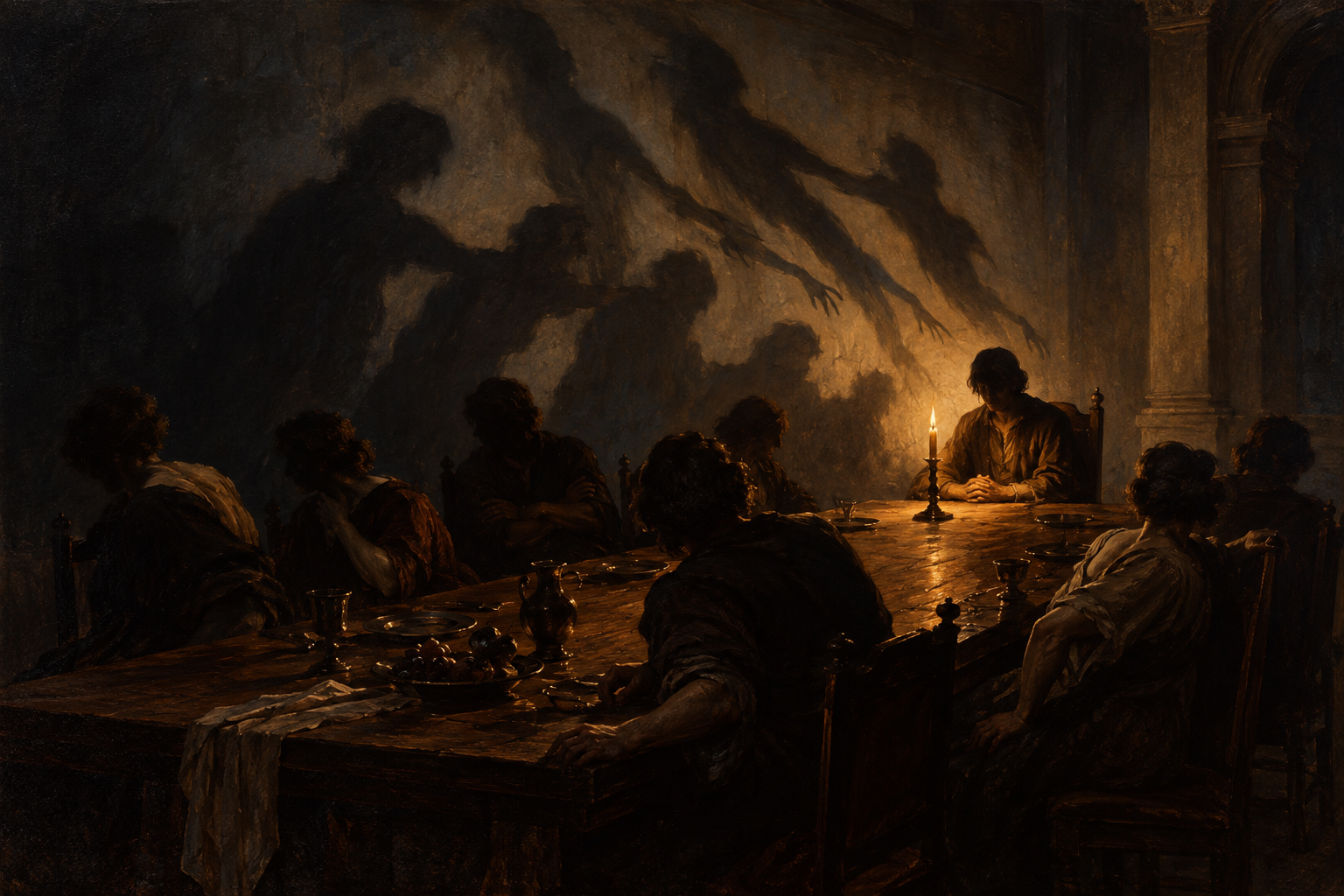
The shadow is everything about yourself you have disowned, the traits you cut off to become an acceptable personality. It is not only dark. Repressed strength, ambition, and creativity often live there too, what Jungians call the gold in the shadow.
The anima is the unconscious feminine in a man, the animus the unconscious masculine in a woman. These figures connect the personal psyche to the collective layer and tend to be projected onto real people, which is one reason falling in love feels like recognition. We cover this mechanism in detail in our piece on the anima and animus.
The Self, capitalized to distinguish it from the everyday self, is the hardest to pin down because it is two things at once. It is the center of the total psyche, and it is the totality. Jung borrowed the idea partly from Hindu philosophy and described it as the organizing principle of the whole, a kind of inner ordering intelligence that the ego is meant to serve rather than command. The relationship between the small ego and the large Self is, for Edward Edinger in Ego and Archetype, the master axis of the whole process.
Why we start divided
Individuation has a beginning condition, and it is division. Understanding how we get split explains why the work is necessary.
You arrive embedded in a collective. Family, culture, and institutions shape your personality from birth, telling you what to believe, how to behave, what to value, and who you are. The Taoists called the result the acquired mind, the self assembled from conditioning. By early adulthood that self is largely set. You have a stable construct you call “me.”
That construct is always, in Jung’s word, one-sided. It is built from the traits your environment rewarded and stripped of the traits it punished. Whatever did not fit got pushed into the shadow. The polite child swallows their anger. The strong child learns to hide tenderness. The result functions, but it is partial, and the missing material does not disappear. It goes underground and runs on its own.
This is where projection enters, and projection is the mechanism that makes the whole system visible once you know to look. What you cannot see in yourself, you see in others, magnified. The qualities that disgust you most in other people are frequently your own disowned traits, reflected back. Jung’s sharp formulation, which appears in Aion (CW 9ii, par. 126), is that when an inner situation is not made conscious, it shows up outside as fate. You will keep meeting the same “bad luck,” the same impossible people, the same patterns, until you recognize the part of you that is staging them.
That recognition is the doorway. The moment you suspect that the enemy out there might also be a stranger in here, individuation has quietly begun.
When does individuation begin
Here the standard accounts get something half right and overstate it. Jung described two halves of life. The morning is for building an ego and a place in the world: career, family, competence, identity. The afternoon turns inward, toward meaning and the Self. He warned that you cannot live the afternoon by the morning’s program, that clinging to youth’s tasks in later life produces neurosis. Roughly a third of his patients, he said, came to him not with a definable illness but with the senselessness of a life that had achieved its goals and found them empty. We explored exactly that condition in our essay on the emptiness that follows achievement.
So the conventional claim that individuation belongs to midlife has a real basis. But stated as a rule it is too rigid, and Jung’s own framing was more flexible than the second-half slogan suggests.
People are pushed into the work early all the time, usually by force rather than schedule. A serious loss, a breakdown, an addiction, a trauma that cracks the persona open before its time. Suffering is one of the most reliable initiators, and it does not check your age first. Younger people who feel the pull of their own unlived potential are often standing at the same threshold the slogan reserves for the middle-aged. We wrote about that specific dread in the silent war over your own potential.
The honest position: individuation tends to announce itself when the constructed self stops working, and life arranges that failure on its own timetable.
The stages, told honestly
Now the part everyone reduces to a checklist. Jung did identify three figures that mark the path, and he ordered them. But before the order, the warning that makes the order usable.
These are not steps you complete and leave behind. They are movements you keep making, returning to your shadow at a deeper level after you thought you were done with it, meeting the anima or animus again in a new form, circling the Self for decades. The process spirals. Some writers add the persona as a fourth, earlier stage, but that is not quite right either, since shedding the persona is the precondition for starting rather than a stage of the work itself. Hold the three loosely.
Meeting the persona, the precondition
Before anything moves, you have to notice the mask. Most people are so fused with their personas that the question “who am I behind this?” does not register as meaningful. The first crack is usually a quiet disillusionment, a sense that the role you play no longer fits or no longer satisfies. That dissatisfaction is not a malfunction. It is the invitation.
Stage one: integrating the shadow
The shadow comes first because it is closest to consciousness and because you cannot go further while projecting your own darkness onto the world. Integration does not mean acting out the shadow. It means coming to know it, owning that you contain what you condemn, and reclaiming the energy and the gold locked up with the garbage.
Jung called shadow work the apprentice-piece of becoming whole. The phrase is deliberately modest. It is the entry-level labor, hard but foundational, and most people never finish it because it requires admitting things about yourself that the persona was built to deny. The work fails most often not from lack of effort but from approaching it as another self-improvement project, which is precisely the ego move that keeps the shadow intact. We dug into that failure mode in why shadow work so often fails, and into how the shadow quietly runs self-sabotage in this piece on ruining what you want.
The danger at this stage is subtle. Some people, having met the shadow, become fascinated by it and start to identify with their darkness, mistaking cynicism or cruelty for depth. Integration is not a license. It is a reckoning.
Stage two: the anima and animus
If the shadow is the apprentice-piece, Jung called working with the anima or animus the master-piece, considerably harder. This figure is the contrasexual element in the unconscious, the inner feminine in a man, the inner masculine in a woman, and it functions as a bridge to the deeper collective layer.
You meet it first through projection, almost always in love. The sudden, total conviction that a near-stranger is the one, that you have known them forever, is frequently the anima or animus projected onto a real person who happens to fit the hook. The relationship’s real work begins when the projection wears off and you face the actual human standing where your fantasy used to be. Until you withdraw that projection, you are in a relationship with your own unconscious, using the other person as a screen. We trace this in our writing on the lover archetype and on why certain people are impossible to forget.
Jung and his colleague Marie-Louise von Franz described the anima developing through rough levels, from purely physical attraction, through romantic and then spiritual idealization, toward the anima as a guide to inner wisdom. The animus, when unconscious, often shows up as rigid opinion and a harsh inner critic, and when integrated becomes a source of focus, conviction, and the capacity to act.
The danger here is possession. A man gripped by an unintegrated anima becomes moody, touchy, and sentimental in ways he cannot explain. A woman possessed by the animus argues from unshakable, impersonal certainties that are not really hers. Possession by the archetype is the failure state, the inverse of integration.
Stage three: relating to the Self
The Self is the goal and the trap. Jung described it as the archetype of wholeness, often symbolized by a wise elder figure, by the divine child, or by the mandala, the circular image of a centered whole that he found people spontaneously drew when their psyches were reorganizing. He painted his own for years.
But the Self is not a finish line you cross. The deepest error in the whole process is the ego deciding it has reached the Self, that it is now enlightened, whole, special. Jung had a name for this inflation, the mana-personality, the state in which the ego seizes the energy of the archetype and swells up, convinced of its own wisdom. Spiritual communities are full of it. The genuine relationship to the Self runs the other way. The ego learns it is not the master of the house, accepts a role in service to something larger and wiser within, and holds that humility against the constant temptation to inflate. Edinger’s image of the ego-Self axis captures it: not a merger, but an ongoing dialogue between the small knowing center and the large unknown one.
The real mechanism: holding the tension of opposites
This is the section most accounts skip or rush, and it is the actual engine of individuation, so slow down here.
The psyche is built on pairs of opposites. Conscious and unconscious. Masculine and feminine. Instinct and spirit. Good and evil. Thinking and feeling. The divided self favors one pole of each pair and represses the other, which is what makes it one-sided in the first place.
The ordinary mind has two ways of dealing with opposites, and both fail. It picks a side, which represses the other pole and strengthens the shadow. Or it splits the difference into a lukewarm compromise that satisfies neither. Jung proposed a third way, and it is genuinely difficult: you hold both opposites in consciousness at the same time, fully, without resolving the tension by force, and you wait.
What emerges from that held tension is not a compromise but something new, a third position that contains both and transcends them. Jung called the capacity that produces it the transcendent function, described in his essay of that name in Collected Works, Vol. 8. The transcendent function is not a technique you perform. It is what happens when you can bear the discomfort of contradiction long enough that the unconscious offers a uniting symbol, an image or insight that reconciles what the rational mind could only oppose.
A concrete version. You feel both a fierce need for independence and a deep longing for closeness, and they seem irreconcilable, so you oscillate, pushing people away then pulling them back. The work is not to choose freedom or to choose attachment, and not to settle for a half-measure of each. It is to hold both needs as fully real until a way of living emerges that was not visible from inside the either-or. That emergence is the transcendent function doing its job. The yin-yang image points at the same truth: the dark and the light are not enemies to be sorted but complementary forces inside one circle.
Good and evil deserve a note here, because Jung’s view was uncomfortable and is usually softened. He did not think wholeness meant becoming purely good. He thought the obsessive pursuit of goodness, with everything dark exiled to the shadow, was itself dangerous, both personally and collectively. A person who cannot imagine their own capacity for harm is the person most likely to enact it unconsciously. Knowing your own darkness, as he put it, is the best preparation for dealing with the darkness in others.
Psychological types and the inferior function
Jung’s work on psychological types, set out in Collected Works, Vol. 6, is usually mined for personality tests. Its real role is as a practical map of where your individuation work lies.
He distinguished two basic attitudes, introversion and extraversion, according to whether your energy and attention flow inward toward the subject or outward toward the object. Then he named four functions, two ways of perceiving and two ways of judging. Sensation registers what is concretely there. Intuition perceives possibilities and hidden connections. Thinking judges by logic and principle. Feeling judges by value and worth. Everyone uses all four, but each person has a dominant, superior function they rely on and trust.
The point that matters for individuation is the inferior function, the one opposite your dominant. If you lead with thinking, your feeling is underdeveloped and largely unconscious, and it tends to erupt crudely when it does appear. If you trust your senses, intuition is your blind spot. The inferior function is awkward, embarrassing, and childish precisely because you have avoided it your whole life. And that is exactly why it is the door. Developing the inferior function forces you to enter the unconscious through your weakest point, which is the only honest way in. The strong, polished, dominant function cannot take you there, because it is already conscious. The work is at the edge of your competence, never at the center of it.
How individuation actually proceeds in practice
The reasonable question is what you are supposed to do. Jung was wary of recipes, since a method that fits one psyche poisons another, but the tradition has developed real practices. Here is the practical core, wider than the two methods most articles list.
Withdrawing projections
This is the daily engine and the most usable practice there is. When something in another person provokes a reaction out of proportion, especially contempt, fascination, or obsessive irritation, treat it as a clue rather than a verdict. Ask what disowned part of you the reaction points to. You will not always find something, but often enough you will, and each projection withdrawn is a piece of yourself reclaimed. Relationships are the laboratory because they generate the strongest projections. This is slow, unglamorous, and more effective than any peak experience.
Dreamwork
Jung treated dreams as the unconscious correcting the one-sidedness of waking life, sending exactly the material the conscious attitude lacks. Von Franz called dreams the letters the Self writes you every night. You do not need to decode them perfectly to benefit. Start by recording one dream each morning before it dissolves. The act of attending, of treating the dream as a communication worth receiving, begins building the bridge between conscious and unconscious even before you understand the content. Resist the dream-dictionary impulse. A symbol means what it means in your life, not what a list says.
Active imagination
This is dreaming awake, deliberately entering a relaxed waking state and letting images rise from the unconscious, then engaging them as if they were real, asking questions, listening, sometimes arguing. It is how Jung produced the material of his Red Book. It is also the one practice he hedged with a warning, because it can flood a fragile or unstable psyche with more unconscious material than it can hold. If you have a history of being overwhelmed by your inner world, this is work for the company of a trained analyst, not a solo experiment.
Working with complexes
When you get triggered, the complex is showing itself. Rather than acting from it or suppressing it, the practice is to catch the moment, name it, and feel the charge without immediately discharging it onto whoever is in front of you. Over time the complex loses its autonomy and you gain back the energy it was holding hostage.
Symbol, image, and expression
Painting, sculpting, writing, and other expressive work give the unconscious a form it can use to reach you. The point is not to make art. It is to let something inchoate become visible so you can relate to it. A mood you cannot name becomes a figure you can face once you give it an image.
The honest truth about doing it alone
Jung’s process was developed largely in the context of analysis, a sustained relationship with another person who can see what you cannot. You can do real work solo through dreams, journaling, and the withdrawal of projections. But the blind spots that matter most are, by definition, the ones you cannot see by yourself, and a skilled other shortens the path considerably. Treat the solo path as genuine and incomplete rather than as a full substitute.
A word on what sabotages the whole thing. Spiritual bypassing, using the language of growth to avoid the descent into the shadow, is the most common failure. Inflation, the ego congratulating itself on its progress, is the second. Turning individuation into a new and more sophisticated persona, the person who is very into their own depth, is the third. Each of these is the ego protecting itself by impersonating the work. Watching for them is part of the work.
What individuation feels like from the inside
Nobody hands you a certificate. So how do you know it is happening? There are felt markers, and naming them helps, because in the middle of it the experience often reads as something going wrong.
It frequently starts as disillusionment. The role that used to satisfy you goes flat. Success arrives and feels strangely hollow. A depression settles in that does not map to any single cause. In the Jungian reading, this is not always pathology. Sometimes it is initiation, the psyche withdrawing energy from a life that has become too small. The meaninglessness is a summons inward.
Other markers: old certainties stop holding, and you find you can tolerate more ambiguity than before. Recurring dreams or a single dream that will not leave you. A growing suspicion that your strongest opinions about other people are telling you something about yourself. Relationships shifting as you withdraw projections, sometimes ending, because they were built on the projections you are now taking back. A slow change in what you want, where the things that drove you in the first half of life loosen their grip.
And the warning sign that the process has gone off the rails: inflation. If the work is making you feel superior to other people, more awakened, more whole, you have most likely identified with an archetype rather than related to it. Real movement tends to produce humility and a wider tolerance for human failing, including your own, not a sense of having graduated.
Is individuation selfish
This objection comes up immediately and deserves a straight answer, because the whole project sounds like an elaborate exercise in navel-gazing. Strip away your social roles, attend to your dreams, withdraw from collective demands to pursue your own inner development. Is that not just self-absorption with better citations?
Jung’s answer was the reverse, and he argued it hard. The unintegrated person is the dangerous one. Because they have not faced their own shadow, they project it outward, onto scapegoats, enemies, and out-groups, and they are the easiest to sweep into the mass movements that commit atrocities while feeling righteous. He had watched exactly this happen in Europe. His claim was that the only real defense against the madness of the crowd is the person who has done the internal work of organizing their own psyche, because that person is harder to possess. Individuation, on this reading, is a civic responsibility disguised as a private one.
There is a relational version of the same argument. The person running on projections cannot truly meet anyone, because they keep meeting their own unconscious wearing other people’s faces. Withdrawing projections is what makes genuine relationship possible. You become more related as you individuate, not less, and more responsible, because you can no longer outsource your darkness to a convenient enemy. The work that looks like turning inward is what eventually lets you turn outward and actually see someone.
The criticisms worth taking seriously
A page that pretends Jung is beyond question is not an authority, it is a fan. Individuation has real critics, and the honest move is to give them their say.
The empirical objection is the largest. Individuation, the archetypes, the collective unconscious, none of it is easily testable by the standards of contemporary scientific psychology. Much of Jung’s evidence was clinical, interpretive, and drawn from myth, alchemy, and his own inner experience. Academic psychology has largely set it aside for that reason. A fair response is that individuation is better understood as a framework for meaning and a phenomenology of inner experience than as a falsifiable scientific theory, and that it should be judged on whether it illuminates lived experience rather than on whether it predicts laboratory results. But the objection stands, and anyone who tells you Jung is settled science is overselling.
The cultural objection. Jung’s model draws on a particular European, often Christian and esoteric, frame, and his readings of Eastern traditions were filtered through it. The universality he claimed for the archetypes is exactly the part hardest to establish across cultures.
The objection to the anima and animus. Critics, including many sympathetic ones, find the contrasexual archetypes essentialist, built on fixed assumptions about masculine and feminine that do not survive scrutiny and that read as products of Jung’s time. Plenty of contemporary Jungians keep the underlying idea, that the psyche integrates qualities it has split off and gendered, while dropping the rigid male-female mapping.
The elitism objection. Jung suggested that few people individuate, which can read as a spiritual hierarchy with the analyzed at the top. And the vagueness objection: the language is fluid enough that almost any inner event can be folded into the theory after the fact, which makes it powerful as interpretation and weak as prediction.
None of this means the concept is worthless. It means individuation is a particular lens, deep and useful and partial, and holding it with that awareness is itself the more individuated stance.
Individuation and the end of life
Jung put something at the far edge of the process that most modern treatments avoid, because it is uncomfortable. He thought the second half of life, and the approach of death, was not a problem to be denied but a goal the psyche was orienting toward all along. He suggested that a psyche that refuses to prepare for its own ending, that lives the afternoon as a frightened extension of the morning, becomes neurotic, and that there is a kind of completion in turning toward the end consciously rather than fleeing it. You do not have to share his intuitions about what, if anything, lies past death to take the practical point: a life oriented only toward acquisition and youth has no map for its own later chapters, and individuation is partly the work of drawing that map while there is still time to use it.
Where to begin
No five-step program, because the process resists one. But there are honest first moves, and they are smaller than people expect.
Start paying attention to your projections, especially your strong dislikes. Keep a dream beside your bed and write one down each morning without trying to interpret it. Notice the roles you play and ask, gently, what is underneath them. When something triggers a reaction far larger than the event, treat it as information about you rather than a fact about the world. Read Jung’s Memories, Dreams, Reflections, which is his own account and far more readable than the technical works. And if the material starts to feel like more than you can hold alone, find a Jungian or depth-oriented analyst, because the deepest blind spots are the ones another person sees first.
The work does not finish. That is not a failure of the method, it is the nature of the thing. Wholeness is a direction, not a destination, and the privilege, as Jung framed it, is being able to move in that direction at all, toward the person you already were before the world taught you to be someone smaller. You can find more of his own words on that journey in our collection of Carl Jung quotes, and a parallel argument in Nietzsche’s command to become who you are.
Common questions about individuation
What are the signs that I am individuating?
The usual early signs are disillusionment with a role or identity that used to fit, a depression or emptiness that does not match your circumstances, recurring dreams, a growing suspicion that your judgments of others reflect you, and shifting relationships as old projections fall away. Increasing tolerance for ambiguity is a good sign. A growing sense of superiority is a warning sign that the process has tipped into inflation.
How long does individuation take?
It is lifelong. Jung did not frame it as something you complete, and treating it as a project with a finish line is itself one of the obstacles. You make progress in seasons, often after periods that feel like regression or stuckness.
Can I individuate without a therapist?
Partly. Dreamwork, journaling, expressive practice, and the steady withdrawal of projections are real solo work. The limit is structural: your most consequential blind spots are the ones you cannot see unaided, and a skilled analyst shortens a path that is otherwise long and easy to lose.
Is individuation the same as self-actualization?
They overlap but differ. Maslow’s self-actualization describes realizing potential at the top of a needs hierarchy, an upward movement toward fulfillment. Individuation requires a descent into the shadow first and aims at wholeness that includes the dark, which the self-actualization model tends to omit.
Can individuation be dangerous?
The process can destabilize you, especially active imagination and deep shadow work, if you open more unconscious material than you can hold. The other danger is inflation, the ego identifying with the archetypes it encounters and swelling into spiritual self-importance. Both are reasons to go at a sustainable pace and to seek skilled support when the material gets heavy.
Sources and further reading: C.G. Jung, Two Essays on Analytical Psychology (Collected Works Vol. 7); Aion (CW 9ii); Psychological Types (CW 6); The Transcendent Function (CW 8); Memories, Dreams, Reflections. Marie-Louise von Franz, The Way of the Dream and her contributions to Man and His Symbols. Robert A. Johnson, Inner Work. Anthony Stevens, Private Myths. Edward F. Edinger, Ego and Archetype. On the distinct developmental concept, Margaret Mahler, The Psychological Birth of the Human Infant.