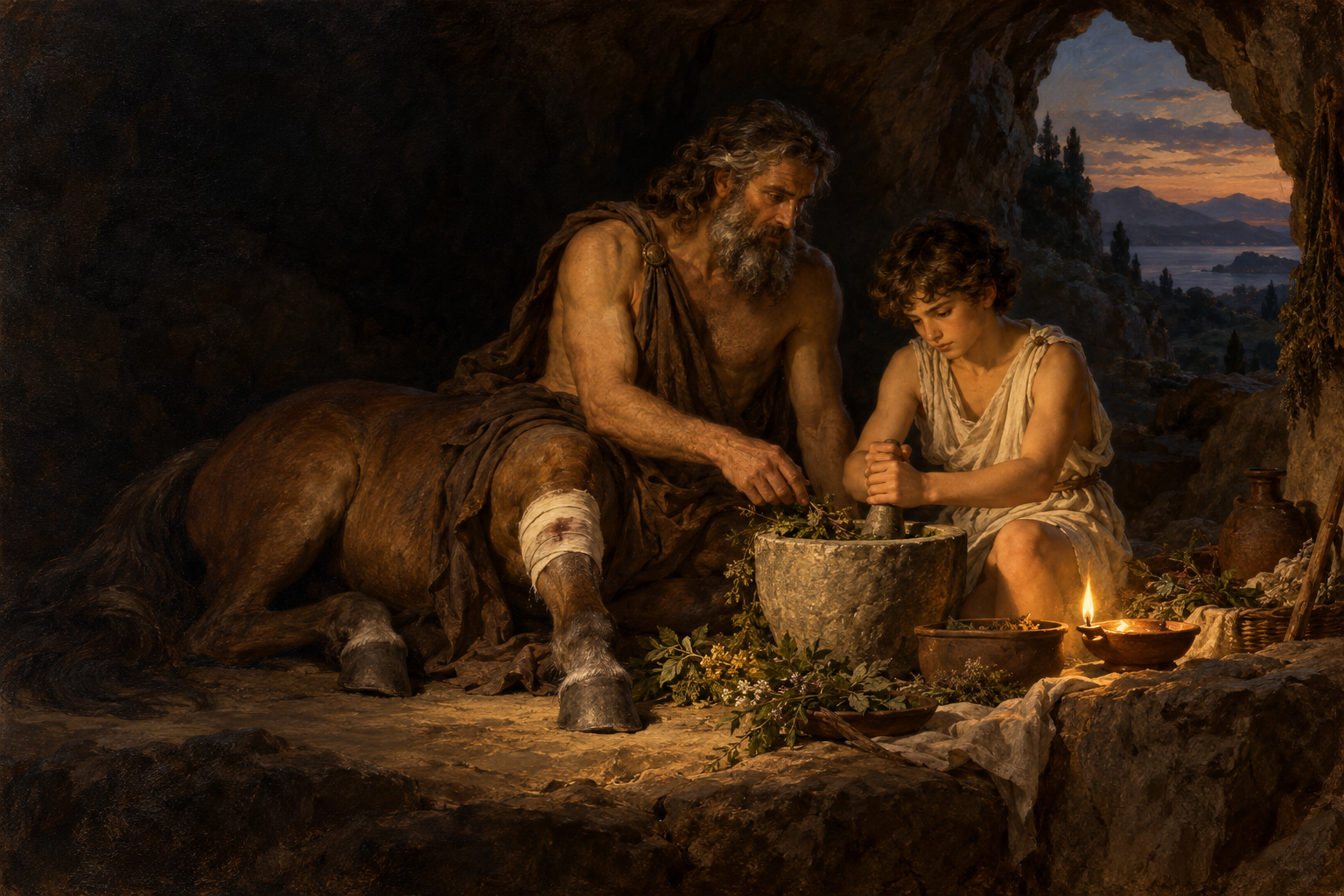
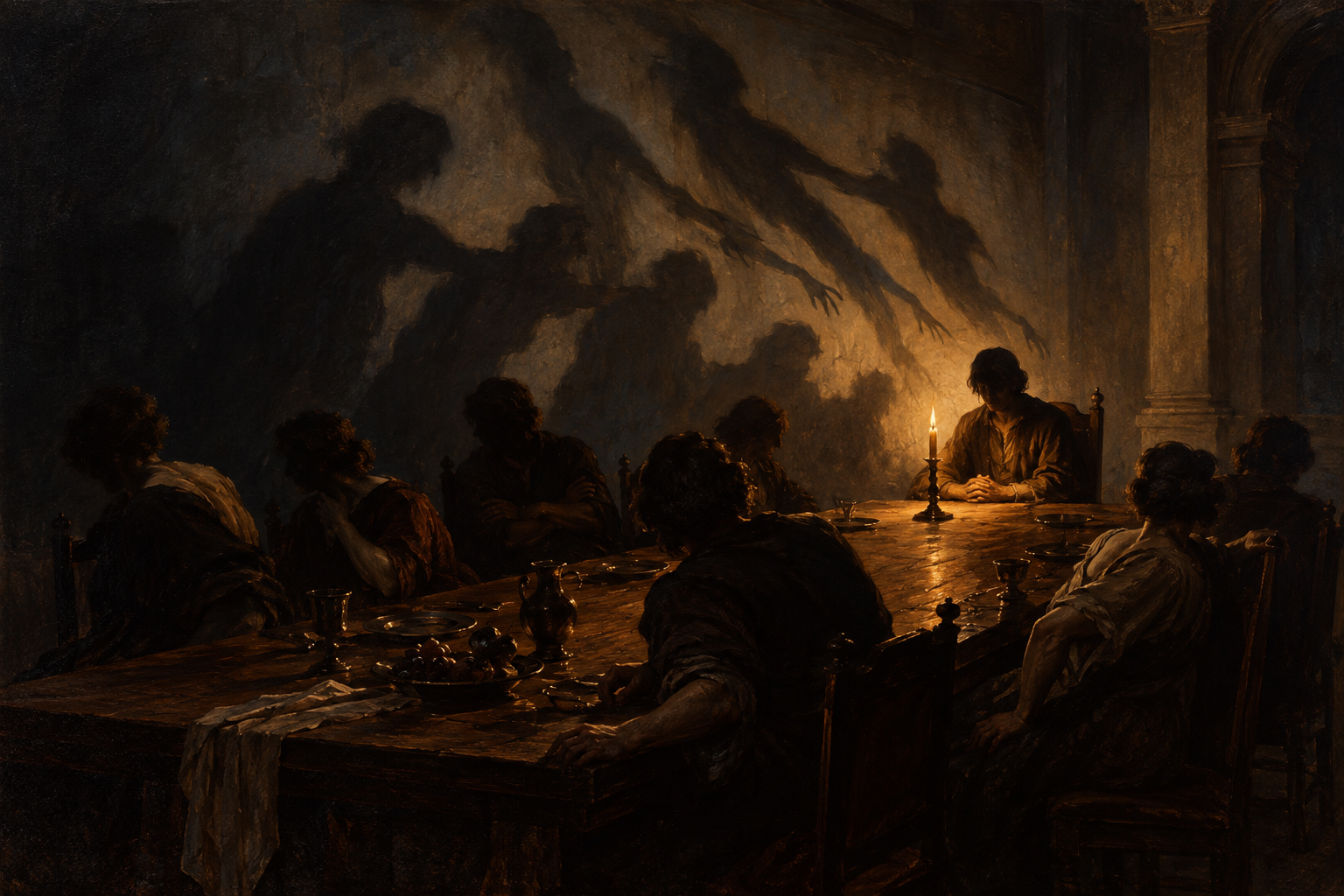
The Hero Archetype: Ego, Ordeal, and the Psychology of the Dragon Fight

The hero archetype is the psychic pattern that organizes the ego’s fight for consciousness against the pull of the unconscious. It appears wherever a person must leave safety, enter difficulty, risk destruction, and return carrying something that was not available before: knowledge, fire, a rescued captive, a slain monster, a hard truth about themselves.
That definition already puts distance between depth psychology and the version of the hero archetype most people encounter online, which tends to describe a personality type: brave, determined, resilient, willing to sacrifice. Those traits belong to the pattern, but they are surface features. Underneath them is a specific psychic drama that Jung traced through mythology, dream, and clinical observation: the struggle of ego-consciousness to free itself from the grip of the unconscious, establish its independence, and survive the inflation that independence produces.
In Symbols of Transformation (CW 5), Jung wrote that the hero myth is “an unconscious drama seen only in projection,” a drama in which the ego “struggles to free itself from the deadly embrace of the unconscious and to establish its independence.” The hero is not the ego at rest. The hero is the ego at war, and the war is against the very ground from which consciousness arose. That is why every hero myth contains both a monster and a mother, and why the monster and the mother are, at depth, the same thing.
This essay treats the hero archetype as Jung and the analytical tradition understand it: not as an inspirational poster, but as a developmental necessity with a built-in expiration date.
The dragon fight: what the hero actually does
Every culture produces hero myths, and despite enormous variation in surface detail, the structural skeleton is remarkably stable. A figure leaves home. Something must be confronted: a dragon, a sea monster, a labyrinth, a giant, an underworld. The confrontation involves risk of death. If the hero survives, something is won: treasure, a bride, fire, a kingdom, knowledge forbidden to ordinary mortals. The hero returns.
Jung reads this skeleton not as entertainment but as psychic autobiography. The “home” the hero leaves is unconscious containment: the warm, undifferentiated state in which ego and unconscious are not yet separated. This is why so many hero myths begin with an unusual birth, the child exposed in the wilderness, the foundling raised by animals, the infant hidden from a devouring king. The unusual birth signals that what is about to emerge does not belong to the old order.
The dragon, serpent, whale, or monster that the hero must face represents the regressive pull of the unconscious, what Jung frequently discusses under the image of the devouring mother. This is not a comment on literal mothers. It is a statement about a psychic force: the tendency of consciousness to slide backward into dependence, inertia, fantasy, and the comfortable darkness of not-knowing. Jung states it directly in CW 5: “The hero who clings to the mother is the dragon, and when the hero is reborn from the mother he becomes the conqueror of the dragon.”
The treasure won from the dragon is consciousness itself: differentiated awareness, the capacity to act from a center that is not simply reactive to instinct or parental programming. In Hindu mythology, the fire-bringer Matarisvan is called “he who swells in the mother,” an image Jung uses to describe the hero as someone who gestates inside the unconscious and then separates from it, carrying light.
This is why the dragon fight is the irreducible core of the hero archetype. Strip away the armor, the swords, the genre conventions, and what remains is a picture of psychological differentiation: the birth of an ego that can stand on its own, say “I,” make decisions, and bear the weight of being a separate being in a world that does not automatically protect it.
The night sea journey: the hero who goes under
Not every hero fight happens on solid ground. One of the oldest and most psychologically potent variants is the night sea journey: the hero swallowed by a whale, sea monster, or dragon, who survives by lighting a fire in the creature’s belly and cutting out its heart or vital organ.
Jung discusses this motif extensively, drawing on Leo Frobenius’ ethnographic research. The pattern is cross-cultural: Jonah in the Hebrew Bible, the Finnish hero Ilmarinen, various Pacific and African hero cycles, and the Greek descent of Odysseus to the realm of the dead (the nekyia, which gives its name to a class of psychological experience). The schema, as summarized by Jungian analyst Jolande Jacobi, follows a sequence: devouring in the west (sunset, descent, regression), sea journey (passage through the unconscious), fire-lighting in the belly (the spark of consciousness refusing to be extinguished), and emergence in the east (rebirth, new dawn, renewed awareness).
Psychologically, the night sea journey describes what happens when conscious control fails and a person is pulled into unconscious material: depression, crisis, loss of identity, the collapse of a persona that had been functioning. The “whale” is the unconscious itself. The hero’s task inside the whale is not to escape immediately but to survive the engulfment, maintain a spark of awareness, and sever the connection to what is consuming him. Jung reads the severed organ as the umbilical cord: the regressive tie to the past, to the mother complex, to the unconscious fusion that makes individual life impossible.
The night sea journey is the hero myth for people who are not fighting external enemies but internal ones: grief, addiction, breakdown, the collapse of meaning. It says that going under is sometimes part of the pattern, not a failure of it. But it also says that going under without the fire, without some preserved consciousness, is not transformation. It is drowning.
The hero as ego development: Edinger’s contribution
Edward Edinger, in Ego and Archetype (1972, Shambhala), mapped the hero myth onto a developmental sequence that clarifies what Jung’s mythological language means in a lived life.
Edinger describes the early psyche as existing in a state of ego-Self identity: the infant does not distinguish between itself and the totality of experience. This is the “paradise” that hero myths remember as the garden, the golden age, the mother’s body. Development proceeds through a cycle of inflation and alienation: the ego inflates (identifies with the Self, feels omnipotent or central) and then is humiliated back into its actual size (alienation, shame, failure). Each cycle, if navigated well, produces a more differentiated ego, one that is neither merged with the unconscious nor cut off from it but related to it across a functioning ego-Self axis.
The hero myth maps the early stages of this cycle. The dragon fight is the moment where the ego must separate from the unconscious matrix and establish itself as a distinct center of will and awareness. This is why the hero archetype is so prominent in adolescence and early adulthood: it corresponds to the developmental task of leaving the parental world, establishing competence, and proving that one can survive independently.
But Edinger’s framework also reveals what popular hero discourse usually omits: the hero pattern is not the endpoint of development. It is the early pattern. The ego that has won its freedom through heroic effort now faces a second, more difficult task: learning to relate to the unconscious without either conquering it or being swallowed by it. That task requires the King, the Sage, the capacity for sacrifice and surrender, none of which the Hero, in its pure form, can provide.
Campbell’s monomyth and its relationship to Jung
No discussion of the hero archetype is complete without Joseph Campbell, whose The Hero with a Thousand Faces (1949) introduced the concept of the monomyth: a universal narrative structure underlying hero myths across cultures. Campbell’s stages (departure, initiation, return) and their sub-stages (the call to adventure, refusal of the call, crossing the threshold, the belly of the whale, the road of trials, the ultimate boon, the return) have become so ubiquitous in screenwriting workshops and creative writing courses that many readers encounter them before encountering Jung.
Campbell was deeply influenced by Jung, and his framework is, at root, a Jungian one: the hero’s journey is a metaphor for individuation, the process of becoming psychologically whole. But Campbell popularized the structure in a way that introduced two distortions worth naming.
The first is linearity. Campbell’s stages suggest a narrative arc with a beginning, middle, and end: departure-initiation-return. In actual psychological life, the hero’s journey is not a single trip. It is recursive. A person may cross the threshold and be swallowed by the whale multiple times across a lifetime, each time at a deeper level. The midlife crisis, the vocational collapse, the spiritual emergency: these are not failures of the hero journey already completed. They are new descents that demand new capacities.
The second distortion is triumphalism. Campbell’s emphasis on the “ultimate boon” and the “master of two worlds” can imply that the hero’s journey ends in mastery. Jung’s view is more severe: the hero’s journey ends in sacrifice. The hero must die, or at least surrender the heroic attitude, for a deeper integration to occur. Clinging to the hero identity past its developmental window produces inflation, the occupational hazard discussed below.
Inflation: the hero’s occupational hazard
This is the point where depth psychology breaks most sharply from popular hero discourse, and the point most articles on the hero archetype avoid.
Jung uses the term inflation to describe a state in which the ego identifies with an archetypal image and absorbs its power, feeling larger, more important, more invulnerable than a human being actually is. The hero archetype is particularly prone to inflation because its entire movement is toward triumph. The ego that slays the dragon and wins the treasure is easily seduced into believing it is the dragon-slayer permanently: a figure exempt from ordinary limits, entitled to admiration, allergic to vulnerability.
In Symbols of Transformation, Jung writes that the hero “always he imagines his worst enemy in front of him, yet he carries the enemy within himself: a deadly longing for the abyss, a longing to drown in his own source, to be sucked down to the realm of the Mothers.” The hero’s inflation is not random arrogance. It is a compensation for an unacknowledged dependency. The louder the hero insists on independence, the more likely it is that the unconscious pull toward regression has not been honestly faced but merely overridden.
Clinically, heroic inflation looks like workaholism, compulsive self-reliance, inability to ask for help, burnout worn as a badge, relationships structured around rescue rather than mutuality, and an internal narrative in which vulnerability equals failure. It also shows up as grandiosity: the leader who cannot tolerate disagreement, the activist who confuses personal rage with justice, the parent who experiences their child’s independence as ingratitude.
The inflation is dangerous not because ambition or courage are bad, but because they have replaced consciousness. The inflated hero does not know they are inflated. They experience their position as simply correct. And because the hero pattern carries genuine archetypal energy, the inflation can be persuasive to others: charisma, conviction, and courage are genuinely attractive, which means the inflated hero often receives social reinforcement for a psychological state that is slowly becoming pathological.
Moore and Gillette: the hero as boy psychology
Robert Moore and Douglas Gillette’s King, Warrior, Magician, Lover (1990, HarperOne) makes a claim about the hero archetype that readers of popular self-help rarely encounter: the Hero is not a mature archetype. It belongs to boy psychology.
This sounds provocative, but the reasoning is precise. Moore and Gillette distinguish between immature archetypes (the patterns that organize boyhood psychology) and mature archetypes (the patterns that organize adult masculine psychology). The Hero is the most advanced immature archetype, the peak of boyhood development, the figure that mobilizes energy, will, and power so the boy can break from the mother and face the tasks of adult life. But it is still a boy’s pattern. Its shadows, the Grandstander Bully (active pole) and the Coward (passive pole), reveal what happens when the Hero’s energy is not contained by mature structure.
The Grandstander Bully is the inflated Hero: someone who uses heroic energy for display, domination, and the denial of limitation. Moore and Gillette write that the boy or man possessed by this shadow “has an inflated sense of his own importance and his own abilities. Denial of death, the ultimate limitation on human life, is his specialty.” The Grandstander Bully cannot acknowledge weakness, and therefore cannot learn. He cannot ask for help, and therefore cannot be helped. He confuses conquest with competence and audience with relationship.
The Coward is the deflated Hero: someone who has given up the fight entirely, who collapses under pressure, who allows others to dominate because the alternative, standing up, feels impossible. Beneath the Coward’s passivity is often a perfectionism that says: if I cannot win completely, I will not try at all. The Coward is not the opposite of the Hero. The Coward is the Hero who has turned his sword on himself.
The developmental task, in Moore and Gillette’s framework, is not to become a better Hero. It is to let the Hero die so that the King (ordered, sovereign, generative) and the other mature archetypes can emerge. This death is not literal. It is the surrender of the heroic attitude: the recognition that life requires not only courage but also the capacity to receive, to yield, to serve something larger than personal triumph. The man who cannot let the Hero die remains, psychologically, a boy, however impressive his resume.
The hero and the shadow: what the dragon also carries
In popular hero narratives, the dragon is the enemy. In depth psychology, the dragon is more complicated. The dragon carries the shadow: repressed fears, desires, and capacities that the ego has excluded from its self-image.
This means the hero does not simply slay the dragon. If the dragon carries the shadow, killing it means destroying the very material needed for wholeness. The hero who slays every dragon and acknowledges nothing from the underworld becomes one-dimensional: strong but shallow, brave but brittle, admired but unknown. This is the paradox at the heart of the hero archetype in Jungian thought: the hero must be strong enough to face the dragon and wise enough not to simply destroy it.
The treasure in the dragon’s cave is often described as gold, a bride, or a magical object, but in psychological terms, the treasure is the shadow content that has been guarded by fear. The fear says: do not look here, do not admit this, do not allow this. The hero’s courage creates the conditions for looking. But what happens after the looking determines whether the hero serves individuation or merely persona maintenance.
A hero who slays the dragon and takes the gold without reflection has won a battle and lost the war. The unconscious material, unintegrated, will simply reconstellate: a new dragon, a new crisis, a new enemy who looks suspiciously like the last one. The hero who engages the dragon, who asks what the monster carries, who recognizes the dragon as partly self, begins the transition from heroic consciousness to something more mature: a consciousness that can hold opposites, tolerate ambiguity, and relate to the unconscious as partner rather than enemy.
The hero in dreams
Hero imagery in dreams often signals a developmental threshold: the psyche is preparing for something that requires courage, sacrifice, or a break from the familiar. The dream may present the dreamer as a warrior, a rescuer, a figure on a journey, someone facing pursuit or combat or an impossible task. It may also present a hero figure who is not the dreamer: a companion, a guide, an admired figure who models a capacity the dreamer has not yet claimed.
The emotional tone matters as much as the content. A dream of heroic combat accompanied by exhilaration may signal genuine readiness for confrontation. A dream of heroic combat accompanied by exhaustion or futility may signal that the heroic attitude has become compulsive, that the ego is fighting when it should be listening, that “more courage” is not what the situation requires.
Dreams of failed heroism are particularly interesting from a Jungian perspective. The sword that breaks, the enemy that cannot be defeated, the rescue that fails: these images do not mean “you are weak.” They often mean the heroic approach is wrong for this particular problem. Some psychic situations require the Sage’s patience, the Lover’s vulnerability, the Magician’s indirect approach, or the King’s capacity to contain tension without acting. The dream of the failed hero may be the unconscious’s way of saying: stop fighting and start listening.
Dreams in which the dreamer becomes the dragon, or discovers the dragon is a familiar figure, or finds treasure that is strange and not immediately useful, are often signals of individuation: the ego is beginning to relate to the shadow as material rather than enemy, which is the beginning of the end of the heroic phase and the beginning of something harder and more complete.
Cultural hero worship and its psychological cost
The hero archetype is the most culturally rewarded archetype in the modern West. Business celebrates the “heroic founder.” Sports celebrates the “clutch player.” Medicine celebrates the “tireless physician.” Military culture celebrates the “selfless warrior.” Education celebrates the “transformative teacher.” In each case, the underlying message is the same: the person who sacrifices everything, who pushes past limits, who refuses to quit, who endures what would break ordinary people, is the person we should admire and imitate.
The cost is visible in aggregate. Burnout, which the World Health Organization classifies as an occupational phenomenon resulting from chronic workplace stress that has not been successfully managed, is the hero archetype in its terminal phase: the ego that fought past every limit and discovered, too late, that limits exist for biological reasons. The cultural inability to treat burnout as a structural problem rather than a personal failure is itself a symptom of hero-worship: if the heroic attitude is always correct, then exhaustion must be weakness rather than information.
The gendered dimension of this worship is worth noting. Traditional masculinity has been organized almost exclusively around the hero archetype: strength, endurance, provision, protection, emotional suppression in the service of duty. Moore and Gillette’s framework suggests that this is not mature masculinity. It is adolescent masculinity that has been culturally frozen. A society that offers men only the Hero as a model of value produces men who cannot age, grieve, depend, or receive without shame, and who experience vulnerability as a threat to identity rather than a condition of being human.
This does not mean the hero archetype should be discarded. It means it should be understood as a phase, not a destination. The Hero’s gifts, courage, will, the refusal to be passively consumed, are genuine and necessary. They become pathological only when they are treated as the entire range of human capacity.
The hero’s sacrifice: what comes after
The deepest insight in Jung’s treatment of the hero archetype is that the hero must eventually sacrifice himself. Not as a romantic gesture, and not as defeat. As a developmental necessity.
In mythic terms, this appears as the hero’s death: Baldur killed by the mistletoe, Osiris dismembered, Christ crucified, the solar hero sinking into the western sea. In psychological terms, it means the ego must surrender its identification with the heroic attitude and enter a new relationship with the unconscious, not as conqueror but as partner. The ego does not disappear. It becomes more honest about its size, its dependency, its limits, and its need for the very unconscious forces it previously fought.
This sacrifice is what Jung means by the second half of life, though the chronological boundary is loose. In the first half, the ego builds itself through heroic effort: career, identity, competence, separation from the parental world. In the second half, the ego must reverse direction: toward integration, toward the recovery of what was excluded, toward a relationship with meaning that does not depend on winning. The hero who cannot make this turn becomes a tragic figure: strong, admired, and increasingly isolated, fighting enemies that are projections of his own unacknowledged inner life.
The sacrifice is not the end of courage. It is the beginning of a different kind of courage: the courage to be ordinary, to need others, to not know, to sit with suffering instead of attacking it, to let something larger than the ego hold the center. This is what the Self offers, and it is what the Hero, by nature, cannot provide, because the Hero’s strength depends on the conviction that he, personally, is the one who must save the day.
The hero archetype is not a costume. It is a fire that forges consciousness, and like all fires, it must be tended, not worshipped. Tend it long enough to win your freedom from the dragon. Then learn to set the sword down, not because you are weak, but because you have fought hard enough to know that not every dragon needs killing, and not every darkness is the enemy.