Nietzsche’s Eternal Recurrence: The Thought That Tests Whether You’d Live Again

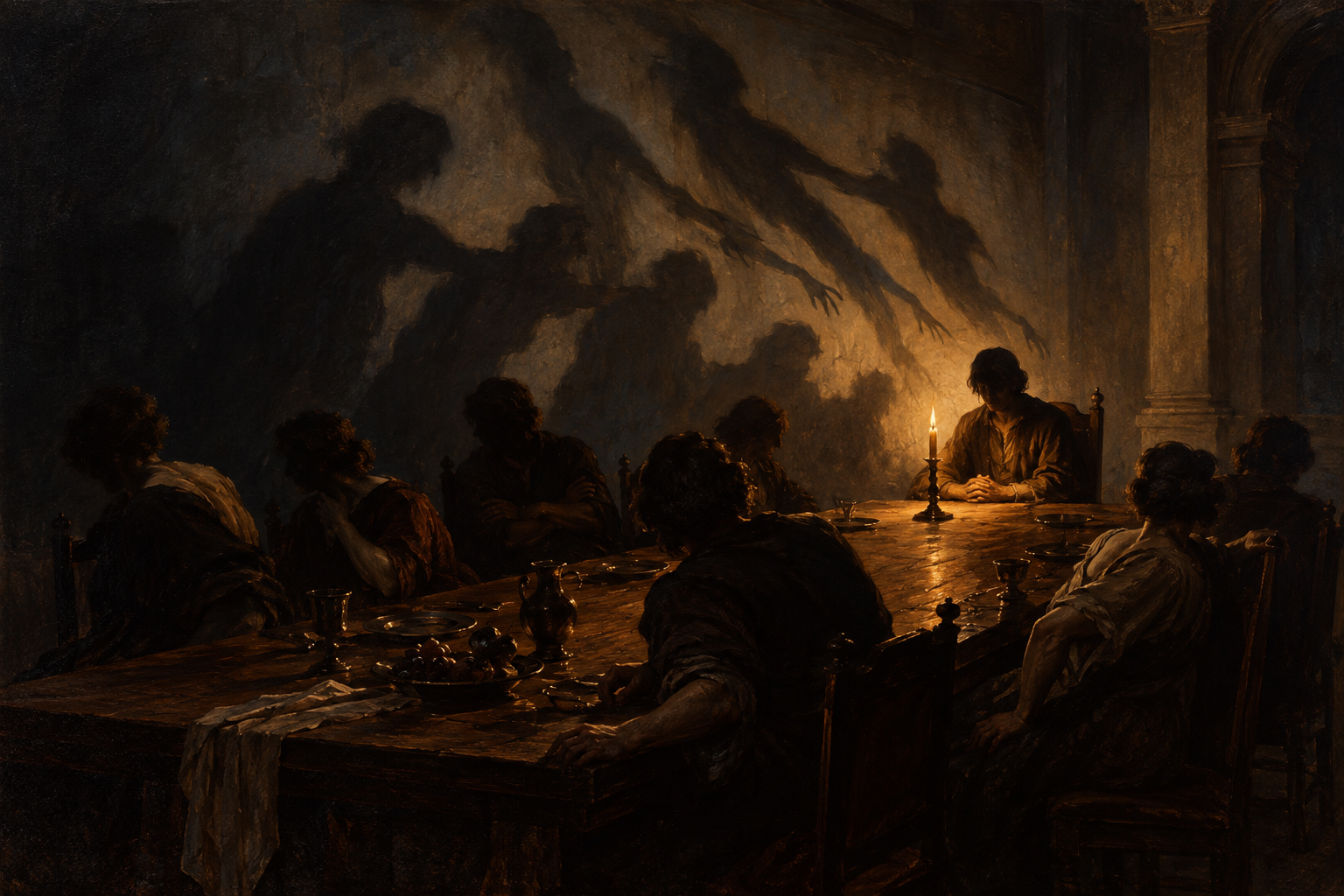
A demon slips into your room on your loneliest night and tells you that you will live this life again. Not a better one. Not a corrected one. This exact life, every joy and every humiliation, every wasted afternoon and every grief, in the same order, forever. Then he asks how you feel about it.
Nietzsche wanted to know your answer, because he thought it told him something you could not fake. This is his idea of eternal recurrence, and read carelessly it looks like a claim about how the universe works. It isn’t, or at least that isn’t where its force lives. What Nietzsche built was a way of measuring whether a person can stand to be themselves.
The passage that started it
The idea shows up in The Gay Science, section 341, under the heading “The Greatest Weight.” Nietzsche stages it as a scene rather than an argument. The demon arrives in your loneliest loneliness and tells you that everything in your life, down to the spider and the moonlight between the trees and the present moment, will return in the same sequence without end. The hourglass of existence turns over again and again, and you turn with it, a speck of dust.
Then comes the fork. Would you throw yourself down and curse him? Or was there once a moment so full that you could answer, you are a god, and I have never heard anything more divine?
That fork is the whole thing. Nietzsche isn’t asking you to solve a physics problem. He’s asking which of those two people you are.
He follows it with the line that gives the section its title. The question, laid on every action, “do you want this once more and innumerable times more,” would sit on you as the greatest weight. And then a quieter question that most summaries skip past: how well disposed toward yourself and toward life would you have to become to want nothing more than this final confirmation? That word, disposed, is doing the real work. Affirming the return is not a mood you talk yourself into. It’s a relationship to your own life that you either have or don’t.
He didn’t invent it, and the difference matters
Cyclical time was old news by 1882. The Pythagoreans, the Stoics, Heraclitus, various strands of Eastern thought had all imagined existence looping back on itself. Nietzsche knew this and said so. Borrowing the shape of the idea was never the point.
His version carries one modification that changes its whole character. The return is identical, down to the last detail. Nothing improves on the next pass. You don’t come back wiser, you come back the same, to make the same mistakes at the same moments for reasons you will find equally compelling every time.
Strip out the possibility of correction and you strip out the usual consolation of cyclical thinking, which is the promise of a fresh attempt. Nietzsche’s loop offers no second chances, only the same chance endlessly. That is why he calls it a weight and not a comfort. A life you would genuinely choose to repeat is a life you have stopped wishing were different. Most people have not stopped, and the demon knows it.
The cosmological argument is the weakest and most disposable part of Nietzsche’s wider philosophy.
Did he actually believe it was true?
Here the honest answer is that Nietzsche scholars have argued about this for a century and have not settled it. If someone hands you a confident yes or no, they’re flattening a real dispute.
There are roughly three positions.
The literal reading, associated with Arthur Danto, takes Nietzsche at his most cosmological. In his unpublished notebooks he sketched something like a proof: energy is finite, time is infinite, so the number of possible configurations of the universe must eventually run out and start repeating. Given enough time, every arrangement recurs, including this one, including you reading this sentence. It’s a real argument. It also doesn’t survive contact with modern physics, and Nietzsche never published it, which tells you something about how much weight he was willing to put on it in his own voice.
The metaphorical reading, most associated with Alexander Nehamas, says the cosmology is beside the point. The recurrence is a device for thinking about your life, an instruction to live as though every act would repeat infinitely, so that the question “would I want this again” becomes the test you apply to how you’re living now. On this view the universe can loop or not, and the thought works either way.
The third position, argued by Paul Loeb, complicates the tidy consensus that Nietzsche kept it allegorical. Loeb points out that most scholarship underreads Thus Spoke Zarathustra, the book Nietzsche considered his most important, and the one place the recurrence gets sustained treatment. In Zarathustra the idea is presented much more like a metaphysical fact than a thought experiment. Zarathustra’s animals describe him dying and returning, entangled in the same knot of causes, coming back to this identical life in the greatest things and the smallest, to teach the eternal recurrence again. That is not the language of a mere hypothetical.
My read, for what it’s worth: the argument over literal truth is the least interesting thing about the idea, and chasing it is how people avoid the part that actually implicates them. Whether or not the cosmos repeats, the test does its work the moment you take the question seriously. The demon doesn’t need to be real to ruin your evening.
What the idea is actually for
Set the metaphysics aside and the recurrence becomes something sharper than any doctrine about time. It sorts people.
Bring the demon’s question to someone who is quietly running from their life, medicating it, postponing it, waiting for the part where it finally starts, and the answer is despair. Repeat all of this, unchanged, forever? The thought is unbearable because the life is already unbearable and only the hope of eventual escape has been holding it together. Recurrence removes the escape hatch.
Bring the same question to someone who has made a kind of peace with what their life has actually been, including the parts that went wrong, and the words land completely differently. Not as a sentence but as a confirmation. Yes, this, again. The philosopher Bernard Reginster and others have described the recurrence as a litmus test for the capacity to affirm life, and litmus is the right word. It doesn’t argue you into affirmation. It reveals whether the affirmation is already there.
This is why Nietzsche ties it so tightly to the question of self-knowledge. You cannot fake your way past the demon. You can tell other people you’re happy, you can tell yourself, but the gut response to “all of it, forever, exactly the same” comes from somewhere underneath the stories you maintain. That response is the reading he’s after.
Amor fati, the disposition that passes the test
Elsewhere in The Gay Science Nietzsche names what makes a yes possible. Amor fati, love of fate. He writes that he wants to learn to see as beautiful what is necessary in things, to become one of those who make things beautiful, and eventually to be only a yes-sayer.
It’s easy to soften this into gratitude or positive thinking, which it is not. Amor fati is not being thankful for suffering and it is not pretending pain was secretly good. It’s the refusal to wish any single piece of your life away, and the refusal has structure to it. Your life is not a list of separable events you can keep or discard individually. Pull one thread, the humiliation you’d most like to delete, and you unravel everything downstream of it, including whoever you became partly because of it. To wish the bad parts gone is to wish yourself gone and someone else in your place. Amor fati is what it feels like to stop doing that.
The recurrence and amor fati are two views of one thing. The recurrence is the test. Amor fati is the disposition that passes it.
The part the philosophy blogs miss: recurrence as shadow work
Here is where Nietzsche and Jung, who rarely get read together, turn out to be describing the same wall from opposite sides.
The person who can’t affirm their life is usually not the person with the worst life. It’s the person carrying the most that they refuse to claim as theirs. Jung had a name for that refused material: the shadow, everything about yourself you’ve disowned, pushed out of sight, decided wasn’t really you. The cruelty you’re capable of. The desire you’re ashamed of. The failures you’ve quietly filed under “that wasn’t the real me.” The shadow isn’t only the dark stuff, either. Sometimes it’s disowned strength, the capacity you won’t admit to because owning it would demand something.
Now put the demon’s question next to that. Would you live all of it again, exactly, forever? You cannot answer yes while still holding half of yourself at arm’s length. The parts you’ve split off don’t get a pass in the loop. They recur too. So a genuine yes to eternal recurrence turns out to require exactly what Jung meant by integration: you stop dividing your life into the chapters you’ll sign your name to and the ones you pretend happened to somebody else.
This reframes the whole exercise. The reason most people flinch at the demon is not that their lives were objectively terrible. It’s that affirming the whole life means affirming the whole self, shadow included, and that is precisely the thing the ego is organized to avoid. Nietzsche’s greatest weight and Jung’s shadow integration are the same demand in different vocabularies. Say yes to the eternal return and you have, in psychological terms, taken back everything you exiled.
Which also explains why the yes is rare and why Nietzsche treated it as an achievement rather than a preference. It isn’t a matter of deciding to be positive. It’s the end state of having done the work of becoming whole, and most people are somewhere in the middle of that work, or haven’t started, and the demon simply reads the meter.
How to actually use it
Nietzsche meant the recurrence to change decisions, not just to be admired. Used as a filter it’s disarmingly practical. Before an action, ask whether you would will it to repeat forever.
The example philosophers reach for is deliberately small. A writer sits deciding whether to work on the book or watch television. Under normal weighting it barely matters, an hour either way. Under the recurrence it acquires enormous significance, because you are not choosing this hour, you are choosing an hour that will repeat without end. Suddenly the trivial choice reveals what you’re actually building your life out of.
Run your ordinary days through that filter and it exposes the gap between what you tolerate and what you would choose. The commute you resent, the relationship you keep meaning to leave, the version of yourself you perform at work, all of it gets asked the same question: this, again, forever? The point isn’t to torture yourself into productivity. It’s that the recurrence is a startlingly honest instrument for telling the difference between a life you’re living and a life you’re merely enduring until further notice.
I’d keep the self-help register restrained, though, because the idea is stronger than its life-optimization applications. Nietzsche wasn’t offering a productivity hack. He was asking whether you can bear the truth about your own existence, and the everyday uses are downstream of that harder question, not a replacement for it.
What it is not
A few misreadings recur often enough to be worth clearing.
It is not reincarnation. No soul travels anywhere. There is no learning across lives, no karmic progress, no next time that’s different. It’s the same life, not a further one.
It is not fatalism. This trips people up, because “everything repeats” sounds like “nothing you do matters.” The reverse is closer to Nietzsche’s point. Because the moment repeats, the moment matters infinitely. Recurrence doesn’t dissolve your choices, it raises the stakes on them to the maximum.
It is not literal physics, or at least it doesn’t need to be. The cosmological argument is the weakest and most disposable part. The test survives its collapse intact.
And it is not about being happy. A pleasant life is not automatically an affirmable one, and a hard life is not automatically unaffirmable. Nietzsche, whose own life held chronic illness, isolation, and very little recognition, is the case in point. The question is not whether your life felt good. It’s whether you can say yes to it as it was.
The wager he leaves you with
The demon is still standing in the room. That’s the thing about the thought experiment, it doesn’t resolve, it just waits for your answer.
If the prospect of living your exact life again, unchanged and forever, makes you want to gnash your teeth and curse, that reaction is information. Not a verdict on whether your life has been hard, but a reading of how much of it you’ve actually accepted as your own. And if somewhere in you there’s a moment full enough that you could call the demon a god and mean it, then you’ve felt, at least once, what Nietzsche spent his whole philosophy trying to make possible.
The question was never really about the universe repeating. It was about whether you can bear to be who you are. Everything else is commentary.
Frequently asked questions
What is Nietzsche’s eternal recurrence in simple terms?
It’s a thought experiment. Imagine you had to live your exact life over and over, infinitely, with nothing changed. Nietzsche uses your reaction to that prospect as a test of whether you can truly affirm your life. Delight means yes; horror means no.
Did Nietzsche believe eternal recurrence was actually real?
Scholars disagree. He sketched a cosmological argument for it in his private notebooks but never published it in his own voice, and it doesn’t hold up under modern physics. Most read it as a thought experiment rather than a literal claim, though some argue that in Thus Spoke Zarathustra he treated it as a metaphysical fact. The test works either way.
What’s the difference between eternal recurrence and reincarnation?
Reincarnation moves a soul into a new life, often with the possibility of progress or learning. Eternal recurrence has no soul travel and no new life. It’s the same life, identical in every detail, repeating without change. Nothing is carried forward or improved.
What does amor fati have to do with eternal recurrence?
Amor fati, love of fate, is the disposition that lets you say yes to the recurrence. It means refusing to wish any part of your life away, because every part is tied to who you became. The recurrence is the test; amor fati is what passing it feels like.
Where did Nietzsche write about eternal recurrence?
The main passage is The Gay Science, section 341, titled “The Greatest Weight.” Its most sustained treatment is in Thus Spoke Zarathustra. Additional discussion appears in his unpublished notebooks.