The Trickster Archetype: Meaning, Myth, and the Psychology of the Rule-Breaker

On the day Hermes was born he climbed out of his cradle, found the cattle of Apollo, and stole fifty of them, walking them backward so their tracks pointed the wrong way. He invented theft and the cover-up in a single morning. He was a few hours old. When Apollo tracked him down, the infant lied with such style that the dispute went all the way up to Zeus, who heard the case and could not stop laughing. Then Hermes handed Apollo a lyre he had built that same day from a tortoise shell, and the furious god forgave him on the spot.
That is the archetype in its purest form. Every other figure in the human imagination serves order in some way. The hero defends it, the ruler keeps it, the sage explains it, the caregiver tends it. The trickster is the one who exists to break it, and the strange thing, the thing the Hermes story understands, is that we love him for it. A world whose rules can never be punctured turns brittle and dies. The trickster is how the imagination keeps that from happening.
This is the most misread of all the archetypes, treated as a villain, a comic sidekick, or a personality-quiz label. He is something stranger and more important than any of those. Here is what the trickster actually is, where he appears across every culture on earth, what Carl Jung saw in him, and how he operates inside your own life, usually at the exact moment you least want him to.
What the trickster archetype is
The trickster is the boundary-crosser. He lives at thresholds, crossroads, doorways, and edges, in the gap between every pair of categories a culture takes for granted. Sacred and profane, animal and human, male and female, living and dead, truth and lie. Wherever there is a line, the trickster is the one who steps over it, smudges it, or reveals that it was painted on.
His tools are wit, disguise, and appetite. He lies, steals, shapeshifts, and seduces, and he does it less from malice than from a kind of bottomless hunger and curiosity. This is the first thing most people get wrong. The trickster is not evil. Evil requires a settled intention to harm, and the trickster rarely has a settled anything. He is amoral rather than immoral, operating beneath good and evil the way a small child or a clever animal does, which is why so many trickster figures are animals or half-animals.
He is also, crucially, double. The trickster creates and destroys in the same gesture. He is fool and genius, dupe and con man, the one who sets the trap and the one who walks into it. Hermes is the god of thieves and the god of travelers who protects against thieves. Loki gives the gods their greatest treasures and engineers their doom. This doubleness is not a flaw in the pattern. It is the pattern. The trickster holds opposites together that the rest of the culture insists on keeping apart, and that is precisely his function.
It helps to separate him from the figures he gets confused with. The fool is innocent and gets hurt by his own naivety, dreaming as he walks toward the cliff edge. The trickster knows exactly where the cliff is and is thinking about who he can push off it, or whether he can sell tickets. The villain wants power and works to seize it. The trickster has no interest in holding power, only in deflating anyone who does. The rebel fights the system to replace it with a better one. The trickster has no better system in mind and would mock yours too. He is not against order on principle. He is against any order that has forgotten it is provisional.
The trickster lives in every culture on earth
You cannot find a mythology without one. That fact alone tells you the trickster is not a local invention but something built into the way human beings imagine, which is exactly what Jung meant by an archetype. The figures change costume from one part of the world to another, and underneath the costume the same impossible creature keeps reappearing.

In Greece he is Hermes, messenger of the gods, guide of the dead, patron of merchants, liars, and anyone who crosses a border. The Greeks also gave him a mortal cousin in Odysseus, the man of many turns, who wins by cunning where other heroes win by strength, and a rebel-benefactor version in Prometheus, who steals fire from the gods and hands it to humanity, paying for the theft with his liver for eternity.
In the Norse world he is Loki, blood-brother to Odin, a shapeshifter who has been a salmon, a fly, a mare who gives birth to an eight-legged horse. Loki talks the gods out of trouble as often as he talks them into it, and his mischief escalates across the myths until he arranges the death of the beloved god Baldr and is bound beneath the earth with venom dripping on his face, waiting to break loose at the end of the world. The Norse understood something dark about the trickster that the comic versions soften. Let him run long enough and the joke turns serious.
West Africa gave the world two of the greatest. Anansi the spider, from the Akan people of Ghana, tricked the sky god out of all the stories in existence, which is why stories are sometimes still called spider stories, and carried his cunning across the Atlantic in the memory of enslaved people, where he became Aunt Nancy and stands behind Br’er Rabbit, the small clever creature who survives a brutal world by outwitting the strong. Among the Yoruba there is Eshu, the divine messenger who stands at every crossroads and tests everyone who passes. One of his oldest stories has him walking down the boundary between two friends’ fields wearing a hat that is red on one side and black on the other, so that each friend sees a different color and they fall to fighting over what they saw. Eshu does this to remind them that the truth has more than one side, and that their certainty was always a kind of blindness.
Across Native North America the trickster is everywhere and goes by many names. Coyote in the Southwest and the Plains, who brings fire and shapes the world and also gets himself killed by his own greed in story after story, only to wake up and do it again. Raven on the Pacific Northwest coast, who steals the sun, moon, and stars from the box where a selfish chief hoarded them and releases light into the world. Iktomi the spider among the Lakota. And Wakdjunkaga among the Winnebago, the figure at the center of the cycle that would catch Carl Jung’s attention.
The pattern keeps going. In Polynesia, Māui snares the sun to slow the day, fishes whole islands up from the sea, and steals fire for humanity before dying in his final attempt to defeat death itself. In China, Sun Wukong the Monkey King masters seventy-two transformations and wreaks such havoc in heaven that it takes the Buddha himself to contain him. Medieval Europe had Reynard the Fox, who humiliates the wolf and outmaneuvers the lion-king, and Till Eulenspiegel, the wandering prankster who takes every instruction literally to expose how foolish the instruction was. Europe also kept the trickster alive in ritual, in the Lord of Misrule who ruled the Christmas revels, the Feast of Fools that turned the church hierarchy upside down for a day, and the court jester, the only person permitted to tell the king the truth because he wrapped it in a joke.
That last detail is the key to the whole survey. The jester could say what no advisor dared because the joke made the truth survivable. Every culture builds a licensed rule-breaker into its structure, a sanctioned space where the sacred can be mocked and the order inverted, precisely so that the order does not have to pretend it is absolute. The trickster is the pressure valve a civilization installs in itself.
What Carl Jung said about the trickster
Jung wrote his major statement on the figure in 1954, a commentary on the anthropologist Paul Radin’s study of the Winnebago trickster cycle. It is one of his most vivid pieces of writing, because the material gave him something to push against.
The Winnebago Wakdjunkaga, Jung observed, is barely a person at all. In the early episodes of the cycle he is so unintegrated that his own body parts act independently. His left hand and his right hand get into a fight and wound each other while he watches, helpless, as though the two halves of him had never been introduced. He carries his enormous intestines wrapped around his body. He does atrocious things, not from cruelty but from sheer unconsciousness, with no sense that other people are real or that actions have consequences. Jung read this as a portrait of an extremely early state of mind, a consciousness that has hardly separated itself from the animal, from instinct, from the undifferentiated flux of the unconscious. The trickster is what the psyche looked like before the ego pulled itself together.
But the cycle does not leave him there. Across its episodes Wakdjunkaga slowly grows more coherent, more human, more capable of relationship and restraint, until by the end he performs genuine acts of creation and benefit for the people who will come after him. Jung saw in this arc a compressed myth of the evolution of consciousness itself, the long climb out of instinctual darkness toward awareness. The trickster carries, folded inside his foolishness, the latent form of the savior, the culture hero he will eventually become. The same figure who gets his head stuck inside an elk skull also brings fire to humanity.
For Jung the trickster was above all a collective shadow figure, the sum of all the inferior, undeveloped, and disreputable traits that individuals would rather not own. This is why the figure is so durable and so beloved. He carries, in a form we can laugh at, everything we have disowned in ourselves. Jung pointed to the way the medieval church could not suppress the trickster spirit but had to give it a sanctioned outlet in the carnival and the Feast of Fools, because the more solemn and one-sided a culture’s official ideal becomes, the more energy collects in the shadow it refuses, and that energy will find a way out. The trickster is what comes up to compensate whenever a civilization takes itself too seriously. He surfaces again in alchemy as Mercurius, the slippery, shapeshifting spirit Jung spent years studying, the god of transformation who is also a deceiver, and in Christian thought as the Devil cast in the old role of the ape of God, the mocking imitator.

Jung made one observation about the trickster’s function that matters more than any other, and it is the part the listicles miss completely. The trickster can reveal a situation but he cannot resolve it. His role is to expose, to puncture, to show you the truth of where you stand, especially the truth your pride has been hiding from you. He deflates inflation. He humiliates the part of you that has gotten too pleased with itself, and that humiliation, painful as it is, returns you to reality and to humility, which is the ground any real development has to start from. The trickster brings the problem into the light. Finding the problem, as Jung knew, is already half of the cure. We trace where that work leads in our guide to individuation, the long process the trickster so often kicks into motion.
The trickster and the shadow
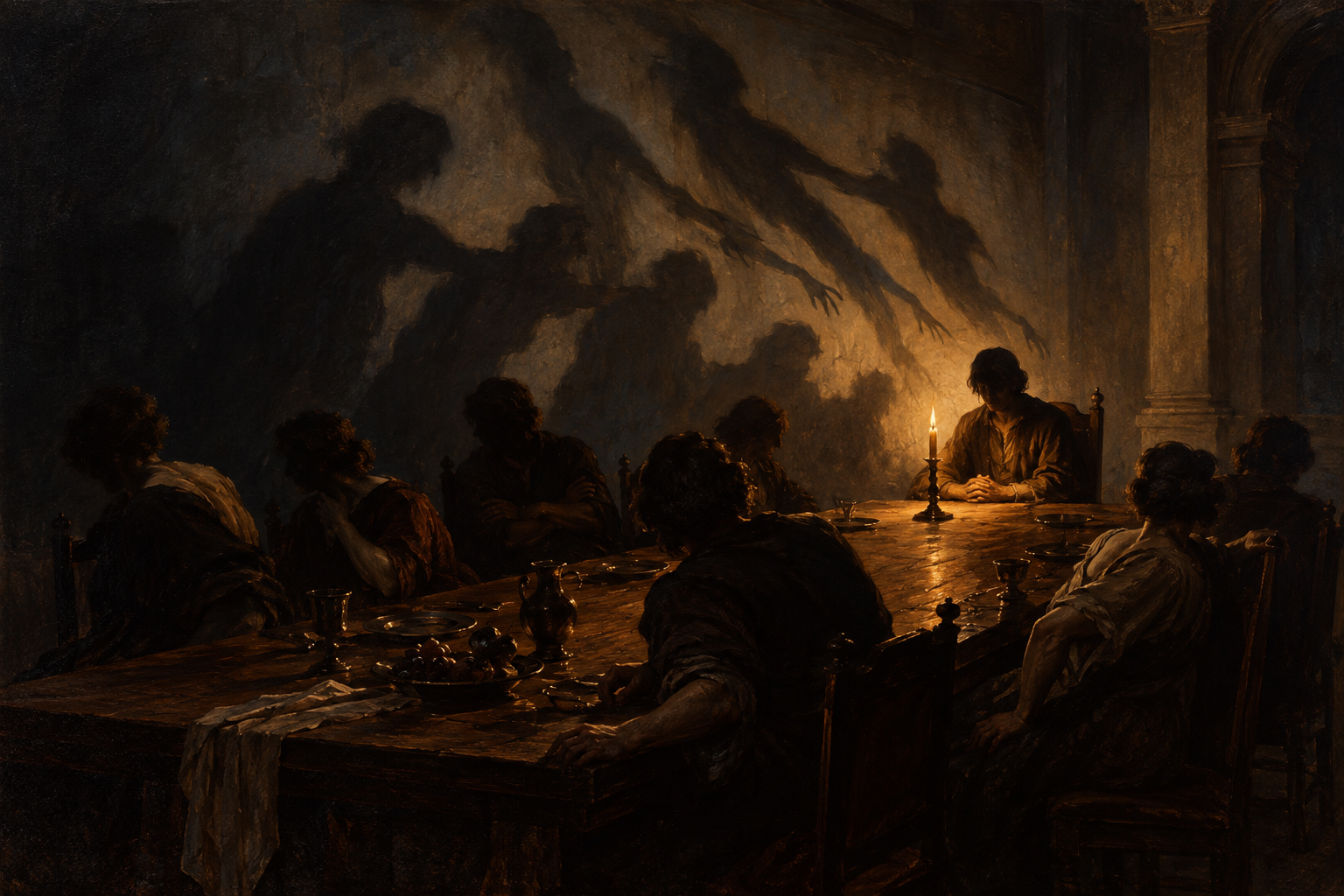
If you spend time in Jungian circles you will hear that the trickster is an aspect of the shadow, and that is right as far as it goes, though it needs refining. The shadow is everything you have pushed out of your conscious self-image, the whole disowned basement of the personality. The trickster is the shadow in a particular mood. He is the shadow when it stops sulking in the dark and starts acting, autonomously, mischievously, with an intelligence of its own.
This is what makes him feel uncanny when he shows up. The trickster is the part of the unconscious that seems to have its own agenda, that operates as if it were a separate person living inside you. Jung had a precise term for this, the autonomous complex, a cluster of psychic energy that splits off and behaves like a second personality. When a complex like this takes the wheel, you do not decide to act. You watch yourself act, the way Wakdjunkaga watched his hands fight, and afterward you say the most honest sentence in the language: I don’t know what came over me. Something came over you. The trickster did. And the more rigidly your conscious personality insists on being good, controlled, and respectable, the more lively and disruptive the figure waiting in the basement becomes.
The trickster inside your own life
Here is where the archetype stops being a topic and becomes uncomfortably personal, because the trickster does not stay in the myths. He works in you, and you can learn to recognize his fingerprints.
He is the slip of the tongue that says the thing you were carefully not saying. He is the joke you crack at the funeral, the worst possible moment, because some part of you cannot bear the solemnity and has to puncture it. He is the strange coincidence that arrives exactly when you needed disrupting, the lost keys on the morning of the interview you secretly did not want. He shows up wherever your conscious will and your unconscious life are pulling in opposite directions, and he always sides with the unconscious.

His most painful form is self-sabotage. You build the relationship, the career, the carefully managed life, and then some part of you reaches out and knocks it over, and you cannot explain why. The standard reading is that something in you is broken. The trickster reading is more interesting and more useful. Ask what you had built. Very often the thing the trickster wrecks is a life that had become a performance, a persona so complete and so airless that the rest of you could no longer breathe inside it. The sabotage is crude and it costs you, but it is also a refusal, the unlived part of you staging a jailbreak from a cage you built yourself and called a life. We wrote about this collision in detail in the psychology of self-sabotage and in the war you wage against your own potential. The trickster is frequently the one lighting the fuse.
This does not make the destruction good. It makes it meaningful, which is different. The work is not to celebrate the trickster or to suppress him, both of which fail. It is to start listening to him before he has to resort to demolition. When you notice the impulse to blow something up, the question worth asking is not how to stop the impulse but what truth it is pointing at. What has become false. What you have outgrown and refused to admit. The trickster only gets violent when he has been ignored for years.
Why a psyche, and a culture, needs him
It would be easy to treat the trickster as a problem to be managed. That would be a mistake, and the cultures that built him into their festivals understood why.
A system that cannot be disrupted cannot change, and anything that cannot change is already dying. This is true of a society and it is true of a self. The trickster is the principle of change wearing a grin. He is the necessary solvent that keeps structures from hardening into tombs. The writer Lewis Hyde, in the best modern study of the figure, makes the case that the trickster is the origin of culture’s creativity, the one who works with what the society has thrown away, who crosses the boundaries that everyone else treats as walls, and who in doing so opens the new road.

The artist, the satirist, the inventor, and the reformer are all trickster-descended, all people who refused to accept that the existing categories were the only ones possible.
Inside a person the function is the same. The trickster deflates the pompous, punctures the persona, and breaks the spell of your own self-importance, and that deflation, humiliating as it feels, is what keeps you honest and human. A psyche with no trickster is a psyche that has taken its own mask for its face. The figure that wrecks your dignity is also the one preventing you from becoming a monument to yourself.
So the question of whether the trickster is a good archetype is the wrong question, the way asking whether fire is good is the wrong question. He is the agent of change, and change saves and destroys depending on what it meets and how you meet it. What you can say is that a life with no room for him goes brittle, and a life that lets him run unchecked goes to ruin, and wisdom is the narrow art of keeping him in the room without handing him the keys.
The trickster in literature and film
Once you know the shape, you see him everywhere in stories, because storytellers reach for him whenever they need to inject mischief, truth-telling, or change into a plot.

Shakespeare loved the figure. Puck scrambles the lovers in A Midsummer Night’s Dream and ends the play winking at the audience. The Fool in King Lear is the only one allowed to tell the king he is a fool, the jester’s ancient license at work. Falstaff is a whole philosophy of misrule in one enormous body, and Autolycus in The Winter’s Tale is a pickpocket who sings while he robs you. Behind them stands the older literary tradition of the picaresque, the rogue’s tale, where a clever low-born survivor lies and schemes his way through a corrupt world and exposes its hypocrisy by refusing to play along, a line that runs straight to Huckleberry Finn and his conning companions the Duke and the Dauphin.
Modern screens are full of him, often without the writers knowing his lineage. The Joker is the trickster turned malignant, the principle of disruption with the saving grace removed, chaos that has forgotten it was ever in service of anything. Captain Jack Sparrow is the trickster as charming survivor, always escaping, never quite trustworthy, somehow always necessary. The Genie in Aladdin is Hermes with Robin Williams’s voice, a shapeshifting servant of transformation. Tyler Durden in Fight Club is the trickster as the eruption of everything a careful man repressed. Loki on film carries his own mythological name and most of his original ambiguity. Bugs Bunny is Br’er Rabbit with a Brooklyn accent, the small clever creature who always outwits the gun. The Cheshire Cat, Beetlejuice, Willy Wonka, Q tormenting Picard across the galaxy, Saul Goodman lawyering his way through the gaps in the rules, Fleabag breaking the fourth wall to pull you into her conspiracy, Mr. Nancy and Mr. Wednesday in American Gods who are simply Anansi and Odin walking around in suits. The costume is contemporary. The creature underneath is four thousand years old.
For anyone writing one, the secret is the doubleness. A trickster who is only chaotic is exhausting, and a trickster who is only charming is a con that wears thin. The figure works when his mischief reveals something true, when the lie he tells exposes a deeper lie everyone else agreed to, when the destruction he causes clears the ground for something that needed to grow. Give him a function and he becomes unforgettable. Give him only mayhem and he becomes noise.
Common questions about the trickster archetype
What is an example of the trickster archetype?
Hermes is the clearest mythological example, the god of thieves, travelers, and boundaries who steals Apollo’s cattle on the day he is born. Other major examples include Loki in Norse myth, Anansi the spider in West African tradition, Coyote and Raven among Native American peoples, the Monkey King Sun Wukong in China, and Māui in Polynesia. In modern stories, the Joker, Captain Jack Sparrow, Bugs Bunny, and Loki on film all carry the pattern.
What did Carl Jung say about the trickster?
Jung, in his 1954 commentary on Paul Radin’s study of the Winnebago trickster, described the figure as a portrait of an early, undifferentiated state of consciousness barely separated from instinct, and as a collective shadow figure carrying the disowned traits of a whole culture. He emphasized that the trickster reveals a situation but cannot resolve it, that he deflates inflation and returns us to humility, and that he carries the latent form of the savior inside his foolishness.
Is the trickster a good archetype?
He is neither good nor bad in himself, which is the point. The trickster is the principle of change and disruption, and change can heal or destroy depending on what it meets. A psyche or a society with no room for him grows rigid and dies, and one that lets him run unchecked falls into ruin. His value is real and so is his danger.
What is the purpose of the trickster archetype?
To break what has hardened, puncture false certainty, and keep a system, whether a culture or a self, capable of change. He exposes the truth that pride conceals, deflates self-importance, and clears the ground for transformation. The court jester telling the king the truth through a joke is the function in miniature.
What is the difference between the trickster and the fool?
The fool is innocent and naive and tends to harm himself through cluelessness, walking cheerfully toward the cliff. The trickster is cunning and aware, and his disruptions are deliberate. The fool is acted upon. The trickster acts.
Is the trickster the same as the shadow?
He is an aspect of the shadow, specifically the shadow in its active, autonomous, mischievous mode. The shadow is everything you have disowned. The trickster is that disowned material when it stops hiding and starts acting on its own, often taking the wheel before you realize what is happening.
What is the rarest Jungian archetype?
There is no fixed ranking, since archetypes are universal patterns rather than personality slots people are sorted into, and the popular “rarest archetype” idea comes mostly from branding and quiz culture rather than Jung. Within the more clinical eightfold model developed by the Jungian analyst John Beebe, the trickster is counted among the harder-to-access shadow positions, which may be why people experience it as elusive.
The figure who wrecks your dignity is the same one keeping you from becoming a monument to yourself. Learn to hear him before he reaches for the dynamite, and the trickster turns from saboteur into the truest voice you have. For the larger map of the psyche he disrupts, read our guide to individuation and our collection of Carl Jung quotes.
Sources and further reading: C.G. Jung, On the Psychology of the Trickster Figure (1954), his commentary in Paul Radin, The Trickster: A Study in American Indian Mythology, with a contribution by Karl Kerényi. Lewis Hyde, Trickster Makes This World: Mischief, Myth, and Art (1998). On the eightfold type model, John Beebe, Energies and Patterns in Psychological Type. The Homeric Hymn to Hermes, for the cattle theft and the invention of the lyre.