The Wounded Healer Archetype: How Your Own Pain Shapes the Help You Give
The wounded healer archetype describes a helper whose own suffering shapes how they understand and answer someone else’s. Jung’s version of the idea comes with a condition: the wound stays useful only while the helper keeps examining how the other person’s pain touches it.
Most people meet the pattern long before they meet the name. Someone who lost a parent at thirty often knows what to leave out when a friend’s father dies, the questions about how it happened and the promise that it gets easier. They send messages that ask for no reply. A few months later the friend starts grieving in a way that looks wrong to them, too fast or too publicly, and the person who listened so well begins to press.
The history that helped them listen is now making it hard to hear a grief that runs differently from theirs. Jung’s remarks on the analyst’s own hurt point at the same difficulty, and it sits behind most of the ways the pattern goes wrong between friends and partners.
What is the wounded healer archetype?
The wounded healer archetype is a pattern in which the capacity to help and the need for help live in the same person, and both are in play whenever that person helps someone else. In Jungian terms an archetype is an underlying pattern that shows up in stories and in relationships, and this one appears wherever people tend each other’s pain, in consulting rooms and at kitchen tables.
The phrase now has two common uses. Self-help writing uses it for someone who turned a painful experience into service, and the question there is what a person made of their past. Analytical psychology asks how that past takes part in a relationship happening now, between this helper and this person. The two overlap, and the second is the question Jung cared about.
A teacher who was humiliated in front of her class as a child may take care never to correct a struggling pupil in public. The same memory can lead her to read every impatient colleague as a bully. Her history tells her what to watch for, while each colleague still has to be judged on what he does.
The term has no clinical standing. It is a frame for reading relationships, and you can find its question useful without adopting the label as an identity. Calling yourself a wounded healer says nothing about whether your influence on a particular person is good, and the term is most useful when it sends you to look at exactly that.
What did Jung say about the wounded healer?
Jung held that a therapist’s own hurt is part of what makes deep treatment work, and that the hurt has to be examined continually for that to stay true. In the passages most often quoted his phrase is the “wounded physician”. By the mid-1970s the English phrase “wounded healer” headed work on two separate tracks: Henri Nouwen’s book on Christian ministry (1972) and C. Jess Groesbeck’s paper in the Journal of Analytical Psychology (1975).
The central passage is in “Fundamental Questions of Psychotherapy” (1951), in volume 16 of the Collected Works. Jung estimates that a good half of any treatment that goes deep consists of the doctor examining himself, then writes that “it is his own hurt that gives the measure of his power to heal” (par. 239). Two paragraphs earlier he allows that a patient’s resistance may show the treatment rests on false assumptions (par. 237). In context, the passage is also a warning about the doctor’s certainty.
The line people quote most comes from Memories, Dreams, Reflections, published after his death: “Only the wounded physician heals” (p. 134 in the 1963 Pantheon edition). Jung sets it in quotation marks, as a saying, and moves straight on to the opposite case, a doctor whose personality works like armour and has no effect on the patient. A longer version on quote sites adds a clause about the physician first healing himself. The clause is missing from the passage.
In both places the healing power sits in a present condition, the doctor’s continuing capacity to be affected by the patient. The popular picture of a wound healed long ago and turned into wisdom is a different idea. Jung knew the territory personally: in the years after his break with Freud he went through what the memoir calls his confrontation with the unconscious, and much of his later work, including his account of individuation, grew out of that period.
The same difficulty turns up whenever someone’s story lands close to home. A woman whose last partner left without warning hears a friend describe a new boyfriend who takes a day to answer messages. Within minutes she is assembling evidence for a familiar ending, though her friend has described one habit in a relationship she knows only in part. Her history is good for one question here, whether the silence bothers the friend at all. Whatever she adds beyond it comes from her own last relationship, and her friend has said nothing yet that calls for it.
How did Chiron become the symbol of the wounded healer?
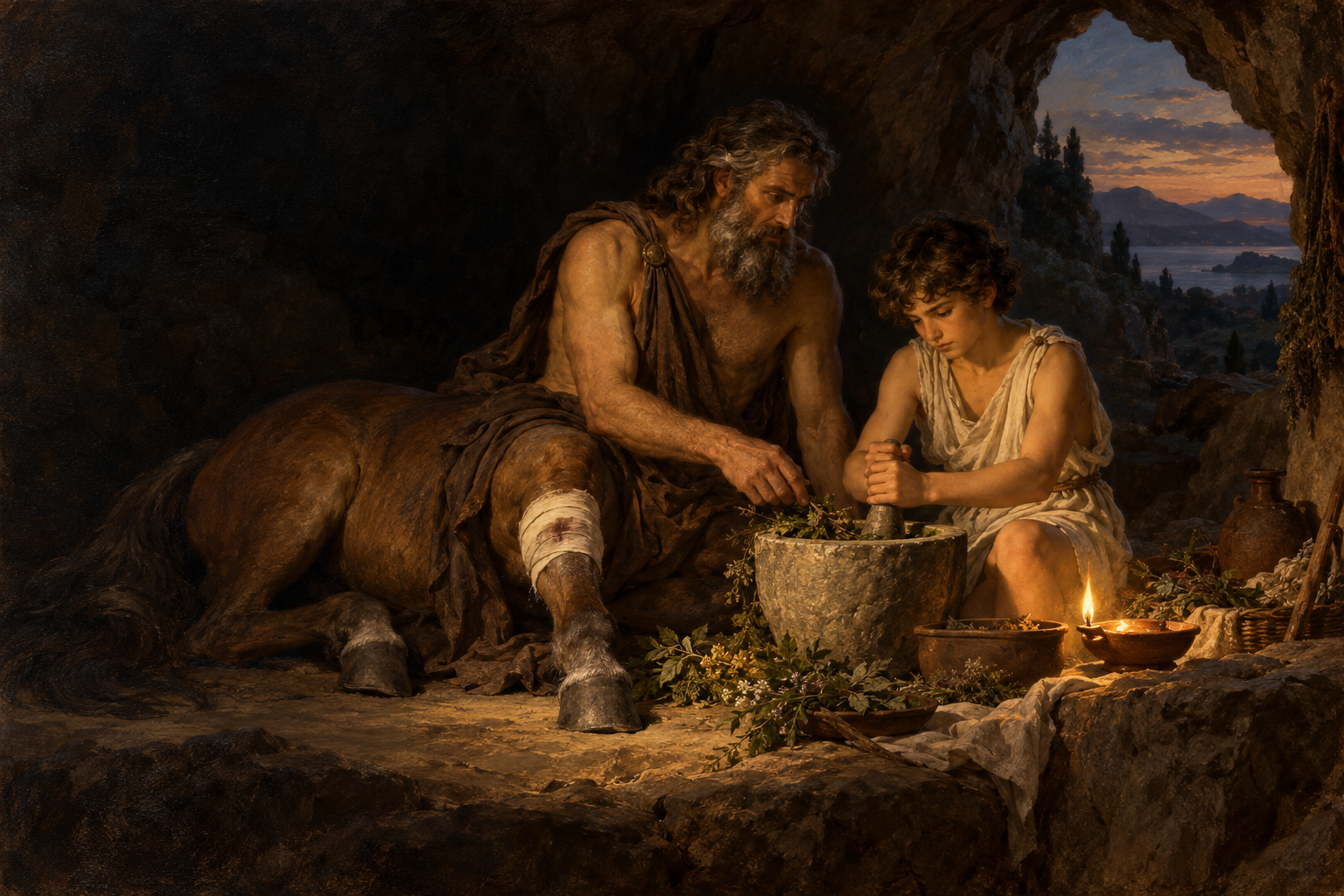
Chiron became the emblem through twentieth-century interpreters. The ancient sources present him first as a celebrated teacher of medicine, and his wound comes later, as the one injury his skill could not cure.
In the Iliad a wounded fighter asks Patroclus for remedies Achilles learned from Chiron. Apollodorus has Apollo carry the infant Asclepius to Chiron, who raises him and teaches him medicine. The same author tells how Chiron was hurt. Heracles, fighting other centaurs, fired an arrow that passed through one centaur’s arm and lodged in Chiron’s knee, then dressed the wound with a salve Chiron gave him, and it did no good. Chiron was immortal, so the poisoned wound could not kill him, and he found release only through an exchange involving Prometheus that allowed him to die. In Ovid’s Fasti an arrow slips onto Chiron’s foot while he handles Heracles’ weapons, and his herbs fail there too.
In both versions Chiron already knows the healing arts when he is wounded. The ancient story gives us a skilled healer who suffers, and the idea that the suffering produced the skill came later.
It came largely through Jung’s circle. The mythologist Karl Kerényi, who worked with Jung, called Chiron “the wounded divine physician” in his 1959 study of Asclepius (as quoted by Groesbeck) and described the healer’s knowledge as knowledge of a wound he forever shares. Groesbeck’s 1975 paper drew on Kerényi to give the Jungian account a mythic ancestry, and pairing Chiron with Jung is now common.
Most of what turns up in a search for Chiron and the wounded healer comes from somewhere else again. The astronomer Charles Kowal discovered the minor planet 2060 Chiron in November 1977, and astrologers, Barbara Hand Clow (1987) and Melanie Reinhart (1989) among them, built a reading of Chiron in the birth chart as the place of a lasting wound and a healing gift. That is a separate system with its own assumptions, though it borrows heavily from Jungian vocabulary.
Read for what it contains, the myth puts skill and an unhealed limit in the same body. For a modern reader it raises a question about limits: what happens to your sense of yourself when something stays broken despite your knowledge and effort? Recovery fits inside the story, and the story makes no case that continuing pain is the price of being useful to anyone.
What can personal experience bring to helping?
Personal experience gives a helper concrete memories to consult, such as what made a hard week easier and which well-meant questions hurt. Those memories become useful when they turn into questions for the other person.
A man who went back to work after months of illness remembers being treated as either fully recovered or permanently fragile. When a colleague returns from sick leave, he asks what would make the first week easier and leaves the medical details alone. Another man with the same history insists that the colleague follow his exact route back, the same phased hours and the same talk with HR.
Their histories match, and the difference between them is how closely each attends to the colleague. Clinical research supports the first half of the archetype’s claim far better than the second. Wounded helpers are common: in a 2022 survey of 1,692 faculty and trainees in applied psychology programmes across North America, more than 80 per cent reported mental-health difficulties at some point in their lives and 48 per cent a diagnosed disorder.
Whether those histories make for better help is far less studied. Noga Zerubavel and Margaret O’Dougherty Wright’s review of the clinical literature lists the benefits therapists most often report, among them empathy and patience when progress stalls. It separates the wounded healer from the impaired professional whose distress damages the work, and it places the potential to help in the process of recovery. Being wounded, on their reading, produces no healing potential by itself.
In ordinary life the most useful version of this is modest: what does my experience help me ask that I might otherwise miss? Someone who has grieved may remember how draining it was to answer messages and offer to drop food at the door with no visit attached. Someone who was ashamed of needing help may phrase an offer so it is easy to turn down.
What is the shadow side of the wounded healer?
The shadow side appears when the helper keeps the healing role for good and hands all the woundedness to the other person. The Swiss Jungian analyst Adolf Guggenbühl-Craig described a healer-patient archetype active in both people: the patient carries an inner healer alongside the illness, and the helper carries a wound alongside the skill.
Groesbeck’s paper sets out what happens when that archetype splits. The patient projects their inner healer onto the doctor, the doctor projects his own wounded side onto the patient, and both then try to close the gap through power. It is a theory built from clinical observation, and the split is easy to find outside therapy.
The friend who always understands
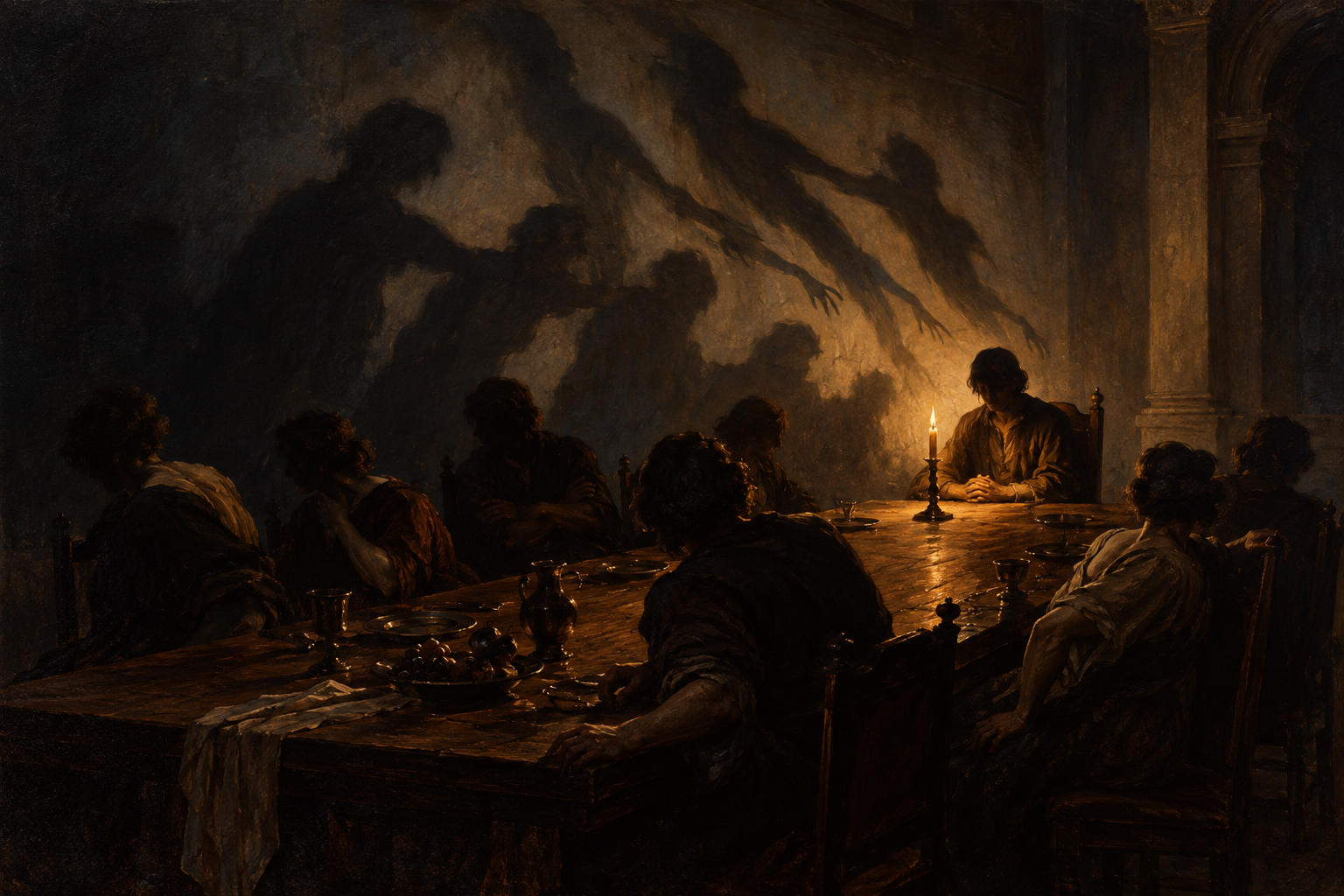
A role that starts out flexible can harden. Someone becomes the trusted adviser in a friendship group, the one who reads people well, and for a while they listen some days and ask for support on others. Gradually being perceptive becomes how they expect to be received. When a friend says “that isn’t what I meant”, they explain the interpretation again, and when the friend disagrees they look for the reason the friend cannot yet accept it.
Disagreement has now become evidence for the interpretation. The cost is visible without any guessing about motives: the friend has fewer ways to describe their own experience and be believed, and a conversation meant to help turns into an argument over who gets to name what is happening. It is the same slide we traced in people possessed by the role of the good helper, where certainty starts to feel like virtue.
Asking someone to repeat your recovery
Leaving a draining job was the turning point in one woman’s recovery. When a friend describes exhaustion at work, she urges him to resign. He explains that he needs the income and wants to try negotiating shorter hours first, and she feels irritated. His plan starts to look timid to her, even a little dishonest.
He is deciding under conditions that differ from hers, and her irritation is worth a closer look. A different solution might make her own sacrifice seem less necessary. She may be asking his life to confirm the meaning she found in hers. She can tell him what helped her and still admit how little she knows about the decision in front of him.
When pain becomes the last word
Suffering deserves a hearing, and it still does not settle every disagreement in the sufferer’s favour. When someone answers criticism by listing what they have survived, their history may explain why the criticism stings. The effect of their behaviour still needs discussing.
A relationship narrows when one person’s pain makes ordinary feedback impossible. The other person can stay silent or look cruel, and over time even a reasonable request turns into a contest over who has suffered more. Habitual helpers are as prone to this as anyone. The question for them is whether their history can be taken seriously while someone else is still allowed to say they caused hurt.
How does the wounded healer show up in relationships?
In close relationships the archetype causes trouble when one partner’s help leaves the other too little room to take part as an equal.
One partner went through a hard separation and believes it taught them to recognise emotional avoidance. When the other asks for an evening alone, the request becomes material for analysis. A disagreement about weekend plans becomes fear of intimacy, and objecting to being analysed becomes more proof of the pattern. The interpreting partner may care a great deal, and their framework has still begun to override the conversation. The other partner can no longer simply want time alone; first they have to convince someone that their own account of their wishes is credible.
A better response starts with the request. What kind of time alone do they want, and is there a practical worry behind it? Has an agreement been broken? Interpretation can come later if it is needed. Closeness asks both people to tolerate the pull between wanting intimacy and bracing against it, and an evening alone can be part of how someone manages that pull.
When support has to change shape
After carrying someone through a difficult year, a helper can meet an awkward moment. The other person starts making decisions alone and taking advice from other people, and the helper is glad and also feels shut out.
That feeling is no proof the earlier help was selfish. A role that organised much of the closeness has changed, and the loss is real. What matters is the next move. The helper can say they miss the time together and look for new ways to connect, or they can question the other person’s judgement until that person feels unable to manage without them.
The wider habit of needing to stay necessary is the subject of how caregiving hardens into control. The wounded healer question is narrower: how your own hurt shapes what you believe you can see in someone else, and what you feel entitled to decide for them.
Letting yourself be helped
Mutuality asks something of the helper too. If the only acceptable position is composed and insightful, there is little room to say you are confused or would like company.
A friend offers to stay after a difficult hospital appointment. The helper answers by explaining the situation expertly and turning the conversation to the friend’s week, and the friend goes home better informed with no chance to help. Privacy or tiredness can explain one evening like that. If it happens every time, one plain request, such as asking the friend to stay for dinner, opens a different kind of evening.
Wounded healer, saviour complex or caregiver?
The three overlap and point at different things. The wounded healer concerns how a helper’s own suffering enters the help. The caregiver, a figure from Carol Pearson’s twelve-archetype system, is organised around providing care and being needed. The saviour complex is a popular label, absent from diagnostic manuals, for a felt duty or special authority to rescue.
| Pattern | What it focuses on | A useful question |
|---|---|---|
| Wounded healer | How personal suffering enters the act of helping | Am I letting their experience differ from mine? |
| Caregiver archetype | Providing care and meeting other people’s needs | Can I have needs while someone else needs me? |
| Saviour or healer complex | A felt obligation or special authority to rescue or fix | Can they refuse my help without paying for it? |
In everyday use “healer complex” means a compulsive investment in fixing other people. Someone can have it without thinking of themselves as wounded, and someone whose experience helps them support others may have no wish to rescue anybody.
Labels help least when they replace a description of what happened. “You have a saviour complex” starts an argument about identity. “I asked you to listen, and you rang my sister without asking me” describes conduct that can be discussed and changed.
The distinction matters because some helping carries real responsibility, and a parent’s duties to a young child are a different thing from a friend’s offer of company. Archetype language should leave room for care that is unequal because the situation requires it.
How can you work with the pattern?
Start with one recent, ordinary interaction in which helping turned tense, where advice was ignored or you caught yourself explaining what someone really felt. Then separate what you observed from what you inferred. “He did not take my suggestion” is an observation. “He does not want to get better” is an interpretation, and written side by side the two show how much of the conflict rests on an explanation nobody has checked.
Next, look at your share. What did you want the help to achieve, and what response were you hoping for? An old experience may have made the moment feel more urgent than it was.
Some questions to carry into the next conversation:
- What help did the other person ask for?
- Which details remind me of my own history, and which are different?
- Can I explain my concern without claiming to know their hidden motives?
- What do I feel when they turn to someone else for support?
- Am I trying to get something for myself through helping?
- What would respecting their answer require me to do next?
Self-examination easily becomes another performance of insight, full of sophisticated explanation and unchanged behaviour. A small repair usually does more, whether that means admitting an assumption or asking permission before stepping in again. The questions above lead into the core practices of shadow work, especially tracking triggers and withdrawing projections.
When the same role keeps appearing with different people, writing several relationships out side by side shows it more clearly than thinking about any one of them. The Shadow Work Field Journal includes pages for mapping one pattern across several relationships. If the reflection starts to overwhelm you, pause and talk it through with a therapist.
Can a wounded healer heal?
Yes. Remembering what it was like to be vulnerable is compatible with recovery, and with a life no longer organised around what happened. What Jung asked of the helper was continuing awareness of the wound, and a person who has largely healed can keep that.
People also help others well without having lived through the same thing; attention and a willingness to be corrected carry much of the weight. In professional settings personal experience is no substitute for training or for the ethical duties that come with the role.
The evidence for the constructive side of the archetype is thin. Surveys show that wounded helpers are common, and the benefits reported in the literature come mostly from clinicians describing their own work. Zerubavel and Wright found very little research on how therapists’ own recovery shapes what they do with clients, and they note that the idea is often misunderstood or romanticised. The archetype works as a lens for reading a relationship after the fact, and it cannot predict which wounded person will help well.
This article is written for understanding and offers no diagnosis. If old pain is spilling into the help you give, or a helping role has become unsustainable, a therapist or depth-oriented analyst is the right place to take it.
Sources and further reading
- C. G. Jung, “Fundamental Questions of Psychotherapy” (1951), in The Practice of Psychotherapy, Collected Works vol. 16, translated by R. F. C. Hull, pars. 237-239; volume contents on JSTOR.
- C. G. Jung, Memories, Dreams, Reflections, recorded and edited by Aniela Jaffé (New York: Pantheon, 1963), p. 134.
- C. Jess Groesbeck, “The Archetypal Image of the Wounded Healer,” Journal of Analytical Psychology 20, no. 2 (1975): 122-145; reprint in Junguiana (2022).
- Adolf Guggenbühl-Craig, Power in the Helping Professions (Spring Publications, 1971), as summarised in Groesbeck.
- Karl Kerényi, Asklepios: Archetypal Image of the Physician’s Existence (Princeton University Press, 1959), as quoted in Groesbeck; publisher’s page for the current edition.
- Noga Zerubavel and Margaret O’Dougherty Wright, “The Dilemma of the Wounded Healer,” Psychotherapy 49, no. 4 (2012): 482-491, doi:10.1037/a0027824; full text in Duke University’s repository.
- Sarah E. Victor and colleagues, “Only Human: Mental-Health Difficulties Among Clinical, Counseling, and School Psychology Faculty and Trainees,” Perspectives on Psychological Science 17, no. 6 (2022): 1576-1590; abstract from the Association for Psychological Science.
- Henri J. M. Nouwen, The Wounded Healer: Ministry in Contemporary Society (Doubleday, 1972).
- Homer, Iliad 11.832; Apollodorus, Library 2.83-87 and 3.118-122 (numbering as on Theoi); Ovid, Fasti 5.379-414; the ancient sources on Chiron in translation.
- Barbara Hand Clow, Chiron: Rainbow Bridge Between the Inner and Outer Planets (Llewellyn, 1987); Melanie Reinhart, Chiron and the Healing Journey (Arkana, 1989).