The Sage Archetype and the Shadow Side of Knowing

Search this topic and the same profile comes back across a hundred pages. Seeker of truth. Values knowledge. Motto, core desire, greatest fear, three brands that use it. The pages read like personality test results because that is where the format comes from.
The Sage archetype, as a named type with a fixed profile, belongs to a system of twelve archetypes assembled for storytelling and marketing in the 1990s. Jung’s own figure carries a different name and a colder temperature. He called it the Wise Old Man, treated it as one face of what he called the archetype of spirit, and spent a good deal of ink warning about what happens to the person who mistakes that figure for themselves.
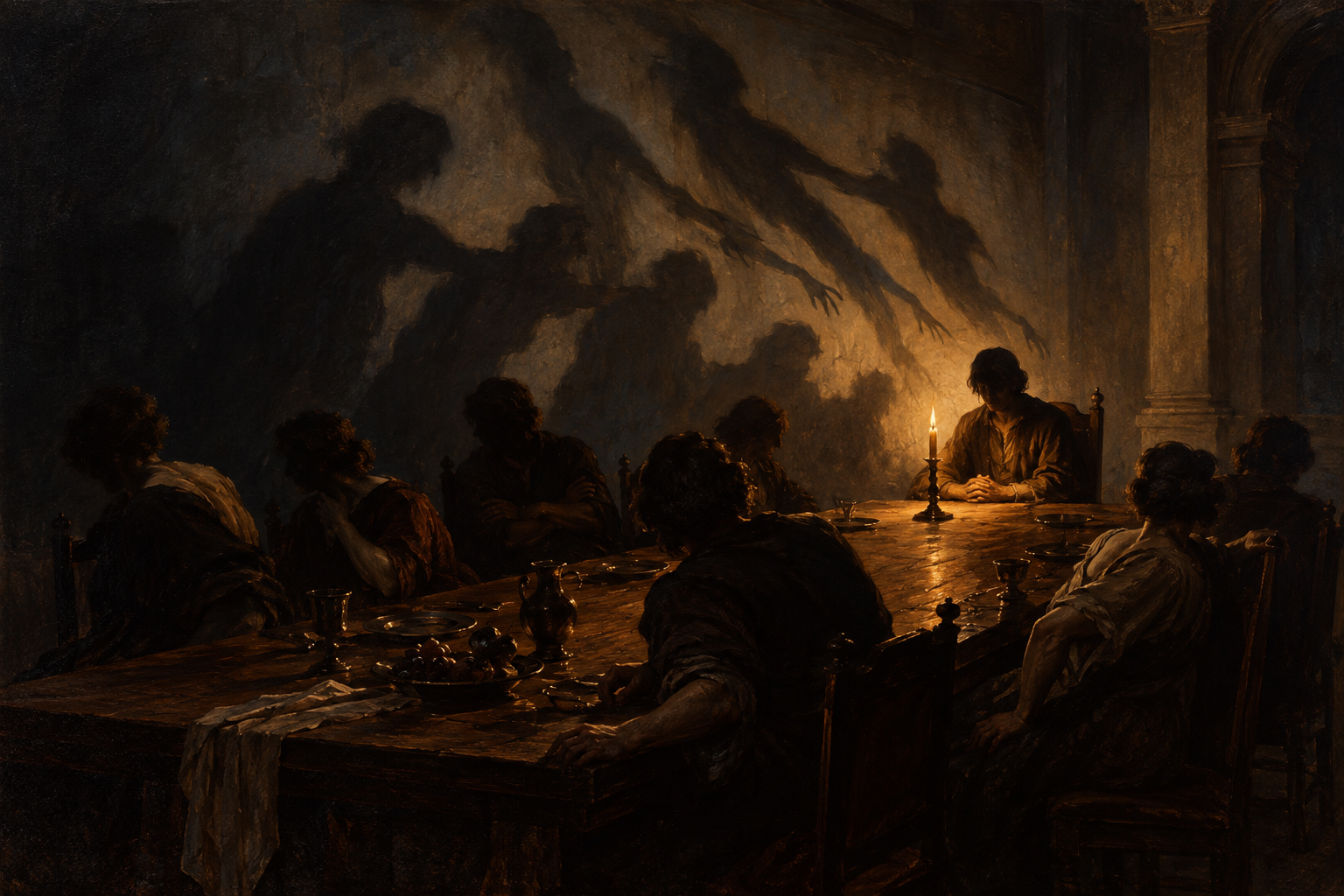
That warning is missing from every page currently ranking for this term, and it is the part that matters. The Sage is the only archetype whose shadow looks exactly like its virtue. A Warrior in shadow is visibly cruel. A Lover in shadow is visibly consumed. A Sage in shadow sounds reasonable.
What is the Sage archetype?
The Sage archetype is the psychic pattern organized around the pursuit of understanding: the drive to know how things work, to see clearly, to find the truth underneath the appearance and to be the one who holds it. It appears wherever a person steps back from the action to interpret it.
In its healthy form it produces discernment. The Sage tolerates complexity, resists the easy answer, changes its position when the evidence changes, and can sit with a question long enough for a real answer to arrive. In its unhealthy form it produces a person who has read everything and risked nothing, who uses analysis to stay out of their own life, and who mistakes the map for the territory so thoroughly that they stop noticing they have never left the house.
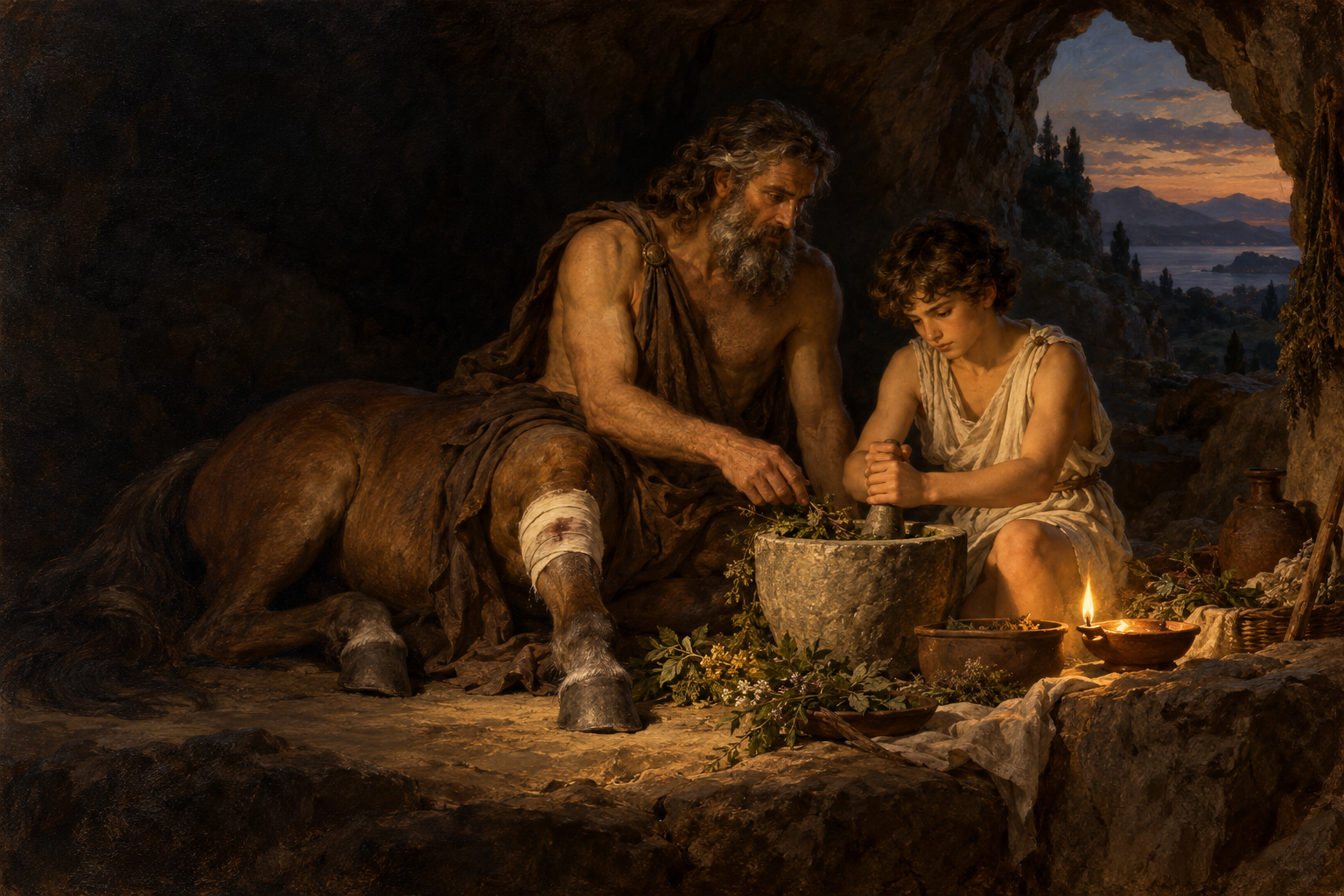
Jung’s version sits underneath both. In The Archetypes and the Collective Unconscious (CW 9i) he describes the old man who arrives in fairy tales at the moment the hero has run out of options, appearing when the situation has become hopeless and only reflection or a sudden idea can produce a way through. The figure supplies what the hero cannot supply for himself: a piece of knowledge, a question, an object, a direction. Then he vanishes.
Jung’s reading of that pattern is the thing worth holding onto. The old man is not a character the hero meets. He is a function of the hero’s own psyche, personified, arriving from a layer the ego cannot reach on demand. When your conscious mind has exhausted itself and the answer surfaces anyway, that is the Wise Old Man. He is what insight looks like when it comes from somewhere you do not control.
Jung’s Wise Old Man and the archetype of spirit
Jung placed the Wise Old Man inside a larger category he called spirit, and the essay to read is “The Phenomenology of the Spirit in Fairytales” (CW 9i, par. 384 and following). It is the closest thing to a primary source on this archetype, and almost nothing written about the Sage online engages with it.
Two points from that essay change how the whole archetype reads.
The first is that the figure carries two clusters of quality at once. On one side he holds knowledge, reflection, insight and a kind of practical cleverness. On the other he holds moral qualities: goodwill, the readiness to help, the willingness to be inconvenienced by someone else’s problem. Jung is explicit that both are required. An intelligence with no goodwill attached to it is a different archetype, and a more dangerous one.
The second point is the one everyone drops. Jung says the old man has a wicked aspect. The same figure who guides the hero in one story appears in the next as the evil magician, the sorcerer, the one who withholds or distorts. Jung had no interest in a purely benevolent wisdom figure, because he had watched the archetype operate in real people and knew what it does when it goes wrong. The guide and the manipulator are the same pattern running in two directions.

This is why the standard Sage profile, with its neat list of positive traits and one tidy weakness at the bottom, describes something Jung never proposed. The archetype is ambivalent at its root. It contains the teacher and the cult leader, and it does not announce which one is in the room.
Marie-Louise von Franz, who spent decades on fairy tales and worked directly with Jung, read the old man in these stories as a personification of the Self, the organising centre of the whole psyche that the ego is meant to serve. That reading explains the strange emotional weight of these encounters. When the wise figure appears in a dream or a story, people report something closer to awe than to admiration. They are meeting the part of themselves that knows more than they do, and it does not feel like a part of themselves at all.
What the Sage wants and what it fears
The typology literature gives the Sage a clean profile, and it is useful as far as it goes:
- Core drive: to understand, and to be the one who understands
- Core fear: being deceived, being ignorant, being the last to know
- Method: research, analysis, questioning, the collection of frameworks
- Gift: perspective, and the ability to hold a position lightly enough to revise it
- Failure mode: analysis that never converts into an act
The last line is the one that carries the psychology. The Sage’s characteristic pathology has nothing to do with being wrong. It is the refusal to commit to being anything, indefinitely, on the grounds that more information might arrive.
There is a version of this that looks like intellectual honesty and functions as cowardice. The person who can see every side of a question and will not stand on any of them is often described as balanced, including by themselves. Watch what the position protects. As long as the answer is still pending, they cannot be held to it, cannot be found foolish, and cannot be humiliated. The permanent suspension of judgement is a defense against a specific fear, and the fear is not of being wrong. It is of being seen to be wrong.
Jung’s typology adds a structural reason this happens. In Psychological Types (CW 6) he describes four functions and argues that the one opposite your dominant will be underdeveloped, awkward, and largely unconscious. The person who leads with Thinking has Feeling as their inferior function. Sage-heavy people are usually thinking types, which means the territory they have avoided their whole lives is the territory of value: what matters, what they want, what they are willing to lose something for. Their weakest function is the one that would have to answer.
Which is why the growth edge for a Sage is never more knowledge. It is the humiliating work of the inferior function, and the route into the unconscious runs through your weakest point rather than your strongest.
Where the twelve-archetype Sage came from
If you have met the Sage as one of twelve archetypes with a motto and a colour palette, that system has a specific origin. Carol Pearson’s Awakening the Heroes Within (1991) set out twelve archetypes as stages of psychological development, the Sage among them. Pearson later worked with Margaret Mark on The Hero and the Outlaw (2001), which applied the same twelve to brand identity. That book is the reason a marketing team can tell you their brand is a Sage.
The system is genuinely useful and it is not Jung. Jung never produced a list of twelve. He described archetypes as an open set of inherited patterns with no fixed inventory, and he was hostile to schemes that turned the psyche into a filing cabinet. Our guide to Jungian archetypes covers the difference between his open model and the closed twelve in more detail.
Knowing the provenance matters for a practical reason. The brand Sage is a positioning tool, designed to be aspirational, and its shadow has been sanded off so it can be sold. The Jungian Wise Old Man has a wicked aspect built into him because Jung was describing something he had observed in patients and in himself. If you are using the archetype to understand yourself, you want the version with the wicked aspect left in.
Philemon, and the moment Jung stopped owning his thoughts
The most useful account of a Sage encounter is Jung’s own, and he tells it in Memories, Dreams, Reflections.
During the years after his break with Freud, working through the material that became the Red Book, Jung began encountering inner figures. One of them was an old man with kingfisher wings and the horns of a bull, who called himself Philemon. Jung held conversations with him, walking in the garden, speaking both parts aloud.
What he took from those conversations was one specific insight, and it reorganized his psychology. Philemon said things Jung had not thought and would not have thought. Jung was forced to conclude that there are contents in the psyche that produce themselves, that he did not make them, and that his relationship to his own inner life was closer to walking through a room full of people than to operating a machine. He described Philemon as having taught him psychic objectivity: the reality of the psyche as something with its own life, containing figures who know things the ego does not.
Two things about this are worth sitting with.
Jung did not believe Philemon was a spirit. He treated the figure as a psychic reality, which for Jung was a real category and a serious one, and he refused both the reduction (“just my imagination”) and the literalism (“an entity”). Holding that middle position is the entire discipline of active imagination, and it is harder than either alternative.
He also did not become Philemon. He talked to him. The whole of Jung’s later warning about this archetype turns on that distinction, and it is where most people who meet the figure go wrong.
The mana-personality: what happens when you become the Sage
Here is the material that no ranking page on this topic covers, and it is the reason the Sage is worth writing about at all.
In Two Essays on Analytical Psychology (CW 7), Jung describes a specific hazard that appears at a specific point in the individuation process. He calls the result the mana-personality. Mana is a Melanesian term for extraordinary potency, the charge that attaches to a chief, a shaman, an object of power. Jung borrowed it because he needed a word for what an archetype carries.
The sequence runs like this. A person does the work of withdrawing projections. They stop meeting their own unconscious in other people. As they integrate the anima or animus, the energy that was bound up in that figure comes loose. It has to go somewhere. If there is no consciousness of what is happening, it flows into the ego, and the ego swells to accommodate it.
The result is a person who has become the Wise Old Man. Not someone who has met the archetype and learned something. Someone who is now living inside it, wearing its mana as personal property.
Jung’s description of this state is unsparing, and he includes himself among those at risk. The mana-personality knows. Its certainty is not arrogance in the ordinary sense, because ordinary arrogance can be embarrassed. This is deeper. The person has genuinely contacted something larger than the ego, the contact was real, and they have drawn the wrong conclusion from it. They think the largeness was theirs.

What it looks like from outside:
- The tone of settled authority on questions that remain open
- An inability to be taught by anyone, combined with fluent talk about staying open
- Followers, or an appetite for them, and discomfort when someone declines the role
- Advice given freely, unsolicited, and slightly too often
- Disagreement experienced as a failure of comprehension in the other person
The last is the reliable marker. The mana-personality does not argue. It explains, and if you keep disagreeing it concludes you are not ready.
Every spiritual community, every therapeutic school, every corner of the internet organized around self-knowledge produces these people continuously, and they are usually the most impressive person in the room. That is the trap. The archetype carries real charge, so a person possessed by it becomes magnetic, and the magnetism is confirming. Being surrounded by people who treat you as wise is powerful evidence that you are.
Edward Edinger’s framing in Ego and Archetype is the cleanest correction. The ego and the Self are meant to sit in relationship along an axis, in dialogue, with the ego serving something larger. Inflation is what happens when the ego collapses that distance and takes the Self’s authority as its own. The cure is not to reject the encounter. It is to keep the gap open, which means continuing to be an ordinary person who happened to see something.
We have written about the same mechanism in the language of shadow work, where the person who has done the work builds a new identity out of having done it. The Sage version is more dangerous because it comes with better vocabulary.
The senex: the Sage after the life goes out of it
James Hillman gave the pathological Sage its most precise name, and it has almost no presence in the popular material.
In his work on the senex and the puer, Hillman describes the senex as the archetype of old age in its structural sense: Saturn, the planet of limit, time, gravity, endings. The senex brings order, boundaries, the capacity to finish things, patience with slow processes, and the willingness to say no. A culture with no senex cannot maintain anything.
Split off from its opposite, the senex dries out. Hillman’s descriptions of the negative senex read like a diagnosis of a certain kind of older intellectual: rigid, cold, suspicious of enthusiasm, contemptuous of the young, hoarding what he knows, unable to be surprised. The wisdom curdles into cynicism, which is the cheapest available imitation of it. Cynicism costs nothing and buys the same appearance of depth.

The opposite pole is the puer aeternus, the eternal youth, described at length by von Franz: full of possibility, allergic to commitment, brilliant and unfinished. Hillman’s argument is that these two are one archetype with two faces, and that the damage happens when they separate. The puer with no senex never lands. The senex with no puer never opens.
A Sage in good working order holds both. There is a specific quality in genuinely wise older people that is hard to name and unmistakable when you meet it: they are still curious. They have accumulated forty years of considered positions and they will still lean forward when someone says something they have not heard. The senex supplies the structure. The puer supplies the reason to keep looking.
The failure is easy to detect in yourself. Ask when you last changed your mind about something that mattered. Not a small revision. A position you had argued for, publicly, that turned out to be wrong. If nothing comes to mind from the last several years, the archetype has gone dry, whatever the quality of the positions.
Wisdom as a defense against feeling
The Sage has one more shadow, and it is the most common by a wide margin. It has a clinical name.
Intellectualization was described by Anna Freud in The Ego and the Mechanisms of Defence (1936) as one of the ego’s methods for handling material it cannot tolerate. The mechanism is simple. You take an experience that would otherwise be felt and you convert it into an object of study. The content stays. The affect drains out.
A person doing this can talk about their childhood with total accuracy and no visible distress. They can name their attachment pattern, describe the mechanism by which their father’s absence shaped their relationships, and cite the research. Nothing in the account is false. Nothing in it has been felt, either, and the accuracy is what makes it work. A crude defense gets noticed. This one gets praised for insight.

Depth psychology is a superb medium for this defense, which is an uncomfortable thing to write on a site about depth psychology. The vocabulary is elegant, the frameworks are satisfying, and a person can spend fifteen years acquiring both while changing nothing. Jung’s own line about it is blunt: learn the theories as well as you can, and put them aside when you touch the living soul. He was talking to analysts, and the warning applies to everyone reading about their own psyche.
The test is behavioural, and it is the same test that applies to shadow work that stays in the journal. Has the understanding changed what you do? Not what you can explain. What you do, in the specific situations where the pattern used to run you. If the answer is that you now understand exactly why you keep doing the thing, and you keep doing the thing, the Sage has been recruited by the ego to protect the very material it claims to be examining.
Insight is a stage. Treating it as the destination is how the archetype defeats itself.
The female Sage
Jung wrote about the Wise Old Man and also about the Wise Old Woman, and he treated them as versions of the same archetype constellated in different psyches. In practice the feminine form has been documented less and flattened more, so it is worth separating what is inherited from what is recent invention.
The figure has a long mythological history. Athena, goddess of strategic intelligence and craft, spends the Odyssey appearing to Telemachus disguised as an old family friend named Mentor, which is where the English word comes from. Sophia, in the Gnostic material Jung studied closely, is wisdom personified as a feminine divine figure. Fairy tales are full of old women in forests who know the way through, and von Franz noted that they are as likely to be dangerous as helpful. Baba Yaga keeps a fence of bones and still gives correct directions.
One correction worth making, because it circulates constantly. The maiden, mother and crone triad is frequently presented as an ancient goddess pattern recovered from prehistory. It comes largely from Robert Graves’s The White Goddess (1948), a work of poetic reconstruction rather than history, and it entered popular spirituality from there. The crone as a figure of feminine wisdom is real and useful. Its provenance is twentieth-century literary, and a page that tells you otherwise is repeating something it has not checked.
The distinctive difficulty of the feminine Sage is worth naming. The masculine version has a socially available role: professor, elder, advisor, the man whose certainty reads as competence. Women who carry the same archetype have historically been sorted into other categories, and the same trait that makes a man authoritative has made a woman difficult. Which means the feminine Sage’s characteristic distortion tends to run in the other direction from the mana-personality: not inflation, but the systematic underclaiming of what she knows, hedged into invisibility. The archetype is present. The permission to embody it is what has been missing.
Sage archetype examples in myth and film
The examples people reach for are consistent, and the consistency is the point. Every culture produces this figure because every psyche produces it.
In myth and history
Tiresias, blind and able to see, advising kings who ignore him. Solomon, whose famous judgement works by proposing something monstrous to expose the truth. The Delphic oracle, whose inscription told visitors to know themselves before asking about anything else. Socrates, who concluded from the oracle’s verdict that he was the wisest man in Athens only because he alone knew that he knew nothing. Marcus Aurelius, writing private notes to himself about how to remain decent while holding absolute power.
In story and film
Gandalf, who withholds more than he gives and refuses the Ring precisely because he knows what he would do with it. Yoda, who spends his introduction pretending to be a fool in order to test whether the student can see past appearance. Obi-Wan. Dumbledore, whose arc is built around the discovery that he was wrong about something enormous, which is the most Jungian thing in the series. Mr Miyagi, teaching through a method the student cannot understand until afterwards. The Oracle in The Matrix, who gives an answer designed to produce an outcome instead of an answer designed to be true.
Notice the recurring device. The wise figure almost never simply hands over the information. They withhold, misdirect, answer a different question, or make the student do something pointless for a month. Storytellers arrived at this independently and repeatedly because it reflects something correct about how insight works: a piece of understanding that arrives before you can use it does not take. The Sage’s real function is to arrange the conditions for you to see it yourself.
The shadow versions
These are just as recognizable once you look for them. The cult leader whose insight is genuine and whose use of it is predatory. The academic who has turned a discipline into a fortress and defends it against every new idea. Hannibal Lecter, who is the Sage with the goodwill surgically removed, which is exactly the wicked aspect Jung said the archetype contains. The mentor who needs the student to stay a student.
If you want the archetype in the writer’s own words, the Carl Jung quotes collection includes several lines that belong to this figure, including his warning about unearned wisdom.
How the Sage appears in dreams
Sage figures in dreams usually signal that the conscious position has run out of road. Jung’s fairy tale essay describes exactly this: the old man arrives at the impasse. The dream is compensating for an ego that has exhausted its own resources and does not yet know it.
Common forms:
- An old man or old woman, often a stranger, sometimes a dead relative, who says one sentence and leaves
- A teacher, doctor, priest or professor, appearing in a setting where they do not belong
- Libraries, archives, and old books, especially one specific book you cannot open or read
- An animal that speaks, which in fairy tale terms is the same figure arriving through instinct
- A voice with no body attached to it, which people tend to remember for years
The interpretive questions matter more than the catalogue.

When the figure speaks, what does it say, and what is your response inside the dream? Do you argue, obey, ignore, or fail to hear? The relationship is the content. A dreamer who receives excellent advice from a wise figure and immediately dismisses it is being shown something about their waking relationship to their own knowing.
Two failure modes to watch for, since the method for working with any dream figure starts with your own associations before anything else.
The first is treating the figure as an oracle. Some dreamers begin outsourcing decisions to a dream character, which reproduces the same abdication the dream was compensating for. The figure is part of you. Its authority is not external and it does not relieve you of the choice.
The second is treating it as a compliment. Dreaming of a wise old man does not mean you are one. Frequently it means the opposite, that the quality is showing up in projected form because it has nowhere else to live. The figure that appears in a dream is the one you are least in contact with while awake.
What the Sage needs in order to grow up
The Sage matures by acquiring the things it has spent its life avoiding, and none of them are informational.
Being wrong in public
Not privately conceding a point. Having held a position visibly, having it fail, and surviving that. The Sage that has never been humiliated has never tested whether its identity can survive being mistaken, which means the identity is running the show. Every genuinely wise person you have met has this in their history somewhere.
Committing before certainty arrives
Most decisions worth making are made on insufficient evidence, because the evidence arrives after the commitment. The Sage’s instinct is to wait. The corrective is to act at the point where waiting has become the decision, and to accept the cost of being early.
Feeling
The inferior function, approached deliberately. For a thinking type this means the slow, embarrassing work of finding out what you want and what you love, which cannot be reasoned toward and will not be efficient. It is worth saying plainly that this is the hardest item on the list and the one most likely to be skipped in favour of reading about it.
Something the Jester has
The Sage takes itself seriously by construction, which is its function and its blind spot. The capacity to be ridiculous, to play, to say something stupid on purpose, is what keeps the archetype from calcifying into the dry senex. The traditional pairing of the wise counsellor and the fool in a royal court exists because a court needs both, and the fool is the one permitted to tell the truth.
There is a version of this that Moore and Gillette describe in King, Warrior, Magician, Lover under the heading of the Magician, the archetype of knowledge and initiation whose shadow poles they name the Manipulator and the Denying Innocent One. The Manipulator uses what he knows to control people who do not know it. The Denying Innocent One sits on knowledge that someone else needs and quietly enjoys the withholding. Both are failures of the same duty: knowledge carries an obligation to be transmitted, and a Sage who has forgotten that has become a hoarder with a good vocabulary.
Jung’s own position on where this leads is worth ending on, because it cuts against everything the archetype wants. The goal of the process he described was never expertise. It was wholeness, which includes the parts of you that know nothing, and he was clear that the people who arrived at it were more uncertain about themselves rather than less. Near the end of his life he wrote that the more uncertain he had become about himself, the more he felt a kinship with all things.
That sentence is the whole archetype in its mature form. The Sage’s final piece of knowledge is the size of what it does not know, and the effect of holding that honestly is closeness to other people, not distance from them. Anyone who has arrived somewhere else has taken a wrong turn earlier and is still walking.
Common questions about the Sage archetype
Is the Sage a Jungian archetype?
Partly. Jung described the figure and called it the Wise Old Man, treating it as one expression of the archetype of spirit, and his main treatment is in The Archetypes and the Collective Unconscious (CW 9i). The name “Sage” and the profile that goes with it come from Carol Pearson’s twelve-archetype system, developed decades after Jung and later adapted for branding. The underlying pattern is Jung’s. The packaging is not.
What is the Sage archetype’s greatest weakness?
Substituting understanding for living. The characteristic failure is a person who can explain their situation with total precision and has not changed anything about it. Analysis becomes the activity, and because it produces the felt sense of progress, it can continue indefinitely without producing any.
What is the difference between the Sage and the Magician?
The Sage seeks to know. The Magician seeks to transform, using what is known. In Moore and Gillette’s framework the Magician is the archetype of awareness and initiation, the one who holds specialised knowledge and applies it to change something, including other people. The overlap is large enough that the two are often treated as one figure. The distinction that holds up is whether the knowledge stays contemplative or gets used on the world.
What is the shadow of the Sage archetype?
It runs in three directions. The inflated Sage identifies with the archetype and becomes what Jung called a mana-personality: certain, unteachable, magnetic, and surrounded by people who confirm it. The dry Sage becomes Hillman’s negative senex, rigid and cynical and no longer curious. The defended Sage uses insight to avoid feeling, which is intellectualization operating with an unusually good vocabulary.
Can the Sage archetype be feminine?
Yes, and Jung wrote about the Wise Old Woman alongside the Wise Old Man. Athena, Sophia and the old woman in the forest of fairy tales all carry it. The distortion tends to run opposite to the masculine version: understated instead of inflated, hedged into invisibility, because the role has been less available socially.
What is a Sage brand archetype?
A brand positioned around expertise, research and the promise of clear thinking, drawn from Margaret Mark and Carol Pearson’s The Hero and the Outlaw. Universities, research institutions, news organizations and consultancies usually sit here. The category is a marketing tool with the archetype’s shadow removed, which is fine for positioning a brand and misleading if you use it to understand yourself.
How do I know if the Sage is my dominant archetype?
The reliable indicator is where your energy goes under stress. Sage-dominant people respond to distress by researching it. A diagnosis, a breakup, a crisis at work, and the first move is to understand the situation thoroughly, with the understanding standing in for the response. If you recognise that as your reflex, and you also recognise the feeling of having read enough about a problem to feel calmer without having touched it, the archetype is running.
Sources and further reading: C.G. Jung, “The Phenomenology of the Spirit in Fairytales” and “Archetypes of the Collective Unconscious,” in The Archetypes and the Collective Unconscious (Collected Works Vol. 9i); “The Mana-Personality,” in Two Essays on Analytical Psychology (CW 7); Psychological Types (CW 6); Memories, Dreams, Reflections, on Philemon. Marie-Louise von Franz, The Interpretation of Fairy Tales. Edward F. Edinger, Ego and Archetype. James Hillman, Senex and Puer. Robert Moore and Douglas Gillette, King, Warrior, Magician, Lover (1990). Carol S. Pearson, Awakening the Heroes Within (1991); Margaret Mark and Carol S. Pearson, The Hero and the Outlaw (2001). Anna Freud, The Ego and the Mechanisms of Defence (1936). On the maiden-mother-crone triad’s modern origin, Robert Graves, The White Goddess (1948).