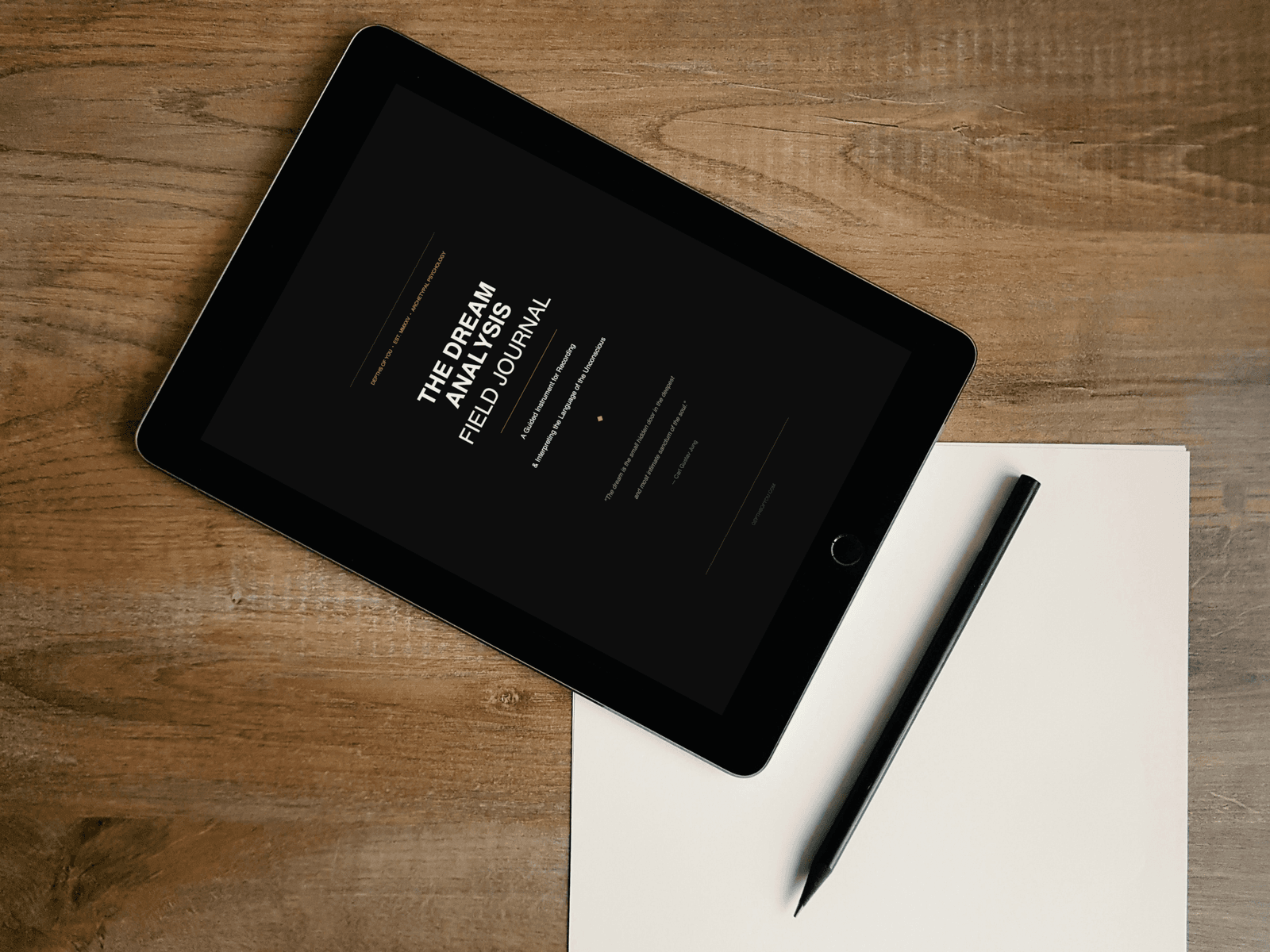
The Apothecary
Dream Analysis Journal
A guided Jungian instrument for recording your dreams and learning to read what your unconscious has been telling you every night.
What's Inside
✦
35
Guided Dream Analyses
◈
47
Archetypal Symbols Decoded
△
4
Active Imagination Sessions
▣
3
Recurring Motif Trackers
◆
121
Pages
$22.00$35.00
Secure checkout·Instant PDF download·Print or use digitally
If this journal doesn't challenge the way you see yourself, reach out and we'll make it right.
About This Journal
About This Journal
You wake up with the feeling still on you. Something happened in the dark, something that mattered, and within minutes it’s gone. By the time you’ve reached for your phone, the dream has dissolved into a vague residue you’ll never recover.
So you tell yourself dreams don’t mean anything. Random noise. Leftover static from the day.
Jung knew better. He spent his life proving that dreams are the most honest voice you have, the one part of you that refuses to perform, flatter, or lie. While your waking mind manages its image and rehearses its excuses, the unconscious speaks in images every night, compensating for everything your conscious attitude has left out of balance.
The problem was never that your dreams are meaningless. The problem is that no one taught you how to listen.
This journal teaches you the method.
The Dream Analysis Field Journal is built around Jung’s actual approach to dream work, refined into a four-step practice you repeat with every dream you record. Not a dream dictionary that tells you a snake means betrayal. A method.
- Capture the dream the moment you wake, in present tense, before the waking mind begins editing it into something more comfortable.
- Move through Personal Associations to find what each image means to you specifically, then Amplification to connect it to the myths and archetypes beneath it.
- Ask the Compensatory Question that sits at the center of all Jungian dream work: what one-sided attitude in my waking life is this dream trying to balance?
- Use the Motif Tracker to follow recurring symbols, figures, and settings across your entire dream series, watching the same message return until you finally receive it.
- Open a direct dialogue with the figures that haunt your dreams through Active Imagination, the same method Jung used to converse with the unconscious.
This is not a notebook with the word “Dream” printed at the top of blank pages. Every dream you record is followed by a full guided analysis. Over time, patterns surface that no single dream could ever reveal.
A single dream is a sentence. A dream series is the argument. This journal is where you finally read it.
121 pages. 35 guided dream analyses. 47 archetypal symbols. One question: what has your unconscious been trying to tell you?
Before You Begin
Common Questions
A structured dream journal built on Jung's method of dream analysis. Each dream gets a two-page spread: one page to record the dream as it happened, one page to work through a guided four-step analysis. This isn't a blank notebook. It's a complete framework for reading the unconscious.
No. The opening pages teach you how Jung understood dreams, walk you through the four-step method, and explain how to read a dream figure. A 12-term glossary at the back covers key ideas like compensation, amplification, the shadow, and the anima. The journal teaches through the doing.
Most dream journals give you a date field and blank lines, then leave you to guess what any of it means. This one is built around an actual analytical method. Every recording page is paired with a guided analysis covering personal associations, amplification, the compensatory function, and shadow material. It includes a motif tracker for reading patterns across your whole dream series and a 47-symbol lexicon interpreted through a Jungian lens, not a fortune-teller's dream dictionary.
The opposite. A dream dictionary tells you a symbol means one fixed thing for everyone, which is exactly what Jung warned against. The Symbol Lexicon here gives you archetypal starting points and the questions worth asking, but the method always begins with what an image means to you. Your personal associations come first. The journal makes that explicit.
There is no deadline. The 35 dream spreads can carry you through five weeks of nightly recording or several months at a gentler pace. Meaning emerges slowly in dream work, often only when a symbol returns weeks later in a new form. Work at the pace your dreams arrive.
No. The journal states this directly. It is a self-guided tool for reflection and pattern recognition that complements therapeutic work. Dream work can surface intense material; if you are working through trauma or severe mental health conditions, pair it with professional support.
You receive an instant download link on the confirmation page and a backup link via email. Access is immediate. No waiting, no shipping. Print it or use it digitally.
If this journal doesn't change how you listen to your dreams, reach out and we'll make it right. We stand behind the work.